Make informed decisions for your operation with information delivered right to your inbox.
Get the latest tools, innovations and science-based information for the Canadian beef industry, including seasonal production considerations and economic analyses.
Stay up to date with the latest news, updates and information from the Beef Cattle Research Council.
Advancing the Canadian Beef Industry Through Innovation and Knowledge
Research and knowledge mobilization work hand in hand to move the Canadian beef industry forward. By turning new ideas into practical tools and information, they help beef producers make informed decisions and strengthen their operations. The Beef Cattle Research Council (BCRC) supports this progress by funding proof of concept (POC) projects and knowledge mobilization initiatives that connect science with on-farm impact.
Proof of Concept Research
“Proof of concept projects help get new ideas off the ground — testing innovations, technologies and practices from other sectors or countries that could benefit Canada’s beef industry,” says Dean Manning, BCRC chair. “These small, targeted investments use a modest portion of Canadian Beef Cattle Check-Off dollars to evaluate potential solutions and generate the evidence needed to support larger-scale research and long-term industry progress.”
Dean Manning, BCRC Chair
POC Projects Funded Under the 2025 Call for proposals:
Are Maternal Vitamin Levels More Reliable Than Fetal Levels for Diagnosing Nutritional Deficiencies in Abortion Cases? Project lead: Dr. Yanyun Huang, Prairie Diagnostics Services Inc.
The current method for assessing if an abortion is the result of nutrient status of the dam is for the lab to test the fetus for vitamin levels. However, because there is limited vitamin transfer between the ruminant dam and fetus, testing the fetus’s vitamin status may not be giving an accurate picture of the vitamin status of the dam. This team wants to test both the dam and the aborted fetus for vitamin levels and determine if testing the fetus gives an accurate reflection of maternal vitamin levels or if other avenues should be used to evaluate nutritional causes of abortion.
Enhancing Cicer Milkvetch Germination Rate Through Ultrasound Scarification. Project lead: Dr. Erick Santos, University of Alberta.
Wearable Electrochemical Biosensor Patch for Real-Time Cortisol Monitoring in Cattle. Project lead: Dr. Amir Sanati Nezhad, University of Calgary.
Evaluation of Ocularly Delivered Bovine Adenovirus Vectored Vaccine for Pink Eye. Project lead: Suresh Tikoo, Vaccine and Infectious Disease Organization.
Nasal and Blood Transcriptomes in Feedlot Calves Using a Bovine Coronavirus (BCoV) Challenge Model. Project lead: Stacey Lacoste, University of Saskatchewan, Western College of Veterinary Medicine.
Knowledge Mobilization Initiatives
Lee Irvine, BCRC Vice Chair
“Connecting science with on-farm practice ensures that research doesn’t stay on the shelf — it drives real improvements in productivity, sustainability and profitability for Canadian beef producers,” says BCRC Vice Chair Lee Irvine on funding knowledge mobilization initiatives. “The success of innovation depends on building producer awareness and fostering adoption of research, technologies and beneficial practices across the beef industry.”
Through a new pilot initiative, the BCRC opened a call for proposals in 2023 to support regional knowledge mobilization activities with preference given to new and innovative engagement ideas. This funding call was renewed for the second time in 2025. Eight activities were funded beginning in fall 2025 and all activities will wrap up in summer 2026.
Back to Basics Workshops
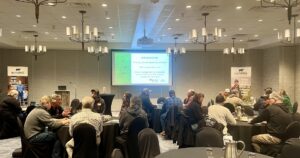
Beef producers had the opportunity to participate in peer group discussions at the event.
Funded through the 2024 call for proposals, the Beef Farmers of Ontario hosted two in-person workshops for beef producers focused on beneficial management practices to improve the cost of production. The objectives of these events included: 1) discussion of on-farm practices required to raise a healthy and uniform calf crop, 2) sharing ideas and learning directly from other producers and their experiences, 3) exploring resources available to assist in on-farm decision making and 4) learning practices that could be implemented on-farm tomorrow.
Participant feedback:
“Excellent! A welcomed change from the usual sit and listen events.”
“Loved it! It was very informative to learn from other producers.”
“Loved the group sessions and being able to get together to talk and not just listen.”
Initiatives Funded by the 2025 Knowledge Mobilization Call:
Beef Cattle Production Seminar. November 5, 2025. Project lead: Alaina Archibald, Peace Country Beef & Forage Association.
Rancher’s University. December 5-6, 2025. Project lead: Shelby Robinson, Saskatchewan Ministry of Agriculture.
Protecting Your Herd: Practical Biosecurity Implementation for Enhanced Cow and Calf Health. February 6-7, 2026. Project lead: Rachel Kehoe, Northern Ontario Farm Innovation Alliance.
Animal Health Workshop. December 11, 2025. Project lead: Cindy Jack, Manitoba Agriculture.
Producer Engagement Leverage in Eastern Canada. November 8, 2025. Project lead: Amy Higgins, Maritime Beef Council.
Fence-O-Rama: Rotational Grazing Boot Camp. May 2026. Project lead: Amy Higgins, New Brunswick Cattle Producers.
Livestock Water Source Management Strategies. Project lead: Alyssa Krawchuk, Lakeland Agricultural Research Association.
Summer Water Quality and Water Systems Tour – September 11, 2025.
Winter Water Systems Tour – February 2026.
The BCRC is Canada’s national industry-led funding agency for beef, cattle and forage research. The BCRC’s mandate is to determine research and development priorities for the Canadian beef cattle industry and to administer Canadian Beef Cattle Check-Off funds allocated to research. A division of the Canadian Cattle Association, the BCRC is directed by a committee of beef producers from across the country. The BCRC is funded in part through a portion of the Canadian Beef Cattle Check-Off which is then leveraged with government and industry partner funding.
Sharing or reprinting BCRC posts is welcome and encouraged. Please credit the Beef Cattle Research Council, provide the website address, www.BeefResearch.ca, and let us know you have chosen to share the article by emailing us at [email protected].
The BCRC is funded by a portion of the Canadian Beef Cattle Check-Off.
Your questions, comments and suggestions are welcome. Contact us directly or spark a public discussion by posting your thoughts below.