Make informed decisions for your operation with information delivered right to your inbox.
Get the latest tools, innovations and science-based information for the Canadian beef industry, including seasonal production considerations and economic analyses.
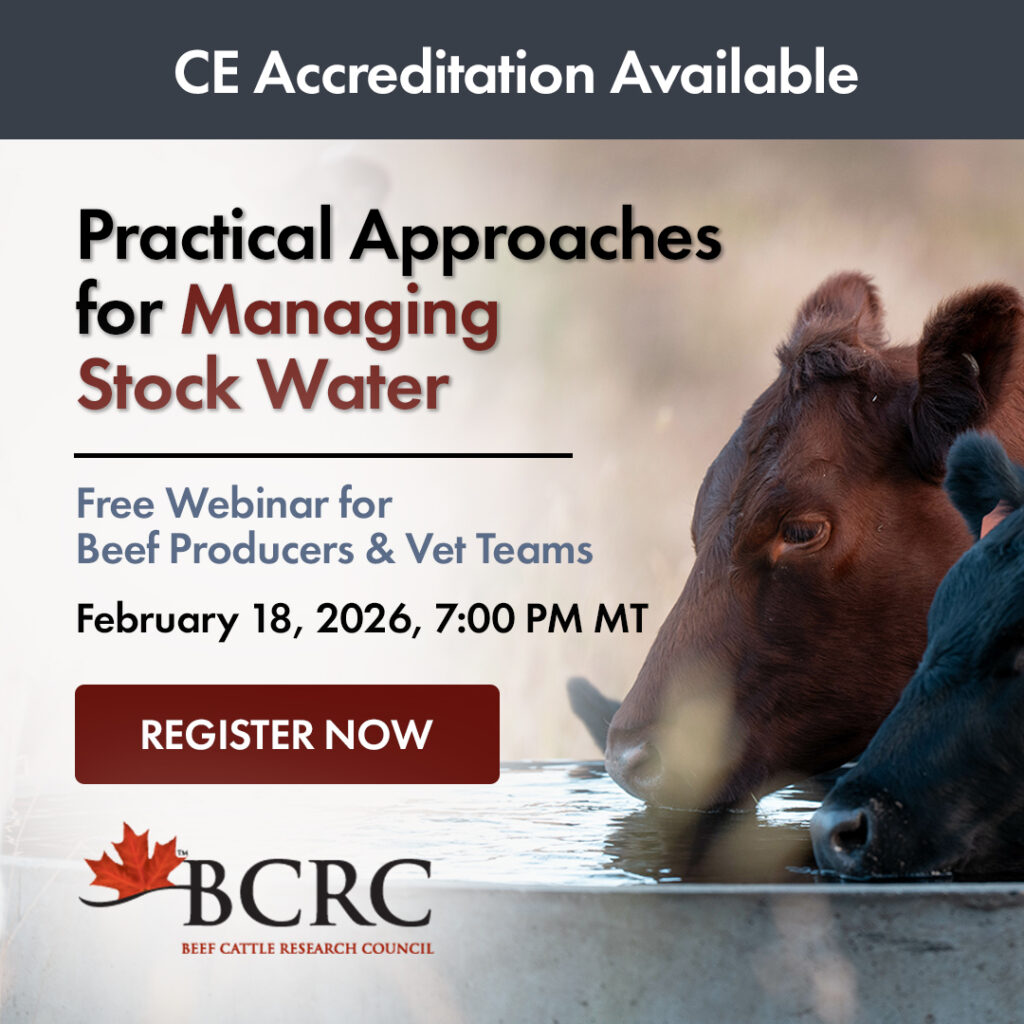
Even water that looks clean and clear can be poor quality — and insufficient access to good-quality water can reduce beef cattle performance faster and more dramatically than any other nutrient deficiency. This February 18 webinar will explore the hidden risks of poor-quality water, discuss its implications for herd health and productivity and provide practical tools and strategies to ensure your cattle have clean, safe and adequate water supplies.
Register for the live webinar to hear from our panelists: Dr. Cheryl Waldner with the Western College of Veterinary Medicine and Saskatchewan beef producer Karla Hicks.
This webinar will be available for one continuing education (CE) credit for veterinarians and registered veterinary technologists and technicians across Canada.
WHEN IS THE WEBINAR?
Wednesday, February 18, 2026, 7:00 PM MT
6:00 PM in BC
7:00 PM in AB
8:00 PM in SK and MB
9:00 PM in ON and QC
10:00 PM in NS, NB and PEI
10:30 PM in NFLD
Duration
Approximately 1 hour.
Cost
BCRC webinars are available free of charge thanks to guest speakers who volunteer their time and expertise to support advancements in the Canadian beef industry through the BCRC’s knowledge mobilization work funded by the Canadian Beef Cattle Check-Off and Canada’s Beef Science Cluster.
INTERESTED BUT UNAVAILABLE FOR THE LIVE EVENT?
Register anyway! This webinar will be recorded and posted online after the event. All registrants will receive a link to the recording and additional learning resources. However, by attending the live broadcast, you’ll have the opportunity to interact and ask questions.
SPEAKERS
Dr. Cheryl Waldner
Dr. Cheryl Waldner is the University of Saskatchewan NSERC/BCRC Industrial Research Chair in One Health & Production-Limiting Diseases at the Western College of Veterinary Medicine. She is actively involved in research, examining factors affecting the productivity of cow-calf herds as the lead investigator for the Canadian Cow-Calf Health and Productivity Enhancement Network (C3H/PEN).
Her current projects include diagnosis of organisms associated with respiratory disease, antimicrobial use and antimicrobial resistance. Dr. Waldner has examined the effects of nutrition on reproductive performance in cow-calf herds – with a particular focus on copper and selenium deficiency. She has more than 300 research publications and received the Canadian Beef Industry Award for Outstanding Research and Innovation in 2024. Cheryl and her husband own and operate a commercial cow-calf herd west of Saskatoon, SK.
Karla Hicks
Karla and her husband Jason ranch in Parkbeg, Saskatchewan. They have a cow-calf, backgrounding and grass operation. They also market their own frozen branded beef product, Bluestone Home Grown Angus Beef. Their children and spouses are the fifth generation of Hicks to ranch and work alongside Karla and her husband.
Karla is currently co-chair of the Canadian Cattle Association (CCA) Foreign Trade Committee, a member of the CCA Environment Committee, chair of Saskatchewan Verified Beef Production Plus (VBP+), a member of the Canadian Roundtable for Sustainable Beef (CRSB) Policy and Framework Committee and a board member of the Saskatchewan Farmland Security Board. Her past experience also includes serving as a director and past chair of Saskatchewan Cattle Feeders Association (SCFA), director at large for Saskatchewan Stock Growers Association (SSGA), chair of Saskatchewan Prairie Conservation Action Plan (SK PCAP), board member of Saskatchewan Angus Association (SAA), as well as many years with 4-H as a member and a leader of the Moose Jaw 4-H Beef Club. In 2015, Karla and her husband received Saskatchewan’s Environmental Stewardship Award (TESA).
WHAT IS A WEBINAR?
Webinars are just like attending a workshop or conference, but from the comfort of your own home or office. They are easy to join and participate in; only a reliable, high-speed internet connection is required.
Register beforehand, and about 5-10 minutes before the webinar is scheduled to begin, click the link that was emailed to you upon registering.
As a participant, you can anonymously answer polls and surveys and will have the opportunity to ask questions near the end of the webinar.
Don’t have high-speed internet? Consider calling a neighbour who does and watching the webinar together, or call your regional ag office to ask whether arranging a group viewing is possible.
Sharing or reprinting BCRC posts is welcome and encouraged. Please credit the Beef Cattle Research Council, provide the website address, www.BeefResearch.ca, and let us know you have chosen to share the article by emailing us at info@beefresearch.ca.
The BCRC is funded by a portion of the Canadian Beef Cattle Check-Off.
Your questions, comments and suggestions are welcome. Contact us directly or spark a public discussion by posting your thoughts below.
*WEBINAR* To Implant or Not? What Cow-Calf Producers Need to Know
Hormone implants are one of the most researched and cost-effective tools available to beef producers, yet uncertainty and misconceptions often keep them from being used. This webinar will break down the facts – what implants are, why they work, how to administer them and where they can benefit cow-calf operations.
Register for the live January 21 webinar to hear from our panelists: Dr. Lauren Younker, feedlot production consultant with TELUS Agriculture, and Betty Green, owner of G7 Ranches in Fisher Branch, Manitoba. This webinar will be available for one continuing education (CE) credit for veterinarians and registered veterinary technologists and technicians across Canada.
WHEN IS THE WEBINAR? WEDNESDAY, JANUARY 21, 2026, 7:00 PM MT
6:00 PM in BC
7:00 PM in AB
8:00 PM in SK and MB
9:00 PM in ON and QC
10:00 PM in NS, NB and PEI
10:30 PM in NFLD
Duration
Approximately 1 hour.
Cost
BCRC webinars are available free of charge thanks to guest speakers who volunteer their time and expertise to support advancements in the Canadian beef industry through the BCRC’s knowledge mobilization work funded by the Canadian Beef Cattle Check-Off and Canada’s Beef Science Cluster.
INTERESTED BUT UNAVAILABLE FOR THE LIVE EVENT?
Register anyway! This webinar will be recorded and posted online after the event. All registrants will receive a link to the recording and additional learning resources. However, by attending the live broadcast, you’ll have the opportunity to interact and ask questions.
Dr. Lauren Younker is a feedlot production consultant with TELUS Agriculture and Consumer Goods. She works with feedlots across Canada and internationally to enhance cattle performance through data-driven management strategies. Lauren specializes in optimizing implant programs through the use of individual animal data, benchmarking and on-site implant audits to align implant use with performance goals and carcass outcomes.
Betty Green, Owner of G7 Ranches
Betty Green is a cattle rancher from the Interlake region of Manitoba where she and her grandson, Curtis, own and operate G7 Ranches. They run a commercial Charolais-Simmental-cross cow herd along with smaller purebred Simmental and Charolais herds.
The ranch’s goal is to background and sell high-performance crossbred calves in an environmentally responsible and sustainable way. To achieve that goal, they believe research and continuous improvement are essential.
WHAT IS A WEBINAR?
Webinars are just like attending a workshop or conference, but from the comfort of your own home or office. They are easy to join and participate in; only a reliable, high-speed internet connection is required.
Register beforehand, and about 5-10 minutes before the webinar is scheduled to begin, click the link that was emailed to you upon registering.
As a participant, you can anonymously answer polls and surveys and will have the opportunity to ask questions near the end of the webinar.
Don’t have high-speed internet? Consider calling a neighbour who does and watching the webinar together, or call your regional ag office to ask whether arranging a group viewing is possible.
Sharing or reprinting BCRC posts is welcome and encouraged. Please credit the Beef Cattle Research Council, provide the website address, www.BeefResearch.ca, and let us know you have chosen to share the article by emailing us at info@beefresearch.ca.
The BCRC is funded by a portion of the Canadian Beef Cattle Check-Off.
Your questions, comments and suggestions are welcome. Contact us directly or spark a public discussion by posting your thoughts below.
Register Now for the BCRC's Free Webinars for Beef Producers and Veterinary Teams
Registration is now open for the Beef Cattle Research Council’s 2025-2026 four-part webinar series. Each session will dig into topics that have an impact on your bottom line, including whether hormone implants are the right fit for your calves, how water quality and systems lead to better herd performance and what you can do to reduce the risk of calf losses.
Speakers: Dr. Lauren Younker, TELUS Agriculture, and Betty Green, G7 Ranch
Hormone implants are one of the most researched and cost-effective tools available to beef producers, yet uncertainty and misconceptions often keep them from being used. This webinar will break down the facts – what implants are, why they work, how to administer them and where they can benefit cow-calf operations.
Speakers: Dr. Cheryl Waldner, Western College of Veterinary Medicine, and Karla Hicks, Bluestone Stock Farms
Even water that looks clean and clear can be poor quality — and insufficient access to good-quality water can reduce beef cattle performance faster and more dramatically than any other nutrient deficiency. This webinar will explore the hidden risks of poor-quality water, discuss its implications for herd health and productivity, and provide practical tools and strategies to ensure your cattle have clean, safe and adequate water supplies.
Speakers: Dr. Lisa Freeze, Field Veterinarian Supervisor with Government of New Brunswick; Dr. Van Mitchell, Metzger Veterinary Services, and Dr. Lauren Wilson, Peterborough Veterinary Services
Are you struggling with calf losses? Join this 90-minute webinar where vets who work with operations like yours discuss what is actually working on the ground to help prevent the most common causes of calf losses. There will be plenty of time to answer your questions with the extended Q & A session.
Speakers: Dr. Allison Pylypjuk, Beausejour Animal Hospital; Dr. Katie Waine, University of Calgary Faculty of Veterinary Medicine, and additional speaker TBD
Are you struggling with calf losses? Join this 90-minute webinar where vets who work with operations like yours discuss what is actually working on the ground to help prevent the most common causes of calf losses. There will be plenty of time to answer your questions with the extended Q & A session.
BCRC webinars are available free of charge thanks to guest speakers who volunteer their time and expertise to support advancements in the Canadian beef industry through the BCRC’s knowledge mobilization work funded by the Canadian Beef Cattle Check-Off and Canada’s Beef Science Cluster.
All four webinars will be available for continuing education (CE) accreditationfor veterinarians and registered veterinary technologists and technicians across Canada. Learn more about CE credit opportunities and frequently asked questions.
Recordings of past presentations can be found on the BCRC’s webinars page.
Want to register but don’t know if you can attend?
Regardless of whether or not you attend the live sessions, by registering you will receive links to attend or watch the webinar recordings after the event has ended. You will also receive event reminders and additional resources on each topic.
Sharing or reprinting BCRC posts is welcome and encouraged. Please credit the Beef Cattle Research Council, provide the website address, www.BeefResearch.ca, and let us know you have chosen to share the article by emailing us at info@beefresearch.ca.
The BCRC is funded by a portion of the Canadian Beef Cattle Check-Off.
Your questions, comments and suggestions are welcome. Contact us directly or spark a public discussion by posting your thoughts below.