Home on the Range 🎙️
CLICK THE PLAY BUTTON TO LISTEN TO THIS POST:
Listen to more episodes on BeefResearch.ca, Spotify, Apple Podcasts, Amazon Music or Podbean.
This article written by Dr. Reynold Bergen, BCRC Science Director, originally appeared in the April 2026 issue of Canadian Cattlemen magazine and is reprinted on BeefResearch.ca with permission of the publisher.
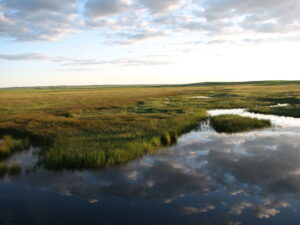
Ranchers get frustrated when their efforts to improve forage yields and quality don’t benefit their cattle, because the neighborhood deer move in instead. But more wildlife may simply be moving in because there are fewer natural areas for them to live.
Imagine what happens when a river floods. Water seeks the easiest path, so it follows the riverbed. Higher ground remains exposed and dry. Bystanders gather on the riverbank to watch the driftwood float by. The water rises, eventually spilling over the riverbank and onto the surrounding floodplain. Cautious people leave the area. Others climb for a higher vantage point. Floodwaters begin to climb the valley walls. More people leave, but determined spectators climb to the top of the valley. High ridges along the top of the river valley remain exposed and connected. Eventually the rising water surrounds the high points, floods the lower spots connecting them and isolates the peaks from each other. This leaves small islands, overcrowded with sightseers questioning their decisions, checking their cell reception and scanning for helicopters.
A similar thing is happening with rangeland biodiversity. A growing global population is increasing the demand for food. Biofuel incentives support crop prices. Provided there’s enough sunshine and moisture, high prices make it tempting to cultivate marginal grassland to grow cash crops, and favorable crop insurance programs may make this look like a safe risk. As cultivated acreage expands, wildlife habitat shrinks. If too much forage and pastureland is converted to crops, the remaining islands of grass will be too small and disconnected from each other to support a functioning grassland ecosystem.
Agriculture and Agri-Food Canada’s Tim McAllister and collaborators from the Alberta Biodiversity Monitoring Institute, Universities in Egypt, Alberta, Toronto and Manitoba used Alberta as a case study to evaluate how continued conversion of hay and pasturelands to crop production would impact biodiversity (Divergent trends in structural landscape connectivity from historic and potential future grassland conversion in Alberta, Canada).
What They Did
They examined Alberta’s six natural regions – the Grasslands region in the south, the forested Boreal region in the north, the Parkland in the middle, Foothills and Rocky Mountains on the west and the Canadian Shield in the Northeast. Most pasture and cattle production occur in the Grasslands, Parkland and Foothills regions. The Canadian Land Suitability Rating System rates land based on its potential to raise small grains and oilseeds. Classes 1, 2 and 3 are the most productive. Land classes 6 and 7 simply aren’t suitable for farming. The research team modeled how biodiversity might be affected if the tame and native pastureland on class 2, 3, 4 and 5 land was cultivated for crop production.
What They Learned
A lot of tame pasture and grassland (and wildlife habitat) has already been lost, but it could still get worse.
Grassland region: Nearly 85% of the original connectivity in the Grassland region still remains (compared to before cultivated agriculture started in Alberta). If future cultivation was expanded to swallow up class 2, 3, 4 and 5 land, 66% of the remaining grassland would be lost and about 50% of the original connectivity would remain. This could have serious negative implications for grassland biodiversity. Some of the remaining corridors would allow for wildlife movement to neighboring regions. For instance, remaining grassland corridors would still enable some movement of biodiversity to the Cypress Hills, Foothills or Parkland regions. But it would be a long walk for a burrowing owl.
Parkland region: Higher rainfall grows trees, and this supports different types of biodiversity. Due to clearing and farming, about 55% of the original connectivity still remains in the Parkland region. If cultivation expanded to include all the remaining class 2, 3, 4 and 5 land in the Parkland, 87% of the remaining grassland would be lost and about 40% of the original connectivity would remain. Some of the corridors would remain intact enough to allow wildlife to move north to the Boreal region or south to the Grassland region.
Foothills region: Substantial connectivity still remains in the Foothills region, likely because it has absorbed some of the biodiversity squeezed out the Grassland region. For example, grizzlies, elk and wolves used to be common throughout the Grasslands, but today they’re mostly found in the Foothills or Rocky Mountains. Nearly 80% of the grassland remaining in the Foothills region would be lost if the remaining class 2, 3, 4 and 5 land was cultivated, and connectivity would be squeezed further. Some of the corridors in the neighboring Rocky Mountain or Grasslands regions would remain intact.
What Does This Mean to You?
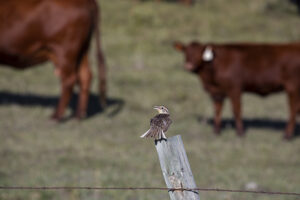
Regardless of where you raise cattle in Canada, cultivation (along with urban sprawl, industrial development, highways, reservoirs, solar farms and other hallmarks of progress not considered in this study) threatens grasslands, connectivity and biodiversity. Keeping land in grass and cattle is a nature-based solution to biodiversity loss and helps to ensure ecosystem intactness.
Bottom Line
A pasture can be cultivated in hours, but it takes years to re-establish one. Canada’s beef producers play a vital role in preserving Canada’s natural spaces, providing key habitat and travel corridors connecting healthy populations and ecosystems. Happy Earth Day.
The Beef Cattle Research Council is a not-for-profit industry organization funded by the Canadian Beef Cattle Check-Off. The BCRC partners with Agriculture and Agri-Food Canada, provincial beef industry groups and governments to advance research and technology transfer supporting the Canadian beef industry’s vision to be recognized as a preferred supplier of healthy, high-quality beef, cattle, and genetics. Learn more about the BCRC at www.BeefResearch.ca.
Click here to subscribe and receive email notifications when new content is posted.
The sharing or reprinting of articles on BeefResearch.ca is typically welcome and encouraged, however this article requires permission of the original publisher.
The BCRC is funded by a portion of the Canadian Beef Cattle Check-Off.

We welcome your questions, comments and suggestions. Contact us directly or generate public discussion by posting your thoughts below.