Make informed decisions for your operation with information delivered right to your inbox.
Get the latest tools, innovations and science-based information for the Canadian beef industry, including seasonal production considerations and economic analyses.
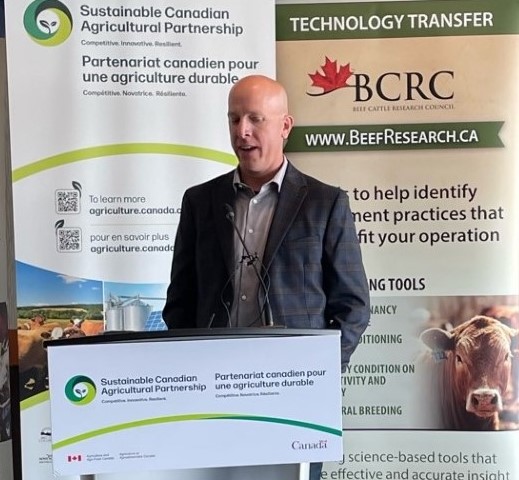
(l to r) Francis Drouin, Parliamentary Secretary to the Minister of Agriculture and Agri-Food, and BCRC Chair Craig Lehr announce new funding
CALGARY, July 12, 2023 – The Beef Cattle Research Council (BCRC) is welcoming more than $12 million in funding from the Government of Canada for Canada’s Beef and Forage AgriScience Cluster under the Sustainable Canadian Agricultural Partnership – AgriScience Program. Francis Drouin, Parliamentary Secretary to the Minister of Agriculture and Agri-Food, made the funding announcement today while attending the Calgary Stampede.
The AgriScience Cluster funding will bolster the Canadian beef sector’s environmental and economic sustainability and resilience as the sector adapts to changing climates and evolving marketplaces. This investment will support sector goals to meet the Government of Canada’s greenhouse gas reduction targets by reducing emission intensity, sequestering additional carbon and maintaining native grasslands in the care of Canadian beef producers.
“The Government of Canada recognizes the importance of Canadian beef,” said Parliamentary Secretary Drouin. “Today’s announcement will help contribute to the continued success of the industry, while keeping it strong and resilient for the future. The results from these innovation, research and technology activities will transform into real results on farms.”
Parliamentary Secretary to the Minister of Agriculture and Agri-FoodFrancis Drouin
BCRC Chair Craig Lehr, Alberta
Alberta beef producer and BCRC Chair Craig Lehr said the results from this AgriScience Cluster will benefit farmers, ranchers, processors, retailers and consumers, as well as the broader Canadian population.
“The demand for beef is expected to grow by 10 percent in the next 10 years and, with one of the lowest environmental footprints for beef production in the world, Canadian producers are well-positioned to responsibly meet growing global beef demand,” Lehr said. “Canada’s Beef and Forage AgriScience Cluster drives research and technology transfer that supports producer profitability with on-farm improvements in things like animal health and performance, feed production and efficient feed use so we can continue to supply high-quality, nutrient-dense protein.”
Canada’s beef industry will contribute more than $9.6 million, primarily through the research allocation of the Canadian Beef Cattle Check-Off, bringing the total AgriScience Cluster investment to more than $21.7 million. BCRC Vice Chair Ron Stevenson, a beef producer from Ontario, said this AgriScience Cluster builds on the success of three previous Beef Science Clusters.
BCRC Vice Chair Ron Stevenson, Ontario
“The Science Clusters recognize the beef sector’s determined leadership and encourage producers in their pursuits of innovation and ingenuity,” Stevenson said. “The Cluster will help the Canadian beef industry realize its tremendous opportunity to increase production and exports while ensuring the maintenance of soil health, water quality, air quality and biodiversity.”
Twenty-three projects will be funded between April 1, 2023, and March 31, 2028, under three themes: climate change and environment; economic growth and development, and sector resilience and societal challenge. The balanced research portfolio, led by respected scientists through collaborative arrangements between academia, government and industry, will work to achieve objectives with the greatest potential to advance the Canadian beef sector. Some projects will explore improved diagnostic tests and vaccines to manage cattle diseases, new forages that can thrive across Canada and food safety technologies in beef processing facilities that reduce water and energy use, while others will develop practical, science-based resources and economic decision-making tools for the industry.
– 30 –
For further information, contact:
Tracy Herbert Extension and Communications Director Beef Cattle Research Council C: 306-850-5026, herbertt@beefresearch.ca
Sharing or reprinting BCRC posts is welcome and encouraged. Please credit the Beef Cattle Research Council, provide the website address, www.BeefResearch.ca, and let us know you have chosen to share the article by emailing us at info@beefresearch.ca.
The BCRC is funded by a portion of the Canadian Beef Cattle Check-Off.
Your questions, comments and suggestions are welcome. Contact us directly or spark a public discussion by posting your thoughts below.
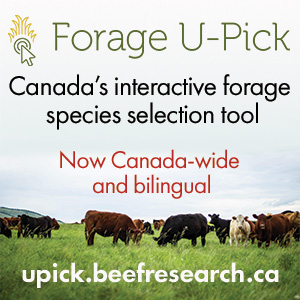
Forage U-Pick: An Interactive Forage Species Selection Tool Now Available Canada-Wide 🎙️
CLICK THE PLAY BUTTON TO LISTEN TO THIS ARTICLE:
The Canadian farms producing top-quality beef are as unique as our country’s topography. They do have one thing in common–each uses forages in some way.
Forage U-Pick–a tool that helps farmers and ranchers from British Columbia to the Maritimes choose forages best suited to their fields, calculate seeding rates and manage forage weeds–is now available online at no cost.
“Selecting forage species that will thrive under the growing and management conditions of a specific field on your farm improves the crop’s productivity. Since well-managed forage is typically the cheapest source of feed, growing productive forages can widen the profit margins of a beef operation,” shares Amy Higgins of the Maritime Beef Council.
Improving accessibility for all Canadian forage growers, the new Forage U-Pick includes Eastern Canada and is available in French via www.boussolefourragere.ca. It builds upon the success and popularity of a previous version that was applicable to Western Canadian producers.
“Good quality information should not be limited. All producers need information they can take onto their farms and help to make the best decisions possible for good forage production,” Higgins adds. “Straight forage producers, livestock producers or crop producers can now all take advantage of Forage U-Pick.”
The newly expanded Forage U-Pick is not just Western made to fit the East. While forage species have general characteristics and adaptabilities that are well documented, there are regional considerations that can positively or negatively contribute to selecting the ideal forage species. For example, soil pH is a critical consideration for Atlantic growers. Forage U-Pick walks growers through defining the characteristics of each specific field and matches forages that are best suited to those conditions. It can also provide options to consider that might not have been an obvious choice.
Higgins is proud that Forage U-Pick captures much of these regional considerations and packages them into one easy-to-use, mobile-friendly site for producers.
Partnerships make projects like this happen. In addition to funding provided by the Beef Cattle Research Council, the expansion of Forage U-Pick was supported by the 2018-2023 Innov’Action agroalimentaire program under the Canada-Quebec Agreement for the Implementation of the Canadian Agricultural Partnership; Conseil Quebecois des Plantes Fourrageres; Maritime Beef Council; Ontario Forage Council; Ontario Ministry of Agriculture, Food and Rural Affairs, and through Pan-Atlantic collaboration from the provinces of New Brunswick, Nova Scotia and Prince Edward Island with Canadian Agricultural Partnership support.
Forage U-Pick originally launched in 2020 and was created through the contributions of more than 13 different organizations to help Western Canadian producers select forage species that are a good fit for their individual fields.
“Saskatchewan Forage Council is proud to have been involved in the development of the original Forage U-Pick concept and its evolution into a valuable tool for all of Western Canada. Watching it adapt for use across the country is exciting and gratifying,” said Shannon McArton, executive director of the Saskatchewan Forage Council.
For more information about the newly expanded Forage U-Pick tool, contact:
Tracy Herbert, Extension and Communications Director Beef Cattle Research Council herbertt@beefresearch.ca
Sharing or reprinting BCRC posts is welcome and encouraged. Please credit the Beef Cattle Research Council, provide the website address, www.BeefResearch.ca, and let us know you have chosen to share the article by emailing us at info@beefresearch.ca.
The BCRC is funded by a portion of the Canadian Beef Cattle Check-Off.
Your questions, comments and suggestions are welcome. Contact us directly or spark a public discussion by posting your thoughts below.
Calf 911 – When and How to Assist with a Difficult Birth
Most experienced producers can think of at least one instance when they were baffled by an unusual calving. Twins, backwards calves and other malpresentations can be very confusing and even overwhelming when you are on your own and doing your best to quickly solve a problem calving.
Advances in breeding and genetics, along with management and nutrition, have moved us ahead of the days when pulling calves was commonplace. But as is the case with anything involving a biological process, there are always anomalies and abnormalities.
Findings through the Western Canadian Cow-Calf Surveillance Network reported that the average level of assisted calving within herds was 4.9%. While that number may look small, 90% of producers assisted at least one calf during the previous calving season. Calving difficulties (dystocia) do occur and can have profound impacts on the bottom line.
Intervening at the wrong time during calving can result in unnecessary stress, injury or even death of the cow and/or calf. Producers should be familiar with the normal sequence of calving. Every scenario is different, however once a water bag appears, a calf should hit the ground within one hour for cows or up to one and a half hours for a first-calf heifer.
A calving decision tree was developed in partnership with Manitoba Beef & Forage Initiatives (MBFI). It is a visual tool that can be used to help identify what the process of calving should look and feel like. The flow chart can also assist with step-by-step decision making when calving is not progressing normally. This information can help in making informed decisions and aid in communicating vital information to veterinary staff if veterinary care is required.
The flow chart follows the cow from the first stage of labour when subtle changes in behaviour and physical appearance first begin and progresses through until the calf is born. If signs of distress or abnormal presentations occur, steps for assessment and interventions are presented.
Timelines are also provided so that the cow is not allowed to labour too long, allowing for intervention to be sought out in time for a positive outcome for both the cow and calf. Timely assistance results in a 9% increase in the number of animals cycling at the onset of the breeding season and a 14% increase in the fall pregnancy rate. Furthermore, timely assistance will increase the chance of a live calf if a cow does have dystocia.
When planning for calving season, the calving decision tree is an excellent resource to keep close at hand, in the barn and with your calving supplies. If a cow needs assistance, it is helpful to have easy and quick access to simple and accurate information when and where you need it.
Sharing or reprinting BCRC posts is welcome and encouraged. Please credit the Beef Cattle Research Council, provide the website address, www.BeefResearch.ca, and let us know you have chosen to share the article by emailing us at info@beefresearch.ca.
The BCRC is funded by a portion of the Canadian Beef Cattle Check-Off.
Your questions, comments and suggestions are welcome. Contact us directly or spark a public discussion by posting your thoughts below.
Updated Livestock Transport Regulations and What You Need to Know
Changes to the Transport of Animals Regulations (Part XII of the Health of Animals Regulations) came into effect in February of 2020 and are being actively enforced.
There are four major changes in the new regulations focusing on:
categorizing animals fit for transport,
record keeping for transporters,
required feed, water and rest times and
contingency planning.
Categorizing Animals Fit for Transport
Code of Practice for the Care and Handling of Beef Cattle (nfacc.ca)
It is a legal responsibility of anyone hauling livestock to be able to recognize and place the animals in their care into the three categories before loading them on the trailer for transport:
fit for the intended transport,
unfit for transport or
compromised.
Record Keeping for Transporters
It is important to not only categorize animals, but document them as well, as animals will need to be reassessed along the journey.
Two new documents are required for transport. These documents focus on recording the status of animals before they are loaded, in transport and upon transfer of care. However, one document may be used to serve both purposes as long as all required information is included.
trailer floor area and when/where the trailer was last disinfected,
animal description including number, weight, time of loading, if animals are fit for transport and any special provisions for any compromised animals and
the last time the animals received feed, water and rest.
This document is to be written and retained by anyone transporting animals in the course of business for a period of two years.
Transfer of Care Record – This document is only needed for auction marts, slaughter facilities or assembly centres and must include the following information:
date and time of arrival,
condition of animals and
date and time of the last feed/water and rest.
This document is to be retained by the receiver for a period of two years. The transfer of care from the transporter to the receiver occurs immediately upon acknowledgement of the shipment and the accompanying Transfer of Care Record.
Changes around maximum feed, water and rest (FWR) intervals are also part of the regulations. The FWR interval requirements depend on the species and class of animals being hauled. Fit and mature (weaned) cattle may be transported for 36 hours between rest periods. At this time, the CFIA does not plan to enforce this maximum transportation time provided the destination has been reached within a maximum 40 hours. Comparatively, a load with any young (too young to be fed exclusively hay or grain) or compromised calves must stop every 12 hours. (See definition of fit and compromised animals in the Decision Tree graphic from the Canadian Food Inspection Agency at the beginning of the article.) Additionally, any animal under nine days of age may only have one direct trip of 12 hours and may not go through an auction mart.
The definition of travel time also changed. In the past, travel time started at loading and ended at unloading. The updated regulations now start the clock at the last time a period of rest including feed and water was initiated and does not end until feed, water and rest are provided at the rest stop or final destination.
Contingency Planning
When transporting an animal in the course of business, contingency planning will need to be considered for every trip. This can be a verbal or written plan and must cover all predictable natural or manmade scenarios that may halt or delay a trip. Planning needs to consider how to provide rest, protection from the elements, feed, water and safety in the event of any unplanned circumstances.
Before heading out on the highway, it is important to know the rules. Demonstrating compliance requires documenting the steps taken to ensure the welfare of the animals in your care and keeping records of any issues. If in doubt, write it down. A smooth trip with no delays is worth the time and effort.
Health of Animals Regulations: Part XII: Transport of Animals – Regulatory Amendment Interpretive Guidance for Regulated Parties (Government of Canada)
Transporting Animals? Health of Animals Regulations Section 153 Transfer of Care (Canadian Food Inspection Agency)
Disclaimer: Information was accurate and as per CFIA regulation at the time of the publishing date. Regulations and regulatory guidance may be subject to change. Please visit the CFIA website for the most up to date information on livestock transportation regulations
Sharing or reprinting BCRC posts is welcome and encouraged. Please credit the Beef Cattle Research Council, provide the website address, www.BeefResearch.ca, and let us know you have chosen to share the article by emailing us at info@beefresearch.ca.
The BCRC is funded by a portion of the Canadian Beef Cattle Check-Off.
Your questions, comments and suggestions are welcome. Contact us directly or spark a public discussion by posting your thoughts below.
Looking to Make the Most of Forage Quality? Consider These Factors 🎙️
Editor’s note: To support current extension initiatives and provide enhanced resources, the Beef Cattle Research Council has increased collaboration andsubsequent delivery of extension content that reflects the production practices and needs of eastern Canadian beef producers. This blog post is the first in an ongoing series of content delivery. Suggestions, ideas, and comments are always welcome.
Thank you to New Brunswick Cattle Producers and Les Producteurs de bovins du Québec for providing access to a French version of this blog post, available here.
Forage quality is an important factor to consider when feeding cattle. While this may seem obvious, maximizing forage quality is sometimes not the focus when management decisions are being made. Yet focusing on quality might enable producers to save costs by getting more out of the forage they have and reducing reliance on expensive concentrates and feed additives.
Forage quality and yield variations in a field depend on a variety of factors including the stage of maturity of the forage, growing conditions, species composition within the field and/or harvest timing decisions. Harvest considerations also include dry down time, or time laying in the windrow, which is impacted by chop length, the use of conditioners and swath width behind the mower. Post harvest management also affects forage quality and is impacted by decisions such as whether to wrap bales in plastic or not and how baled forage is stored. Being aware of these range of factors allows producers to make pre-harvest, harvest, and storage decisions that can optimize forage quality.
To maximize the use of available quality forage, an inventory and quality testing system should be implemented. Notes should be taken on fields which include information such as plant species, maturity at cutting, and age of field. This will allow baled forage to be grouped together based on the same cutting timing (1st, 2nd, 3rd, or 4th cut), forage that was cut and/or baled at a similar time, or that has a similar forage composition.
In addition, feed should be stored to allow access to any group at any time, taking into consideration facilities and limitations. Forage quality testing each feed group provides a better understanding of what quality of feed is on-farm and whether supplies are adequate to meet the herd’s requirements for the year. Early assessment allows time to plan for shortfalls in yield or quality. Testing can begin once stored forage has stabilized, prior to the sale or purchase of forage, or prior to feeding out to animals. Ensure samples are sent to the lab to allow enough time to get results back so that they can inform ration decisions.
Once forage quality test results are received, they can be provided to a nutritionist or producers can use BCRC’s Feed Value Estimator tool to identify how well the tested forage will meet the requirements of different classes of cattle in their herd and their production demands. With this information, producers can better match their forage groups to the production cycle of their animals and more accurately identify the amount of concentrates and feed additives required to meet nutritional needs not fulfilled by forages in the ration.
The following producers have found ways to optimize their feed harvest, inventory, and storage in order to place priority on feed testing and ration development.
Kintail Farms Brook Village, Nova Scotia
Andrew MacLennan and Krista MacGillivray, of Kintail Farms, run a beef and sheep operation near Brook Village, Nova Scotia. By focusing on their forage quality and feed management, Kintail Farms has grown from four cows and 50-60 ewes a few years ago to currently 25 cows and 200 ewes. Some of the changes implemented include harvesting as close as possible to plant boot stage to target higher quality forage and the creation of an inventory and quality testing system for their feed. A tower silo is used to store the highest quality forage while the remaining forages are turned into baleage, chopped silage, and dry hay.
Wrapped forages are stored to allow for ease of access as well as grouped together based on when they were harvested and their forage composition. These groups are stored separate from one another to ensure that mixing of different groups does not happen and to reduce the risk of confusion when pulling from different feeds when creating rations.
They test all of their forage to determine feed quality and then use this information to build rations for their herd, taking into account the production cycle of the animals. By pulling from their different on-farm produced feed quality groups, they can reduce their reliance on off-farm feed sources and supplements. The forages are supplemented by soybean meal and occasionally whole barley or whole corn depending on needs and market prices, however they’ve been able to reduce the amounts of supplements necessary to meet nutritional demands. The changes to their cutting and forage management system have allowed them to reduce the amount of time it takes for their calves to reach slaughter weight by three to five months for the direct-to-consumer market. This has greatly reduced feed and management costs.
Gilchrist Farms Lucknow, Ontario
Brad and Kristie Gilchrist of Gilchrist Farms near Lucknow, Ontario, run a cash crop and purebred Angus cow-calf operation as well as a winter bull development centre. Their focus on feed management is highlighted by the many different feed options produced on-farm, which are grown to target specific quality needs and provide a range of options when making rations for their herd. All feed is tested for nutritional quality and each forage is identified, inventoried, and stored separately.
Gilchrist Farms utilizes pasture, haylage, wrapped dry hay, corn silage stored in bunker silos, and other feed ingredients from on-farm and off-farm sources. Some forage fields are managed specifically to target higher protein requirements of their more nutritionally demanding animals, such as the bulls at the development centre, and are cut based on stage of maturity. Other fields are cut to target yield with this feed used for animals with lower nutritional needs. Feed storage is important as well with all feed being either wrapped, placed in bunker silos, or stored inside to maintain quality.
They maintain a close working partnership with their feed sales representative and animal nutritionist. The herd is split into different groups based on production type, with diets created to cater to specific nutritional needs in each phase of production. Rations are modified further based on animal performance and changes in air temperature throughout the year. Their bulls are weighed every twenty-eight days with daily and average gains tracked to ensure animals are meeting targets.
At Gilchrist Farms, on-farm production of feed and intensive management of diets allows them to have greater control of their herd’s diets and allows them to maintain production targets while reducing costs.
This blog post was developed in collaboration and with the expertise of staff at Perennia Food and Agriculture, based in Nova Scotia.
Ball, D.M., M. Collins, G.D. Lacefield, N.P. Martin, D.A. Mertens, K.E. Olson, D.H. Putnam, D.J. Undersander, and M.W. Wolf. 2001. Understanding Forage Quality. American Farm Bureau Federation Publication 1-01, Park Ridge, IL
Digman, M., D. Undersander, K. Shinners and C. Saxe. 2011. Best Practices to Hasten Field Drying of grasses and alfalfa. University of Wisconsin – Extension, Cooperative Extension Publication A3927, Madison, WI
Click here tosubscribeto the BCRC Blog and receive email notifications when new content is posted.
The sharing or reprinting of BCRC Blog articles is welcome and encouraged. Please provide acknowledgement to the Beef Cattle Research Council, list the website address, www.BeefResearch.ca, and let us know you chose to share the article by emailing us at info@beefresearch.ca.
We welcome your questions, comments and suggestions. Contact us directly or generate public discussion by posting your thoughts below.
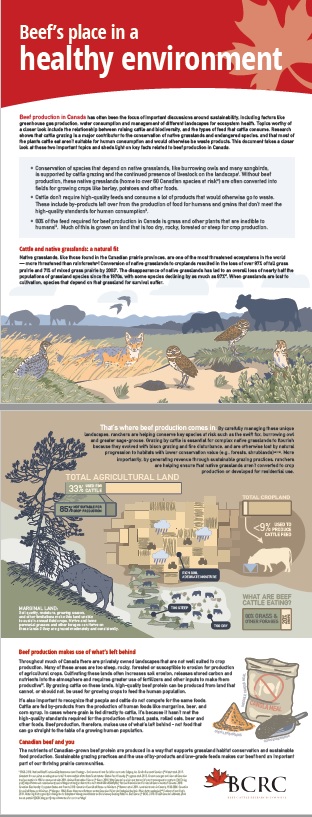
Beef’s Place in a Healthy Environment: Infographic
Cutting back on the amount of beef Canadians consume has been suggested in the media and public conversations online as a strategy to help save the planet. This recommendation may be based on the erroneous belief that Canadian land is inappropriately or inefficiently used in order to produce beef, but it certainly overlooks the positive impacts that a healthy beef sector has on the environment.
In fact, as you’ll read in the accompanying infographic:
much of the land that cattle graze in Canada cannot be used for other purposes
sensitive grasslands, like the endangered Northern Great Plains, and endangered plants, animals and birds can be protected when managed by cattle producers
well managed grazing can also restore unproductive soils that have been degraded through improper management
most of the plants cattle eat and convert into nutrient-dense meat aren’t edible by humans; they are low quality forage and grains that aren’t high enough quality for human consumption and would otherwise go to waste
beef production in Canada provides a unique set of positive environmental and human health impacts that few other food products are capable of
Through the use of technology, innovation and sustainable management practices, Canadian beef producers continue to produce more with less. Research shows that the environmental footprint of Canadian beef production has decreased by more than 15% over the past three decades.
Click here tosubscribeto the BCRC Blog and receive email notifications when new content is posted.
The sharing or reprinting of BCRC Blog articles is welcome and encouraged. Please provide acknowledgement to the Beef Cattle Research Council, list the website address, www.BeefResearch.ca, and let us know you chose to share the article by emailing us at info@beefresearch.ca.
We welcome your questions, comments and suggestions. Contact us directly or generate public discussion by posting your thoughts below.