Make informed decisions for your operation with information delivered right to your inbox.
Get the latest tools, innovations and science-based information for the Canadian beef industry, including seasonal production considerations and economic analyses.
Claire Sampson-MacDonald is the president of Maple Brook Co-operative Pastures Ltd., a community pasture on Cape Breton Island near Maple Brook, Nova Scotia. In Nova Scotia, community pastures were started in the 1960s and run by the provincial governments for decades; but now the province owns the land, and the management of each pasture is handled by community organizations or co-operatives.
Maple Brook Co-operative Pastures currently has 22 members and about 106 acres of cleared land for grazing. The co-op grazes 75-80 head from May to November but is looking to increase its numbers as infrastructure and land improvements are made.
Aging Infrastructure
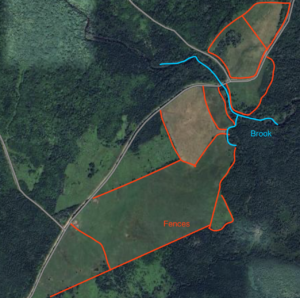
The Maple Brook pasture site is situated on a hill with a brook running through the lowest end of the pasture. For many years, the brook was the primary watering source for the entire grazing area.
This water management approach caused several issues:
Cattle weren’t gaining as much as they could: the single water source in the corner of the pasture meant cattle had to walk a long distance to get water, and the area close to the brook was grazed intensively leading to uneven land use.
With increasingly dry summers, the water levels in the brook were dropping by the end of the summer.
Cattle directly accessing the brook was not ideal for environmental stewardship and water cleanliness.
The BCRC’s Economics of Water Systems Calculator was developed to estimate the potential economic benefits and costs of alternative watering systems compared to direct access to dugout water.
Upgrading to Keep with the Times
Arial view of Maple Brook community pasture. Photo courtesy of Claire Sampson-MacDonald.
Following renewed provincial interest in the community pastures across Nova Scotia, Maple Brook was connected with Perennia Food and Agriculture Corporation, a provincial development agency. The Perennia team recommended developing additional water sources so the pasture could be divided into smaller blocks, allowing for more intensive grazing. They also advised fencing off the brook to limit cattle access, preserving water quality and minimizing environmental concerns. In response, the provincial government allocated funds to the pastures through the Community Pasture Support Program, enabling the co-op to begin making the necessary changes.
A Community Effort
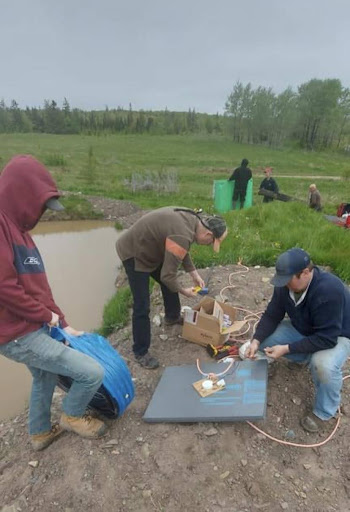
Members of the co-op put time and energy into making the changes, supplementing the funding that Maple Brook received. They also sought advice from Perennia about solar pumps and how to design a water system with readily accessible materials.
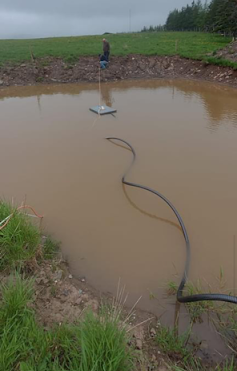
Three ponds have recently been established to catch surface water run-off, with berms to keep them from being filled in. Water is pumped from the ponds using a solar powered pump with a battery back-up into reservoirs and then into troughs for the cattle. Additionally, the brook is now mostly fenced off, restricting cattle access.
One of the three new surface water and run-off ponds at Maple Brook. Photos courtesy of Claire Sampson-MacDonald.
Co-operative members worked together to make changes to the water system.
Adjustments and Future Plans
With more than one water source, Maple Brook is now able to rotationally graze their stock through the paddocks, better utilizing their full pasture area. This also benefited the pasture conditions with better distribution of grazing and animal traffic. In the first year, maintaining sufficient flow to keep the troughs full was a challenge, but equipment modifications to increase the flow resolved the issue. The new system also requires daily monitoring, in person, to address any potential problems. Future improvements will focus on enhancing access and drainage around the trough, as well as increasing their capacity.
Overall, benefits of the new system were quickly realized by Maple Brook: “What surprised me the most was how quickly we saw the benefits to the health of the herd. . . . You could tell even by June of that first year we had the ponds, that the cattle had gained better than what they had in previous years, and we weren’t even halfway through the pasture season.”
There is strong value in working with advisors whose expertise can help guide the process. For producers or groups facing similar challenges, embracing changes recommended by experts can result in benefits quickly.
Key Water Management Takeaways
Ensure cattle have easy access to clean water and, when possible, pump water into a trough.
Monitor water sources and systems regularly to address any problems that may arise.
Fence cattle out of water sources to prevent contamination.
Advisors are available to help with upgrading water systems.
Acknowledgements
Thanks to the following individuals for contributing their time and expertise to review this article and related resources:
Kaley Segboer-Edge, VBP+ Coordinator and ABP Stewardship Lead, Alberta Beef Producers
Dr. Mary-Jane Orr, General Manager, Manitoba Beef & Forage Initiatives
Dwayne Summach, Livestock and Feed Extension Specialist, Saskatchewan Ministry of Agriculture
Jaclyn Horenburg, Producer Relations Specialist, Beef Farmers of Ontario
Geoff Larkin, Climate Change Adaptation Coordinator, Agri-Commodity Management Association
Sharing or reprinting BCRC posts is welcome and encouraged. Please credit the Beef Cattle Research Council, provide the website address, www.BeefResearch.ca, and let us know you have chosen to share the article by emailing us at [email protected].
The BCRC is funded by a portion of the Canadian Beef Cattle Check-Off.
Your questions, comments and suggestions are welcome. Contact us directly or spark a public discussion by posting your thoughts below.