Catch Ergot Before it Costs You🎙️
CLICK THE PLAY BUTTON TO LISTEN TO THIS POST:
Listen to more episodes on BeefResearch.ca, Spotify, Apple Podcasts, Amazon Music or Podbean.
This article written by Dr. Reynold Bergen, BCRC Science Director, originally appeared in the November 2026 issue of Canadian Cattlemen magazine and is reprinted on BeefResearch.ca with permission of the publisher.
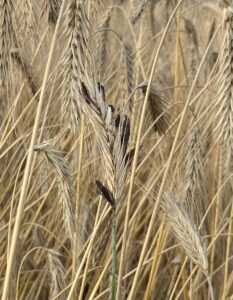
Ergot poses a significant risk to cattle health, welfare and productivity. The Canadian Food Inspection Agency (CFIA) recommends that total ergot alkaloids in livestock feed should not exceed 2 to 3 parts per million (ppm) for cattle.
But does that mean lower levels don’t matter? And what are your options if ergot-contaminated feed is all you have? Can the steam, heat and pressure used during pelleting deactivate ergot toxins? How about periodically alternating between ergot-contaminated and ergot-free feed? Do mycotoxin-binders work?
Gabriel Ribeiro and coworkers at the University of Saskatchewan, Agriculture and Agri-Food Canada and the University of Lethbridge have been working to answer these questions.
What They Did
Diets containing 0, 0.75, 1.5 or 3 ppm ergot were fed to 240 crossbred steers in a small pen study (Effect of increasing concentration of ergot alkaloids in the diet of feedlot cattle: performance, welfare, and health parameters). Steers averaging 617 lbs were backgrounded for 84 days (60% barley silage:40% barley-based concentrate). After a 28-day step up, they were finished for 112 days (10% barley silage: 90% barley-based concentrate). Cattle were fed once daily. Feed intakes, average daily gain, feed efficiency and carcass data were collected.
The second study fed four diets to 60 individually fed Angus-cross steers to see whether the effects of ergot could be minimized by pelleting or by feeding ergot intermittently (Effect of continuous or intermittent feeding of ergot contaminated grain in a mash or pelleted form on the performance and health of feedlot beef steers). One diet contained no ergot. The second diet contained 2 ppm ergot in a finely ground “mash” supplement that was fed throughout the trial. The third diet also contained a 2 ppm ergot mash but was fed intermittently. The ergot diet was fed for one week, then the control diet was fed for two weeks. The fourth diet contained 2 ppm ergot in a pelleted supplement (also fed intermittently). Steers averaged 660 lbs at the start of the 84-day backgrounding period (60% barley silage: 40% barley-based concentrate), stepped up over 28 days, and finished (10% barley silage: 90% barley-based concentrate) for 126 days. Cattle were fed once daily, and feed intakes, average daily gain, feed efficiency and carcass data were collected.
Finally, an “artificial rumen” study examined whether a commercial mycotoxin binder (diatomaceous earth and dried yeast) could measurably reduce ergot levels under lab conditions (Effect of ergot alkaloids and a mycotoxin deactivating product on in vitro ruminal fermentation using the Rumen simulation technique (RUSITEC)).
What They Learned
Ergot negatively affects growth performance and carcass value, even within “acceptable” limits. In study 1, feed intake, average daily gain and feed efficiency decreased as the level of ergot increased. During backgrounding, steers fed the two highest levels of ergot (1.5 ppm and 3 ppm) ate 1 to 2% less and grew 20-30% slower than the control steers. Similarly, during the first 77 days of the finishing period, steers fed these levels of ergot ate up to 10% less and grew 10 to 15% slower than the control steers. By day 78 (mid-May), steers on the 3 ppm diet showed signs of significant heat stress. Ergot interferes with blood flow and reduces the animal’s ability to dissipate body heat. For animal welfare reasons, these steers had to be switched to the control diet for the rest of the trial. For the rest of the finishing period, those steers ate just as much and grew just as fast and efficiently as the control steers. But that didn’t completely undo the damage. At slaughter, steers fed the two highest levels of ergot had carcasses that weighed 2 to 4% less, dressed 1% lighter, and had more single A and less AA carcasses than the control steers. Steers fed the ergot diets also had 3 to 5% dark cutters (compared to none in the control group).
Study 2 was similar. Across the backgrounding and finishing periods, the three ergot containing diets reduced intakes by 6 to 10%, reduced ADG by up to 25% and reduced feed efficiency by up to 8% compared to the control diet. At slaughter, ergot-containing diets reduced carcass weight by up to 6% and reduced the percentage of AAA carcasses by up to 50%.
Did pelleting reduce the negative effects of ergot? No. In study 2, pelleting ergot did not improve DMI, ADG or feed efficiency during the backgrounding or finishing periods compared to feeding ergot as mash. Pelleting ergot didn’t improve carcass merit, either.
Did intermittent feeding reduce the negative effects of ergot? Not really. Compared to feeding ergot continuously, feeding ergot-contaminated feed on a one-week-on-two-week-off basis did not improve feed intake, growth rate or feed efficiency during the backgrounding period, but tended to improve intake (9%) and feed efficiency (6%) during the finishing period. Feeding ergot-contaminated feed intermittently did not improve carcass traits compared to feeding it continuously. A longer “off” period may have produced better results.
Do mycotoxin binders have promise? Maybe. The mycotoxin deactivating product used in this study improved digestibility in the artificial rumen, but it didn’t reduce ergot levels. Animal feeding trials are needed to confirm whether these products cost-effectively improve growth performance or carcass value under real-world conditions.

What Does This Mean to You?
Growing conditions in your area might not have posed a risk for ergot this year. But do you know where your grain came from? Ergot tests aren’t perfect, but they are better than ignoring the risk.
Bottom line
Ergot is very risky. Avoid it if you can. Test your feed sources. If you can’t avoid it completely, dilute it as much as you can.
The Beef Cattle Research Council is funded by the Canadian Beef Cattle Check-Off. The BCRC partners with Agriculture and Agri-Food Canada, provincial beef industry groups and governments to advance research and technology transfer supporting the Canadian beef industry’s vision to be recognized as a preferred supplier of healthy, high quality beef, cattle and genetics.
Click here to subscribe and receive email notifications when new content is posted.
The sharing or reprinting of articles on BeefResearch.ca is typically welcome and encouraged, however this article requires permission of the original publisher.
The BCRC is funded by a portion of the Canadian Beef Cattle Check-Off.
We welcome your questions, comments and suggestions. Contact us directly or generate public discussion by posting your thoughts below.