Can Grading Cameras Predict More Than Overall Carcass Yield? 🎙️
CLICK THE PLAY BUTTON TO LISTEN TO THIS POST:
Listen to more episodes on BeefResearch.ca, Spotify, Apple Podcasts, Amazon Music or Podbean.
This article written by Dr. Reynold Bergen, BCRC Science Director, originally appeared in the December 2025 issue of Canadian Cattlemen magazine and is reprinted on BeefResearch.ca with permission of the publisher.

Canada’s beef researchers and industry development funds were at the forefront of developing the modern camera grading technology now used worldwide. The system originally involved two cameras. A “hot” camera (installed in very few processing plants) measures length, depth and various contours of the carcass side. The “cold” camera (widely used for grading) evaluates marbling, backfat depth and ribeye area and assigns the same quality (marbling) grade and retail yield class (overall lean meat percentage) that human graders do.
Agriculture and Agri-Food Canada researchers led by Dr. Oscar Lopez-Campos at the Lacombe Research and Development Centre showed that camera grading technology can do more than simply predict five retail yield classes. It can also identify differences between carcasses in the composition (and potentially the value) of individual primals and retail cuts for both fed cattle (Prediction of primal and retail cut weights, tissue composition and yields of youthful cattle carcasses using computer vision systems; whole carcass camera and/or ribeye camera; doi.org/10.1016/j.meatsci.2023.109120) and cull cows (Carcass and Primal Composition Predictions Using Camera Vision Systems (CVS) and Dual-Energy X-ray Absorptiometry (DXA) Technologies on Mature Cows; doi.org/10.3390/foods10051118).
What They Did
Six-hundred-and-thirty-four Angus-cross calves were raised and slaughtered as calf-fed (11 to 13 months of age) or yearling-fed (15 to 17 months) cattle at AAFC Lacombe, and 111 cull cow carcasses were sourced from a commercial abattoir.
In both studies, digital images were taken of the carcass side (hot camera) and the grading site between the 12th and 13th ribs (cold camera). The left side of every carcass was cut into eight primals (chuck, rib, loin, round, brisket, foreshank, plate and flank) and weighed. The primals from the fed cattle (not the cows) were further fabricated into 55 retail cuts.
What They Learned
Camera grading for fed cattle carcasses: The cold camera predicted overall retail cut yield (the basis of the Canadian Beef Grading Agency’s five carcass yield classes) better than either the hot camera or both cameras.
The cold camera also predicted the weight of the chuck, brisket and flank primals better than either the hot camera or both cameras. The hot camera worked best for the plate, and using both cameras worked best for the rib, loin, round and plate. But the improvements in accuracy from using either the hot camera or both cameras for these cuts were small (much less than half a pound) compared to simply using the cold camera.
A similar result was seen for primal composition. The cold camera predicted the lean percentage of the chuck, rib, foreshank, plate and flank better than the hot camera (or both cameras). Using both cameras predicted primal lean percentage better (by less than a tenth of a pound) for the loin, round and brisket.
The cold camera predicted retail cut weights better than the hot camera for 49 of the 55 retail cuts. The hot camera predicted the other six better. But again, the benefit of using more than one camera was very small.
Camera grading of cow carcasses gave different results. The hot camera predicted the lean content of the flank, round and foreshank best, and both cameras worked best for the brisket, chuck, loin, plate and rib. As with the fed cattle, differences in accuracy between the various camera combinations were relatively small for most primals. But using both cameras predicted the lean content of the chuck, loin and round more accurately than the cold camera alone. On average, the cold camera’s prediction of lean weight was off by three to seven pounds for these primals. Cull cows vary more in body condition score and muscling than fed cattle, so using the hot camera to get a better sense of overall carcass conformation may help provide better predictions of the lean content of the chuck and round in cows.
What Does This Mean to You?
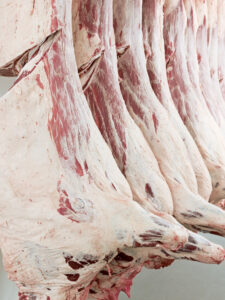
There’s a limit to how far this can go. No animal will ever have more than one brisket per side, for instance. But consider two carcasses with the same weight, quality grade and yield class. They would have the same value at the packing plant. But different retail cuts can have wildly different prices. If slight differences in conformation mean that one carcass happens to carry two more pounds of striploin (retailing for $41/lb) and two fewer pounds of inside round ($20/lb) than average, while the second carcass is the opposite (two fewer pounds of striploin and two more pounds of inside round than average), their true carcass value would differ by $84.
Similarly, three extra pounds of loin from a cow carcass equates to quite a few steak sandwiches. If the packer knew that, they may decide to fabricate (and eventually price) carcasses differently based on these differences. This would be a step closer to value-based marketing. If these data could be tied to individual animal identification and shared back through the system, we’d have an opportunity to intentionally breed for carcass conformation. Wave your hands and talk fast and it can sound pretty exciting. But the “intentional” part would be critical. Selecting too hard for any one trait almost always has downsides. For example, modern turkeys are bred using artificial insemination. Turkeys lost the ability to mate naturally 40 years ago because of heavy selection for exaggerated breast muscling.
The Bottom Line
Computer and imaging technology are developing rapidly. Canada’s beef quality researchers are working hard to turn these technologies into opportunities for our industry to improve and streamline beef carcass processing.
The Beef Cattle Research Council is a not-for-profit industry organization funded by the Canadian Beef Cattle Check-Off. The BCRC partners with Agriculture and Agri-Food Canada, provincial beef industry groups and governments to advance research and technology transfer supporting the Canadian beef industry’s vision to be recognized as a preferred supplier of healthy, high-quality beef, cattle and genetics. Learn more about the BCRC at www.beefresearch.ca.
Click here to subscribe to the BCRC Blog and receive email notifications when new content is posted.
The sharing or reprinting of BCRC Blog articles is typically welcome and encouraged, however this article requires permission of the original publisher.
The BCRC is funded by a portion of the Canadian Beef Cattle Check-Off.

We welcome your questions, comments and suggestions. Contact us directly or generate public discussion by posting your thoughts below.