Make informed decisions for your operation with information delivered right to your inbox.
Get the latest tools, innovations and science-based information for the Canadian beef industry, including seasonal production considerations and economic analyses.
Call for Nominations- Award for Outstanding Research and Innovation
The Canadian Beef Industry Award for Outstanding Research and Innovation is presented by the Beef Cattle Research Council (BCRC) each year to recognize a researcher or scientist whose work has contributed to advancements in the competitiveness and sustainability of the Canadian beef industry.
Nominations are welcome from all industry stakeholders. Download the nomination form here. Nominations must be submitted info@beefresearch.ca no later than May 1st with 3 or more letters of support that speak to the nominee’s influence on Canada’s beef industry.
Eligibility
To be eligible, nominees must be Canadian citizens or landed immigrants actively involved in research of benefit to the Canadian beef industry within the past 5 years. Benefit to the Canadian beef industry must be evident in a strong research program aligned with industry priorities, a demonstrated passion and long-term commitment through leadership, teamwork, and mentorship, involvement in ongoing education and training (where applicable), and active engagement with industry stakeholders. Areas of research pertaining to the beef industry may include:
agricultural economics
animal health and welfare
beef quality
environmental stewardship
feed efficiency
feed grains
food safety
forage and grassland production
genetic improvements
social license to operate
technology transfer
development of industry program(s)
other areas pertaining to the competitiveness and sustainability of the Canadian beef industry
Click here tosubscribeto the BCRC Blog and receive email notifications when new content is posted.
The sharing or reprinting of BCRC Blog articles is welcome and encouraged. Please provide acknowledgement to the Beef Cattle Research Council, list the website address, www.BeefResearch.ca, and let us know you chose to share the article by emailing us at info@beefresearch.ca.
We welcome your questions, comments and suggestions. Contact us directly or generate public discussion by posting your thoughts below.
Three Producers Share Ideas That Improve Efficiency
Beef producers across the country are always looking to improve management and production practices that not only benefit cattle, but also reduce their workload, and help to save time and money.
It may involve improved calf identification measures, installing remote cameras to monitor watering systems, or adopting quiet livestock handling practices in a flexible year-round grazing system. They all help to improve beef production efficiency.
Here are some measures three beef producers say has benefited their operations:
Rob Somerville – Endiang, AB
Rob Somerville who ranches with family members in east-central Alberta is using both high and low-tech technology to help him manage cattle on the century old family farm near Endiang, about 90 minutes east of Red Deer.
On the low-tech side, noting “it may have been a good idea my wife had”, Somerville says for the past two calving seasons he has been using bright coloured dog collars to help him identify calves he needs to be watching.
“All our calves are given I.D. ear tags,” says Somerville who ranches with his wife Laurie. “But when you have a good sized herd and you need to find five calves out of about 300 head it can take a lot of looking to find the ones you want to check. Using these dog collars has made the job just so much easier.”
Photo submitted by Rob Sommerville
The brightly coloured dog collars are applied to calves that need some follow up attention. It could be a situation where Somerville just wants to find a calf to make sure it is nursing its mother, it may be a calf that needs to be fed morning and evening, or in another case, it may be a calf being treated for some health reason that needs to be watched or given a follow up treatment.”Say, for example, it is a calf and I just want to make sure it is nursing,” he says. “I’ll give it an orange dog collar and then when I’m checking the herd it is very easy to pick out. If there is another calf that needs to be fed twice a day I will give it a different coloured dog collar. And if it is a calf that needs to be given some sort of treatment I’ll give it another coloured collar. It makes it so much easier to find them.”
Acting on Laurie’s suggestion, Somerville found the collars at an outdoor sporting supply store. They are large, brightly coloured and made of durable plastic type material. He bought several in different colours.
“An important thing to remember, as soon as you are done trying to track a calf, make sure you take the collar off. They can be cleaned up and reused.”
Value of RFID tags
Another higher tech management tool Somerville began using during the 2019 calving season, is to outfit each calf with a CCIA-approved RFID ear tag as soon as it is born. “The dog collars help with management, but using these RFID tags on newborn calves has actually made me money,” says Somerville. With the RFID tags applied to the calf, almost as soon as it hits the ground, Somerville can usually match the calf RFID to the mother’s RFID, eliminating or reducing the risk of ending up with an orphan calf.
“At the peak of calving when you have 20 or 25 cows calving a day it can get crazy,” he says. “Most pairs mother-up very well, but every once in while you run into a calf on its own and you have to ask “who does this guy belong to?” So we try to be there and apply that RFID tag just as soon as the calf is born, and then we can come back later or the next day to dehorn calves as needed and attach a floppy ID tag in the ear.
Somerville bought a good quality Gallagher RFID tag reader, which also allows him to input management information into the reader right in the field.
“As soon as the calf is born it takes a few seconds to snap the RFID tag into place, you have the calf’s number in the reader and usually the mother is close by so you can capture her number as well and then move on to the next one.”
Somerville says he has had situations where soon after a cow gives birth, the mother wanders off and ignores the calf, in other situations he has had one cow calve but then she mothers up with another cow’s calf, and occasionally there are twins born with both calves needing to be linked to a single mother.
He said it would have been a really useful tool in the spring of 2018 when bad weather hit during calving. “Several calves were literally born in a snowbank so you rushed to get inside to be warmed up, but then it was a challenge to get them paired up with their right mothers later on,” he says.
Somerville says even with his new system of applying RFID tags at birth, if one calf does get missed it is easier to determine the mother of that calf through a process of elimination. “You can identify the ones that are paired up by RFID numbers, so that leaves just one or two that maybe haven’t been,” he says.
Along with the RFID tag number, he can also input calf birthweights and other management information into the reader, which is all useful as he follows that calf through their on-farm finishing feedlot.
“Information on how the calf performs is also useful in making decisions on which cows to cull,” he says. “If you’re short of pasture and need to cut down numbers, it is always good to know who the bottom-end cows are.”
Somerville says he has used the RFID tags for years, but “it was mostly because it was required,” he says. The calves would receive RFID tags at branding or just ahead of sale day. “I see now how they can be a valuable management tool right from birth in helping to keep cow-calf pairs mothered up. Using these RFID tags at calving will make us more money.”
TRAVIS PEARDON – OUTLOOK, SK
Travis Peardon likes to keep an eye on summer and winter watering systems as well as farmyard activities even when he might be some distance from home.
The southern Saskatchewan beef producer, who farms with family members near Outlook uses two camera systems to help him monitor and manage cattle helping him to maintain the beef herd and also saves time and reduces stress.
One camera system is used to monitor remote watering systems on summer pasture and winter feeding areas. The camera either confirms water is available to his 250 head cowherd, or can alert him to a supply problem.
“Actually I got the idea from colleague Alicia Sopatyk, (Saskatchewan Agriculture livestock and feed extension specialist at Tisdale) who had tested the camera idea through the ADOPT program, ” says Peardon, who himself is also a provincial livestock specialist at Outlook. ADOPT is an acronym for Ag Demonstration of Practices and Technologies program.
With their cattle wintered on a site about a half-mile from the farm headquarters, Peardon, for the winter of 2018/19, installed a game camera over the winter watering system. The winter-feeding site has a dugout with water transferred into a wet well and then pumped into a heated water bowl. He has electricity available from nearby irrigation systems to provide power to the watering system, although it can be hooked up to solar power as well.
Photo submitted by Travis Peardon
The $350 game camera is mounted on a post above the water bowl and is programmed to capture three photos per day and transfer those photos to Peardon’s cell phone.”You can set up the camera system to be motion activated or just program the camera to take photos at different times of the day,” he says. The game camera system provides 100 free photos per month. A fee is charged for any photos over the 100 limit.
“We know when our cattle usually head to the waterer so we have the camera programmed to send three photos daily at 10, 11 a.m. and 12 noon,” he says. “It’s a good clear picture of the bowl, so if we can see water in the bowl we know it is working.”
Similarly, they can move the camera to a solar powered watering system used on pasture in the summer.
“Before we had the camera we would need to check the watering systems every day,” he says. “This way we can regularly monitor the waterers and know they are working. You don’t want your cattle to run out of water at anytime, but particularly on a hot day in the summer water needs to be available.”
The game camera photos are transmitted to both Peardon’s cell phone as well as to his father’s cell phone. “That way we can both keep an eye on the watering system and check if there appears to be a problem,” he says.
“It saves time, it provides peace of mind being able to see the waterers are working, and also from a production standpoint you don’t want cattle running out of water,” he says.
Another calving camera system in the farmyard is also a useful tool, says Peardon. It can be monitored form his cell phone or portable tablet.
“The calving camera helps you monitor cattle that are about to calve in the yard,” he says. “You can scan over a group of cows and zoom in on a particular animal for a closer look. You can also zoom in on the waterer in the pen to make sure it is working. And I can also scan most of the farmyard to make sure everything is in order there.”
DEAN MANNING – FALMOUTH, NS
Variable weather is something Dean Manning is learning to work with on his mixed farming operation at Falmouth, NS about a 45 minute drive north of Halifax.
With a 75 to 80 head commercial beef herd being about one half of his farming operation and a market garden and vegetable production being about the other half, he’s been working to develop an extended, but flexible grazing system for his operation.
“I’ve always been interested in grazing management and probably focused more on getting the proper forage stand for a number of years,” he says. “Now I have more focus on extending the grazing system, which is often affected by increasingly variable weather patterns.”
Photo submitted by Dean Manning
And as he moves cattle through a grazing system that has them outside about 90 per cent of the time, he also pays attention to proper, gentle, handling practices, which makes management much easier.In recent years, he’s been working to extend winter grazing as long as possible. Through proper management of a rotational grazing system, he stockpiles forage on both native and tame pastures, he seeds some kale as an annual forage crop for fall and winter grazing, and has also saves part of his corn silage crop for winter grazing as well.
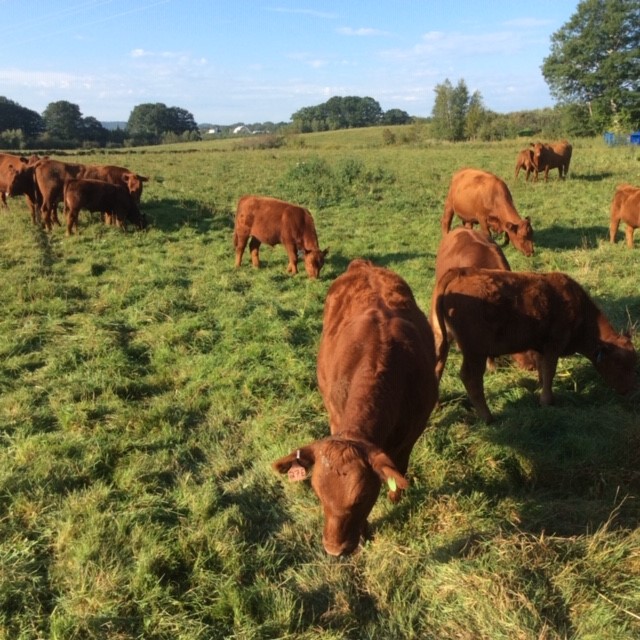
He says his cattle — a Red Angus based cowherd crossbred with continental breeds such as Limousin, Simmental and Charolais — are never really inside for winter feeding. “They are used to being outdoors so that is where they spend most of winter,” says Manning. “There is a loose housing barn they can use for shelter if the weather gets bad, but they come and go as they wish. And we have native pastures that are brushy and well treed so they use that as well if they need shelter from the weather.”
Manning runs both spring and fall calving herds. Calves from the spring herd are weaned in late October and sold as feeders, while calves from the fall herd are weaned in early April and sold in April and May. All calves are weaned with the Quiet Wean nose flap system. It is a system that allow calves to remain alongside their mothers, but once the nose flaps are attached they can no longer nurse. After three to five days of not nursing, the calves are weaned and can be separated from their mothers with considerably reduced stress on the cattle as well as humans who don’t want to listen to the bawling.
With most of the farm landbase devoted to forage production for winter feeding, Manning needs to haul cows to pasture. “We are sort of boxed in here where the farm is with little extra land available close by,” he says. “For summer grazing we need to haul cows to different pastures that may be one to two hours away.”
Tame pastures are a combination of mostly fine-leaf tall fescue, meadow fescue and festulolium, which is a cross between tall fescue and perennial ryegrass. Native pastures are a combination of native grasses, shrubs and trees. “The native pastures are fairly productive land for cattle but not suited for cultivation,” says Manning. “It provides good protection throughout the year if the cattle need shelter from the elements.”
Photo submitted by Dean Manning
In the rotational grazing system, the cattle move through the tame grass pastures three times over the growing season, while the native pastures are used once with maybe a second shorter or lighter grazing later in season.”We try to leave some of the pastures to regrow so the stockpiled forage provides some late fall grazing,” he says. “But once it gets colder we get snow and sometimes freezing rain, or snow melts and freezes and then the pastures get this layer of ice and cows can’t reach the grass. Once it thaws or as we get closer to spring and the ice melts they can go back on those pastures.”
Kale and standing corn remain above the ice layer so they provide grazing later into the winter. While the cattle are grazing these winter crops, Manning also provides supplemental feed in the form of round bale grass silage.
“Sometimes the weather co-operates and we can make hay, but usually we have frequent rains, so most of the grasses are cut and baled at higher moisture and put into in-line wrapping which produces a long sealed tube of bales that turn into silage.”
For winter feeding, along with kale and/or corn grazing, silage bales are hauled out and placed in roundbale feeders to minimize feed waste. “If they are grazing standing corn, for example, we limit feed the corn area they can graze with a moveable electric fencing and we’ll place the round bale feeders on the area that has already been grazed and haul out new bales every day or two as needed. We also keep moving the feeders to a new location to help with manure distribution.”
Manning says, although he’s only used winter corn grazing for a couple years it appears to work well. The cattle do well and it reduces the amount of feed he needs to haul. A downside can be the variable weather.
“If we have frozen ground, the cows can remain on the corn fields, but if we get a thaw they’d be up to their bellies in mud,” he says. When there is a thaw, he moves cows to other pastures with higher ground. He also moves the roundbale feeders to those areas. If it freezes up again, cows can go back to the corn.
“With the variable weather we really have to keep things flexible and move to areas where conditions are more suitable.”
With the need to move cattle by truck to pasture, or just to move animals through rotation in summer, or to fields with better footing in the winter, Manning says it is important to use proper cattle handling practices so moves go smoothly.
“You need to have an understanding of animal behaviour and also be calm when working around cattle,” he says. “We also cull cattle based on their temperament. If you go into a field and something gets their head in the air and ears pointing forward to take off, that’s an animal that isn’t going to stay around this farm. We use calm and quiet handling procedures when handling the cattle and we also want cattle with a quiet temperament.”
Click here tosubscribeto the BCRC Blog and receive email notifications when new content is posted.
The sharing or reprinting of BCRC Blog articles is welcome and encouraged. Please provide acknowledgement to the Beef Cattle Research Council, list the website address, www.BeefResearch.ca, and let us know you chose to share the article by emailing us at info@beefresearch.ca.
We welcome your questions, comments and suggestions. Contact us directly or generate public discussion by posting your thoughts below.
Five Producers Share Ideas That Have Made Their Farms and Ranches More Efficient
Fine-tuned management decisions with quick results and bigger management changes that may take a few years for benefits to materialize — these are ideas that Canadian beef producers are applying to their farming and ranching operations.
Good ideas can range from improving pasture watering systems and regularly testing winter feeds, to reducing costs during the fall/winter grazing period, to simple ideas that reduce the stress of calving out heifers, to more sweeping approaches on how to manage an intensive grazing system — all have a common objective to improve beef herd performance in sustainable farming systems.
Here are some ideas that Canadian beef producers have shared that help them produce more pounds of beef, reduce workload, improve overall efficiency and benefit cattle and the environment:
Sherri and Lynn Grant Grant Ranch Val Marie, SK
Managing calving heifers in remote locations
Lynn Grant. Photo supplied by Sherri Grant
When it isn’t practical to bring the heifers to maternity pens during calving season, you bring the maternity pens to the heifers on pasture. That’s what the Grant Ranch in southern Saskatchewan has done for the past three calving seasons and it’s an idea they wish they’d thought of sooner.
The idea was born in the spring of 2016 says Sherri Grant who along with her husband Lynn and brother-in-law Dean ranch near Val Marie in southwest Saskatchewan, just north of the Montana border. “We were trying a different program in 2015 and had synchronized and A.I.’ed a fairly large group of heifers.” As the heifers started calving in early April 2016, the Grants were dealing with essentially a couple of good problems, calves were coming fast and furious. It was “raining” calves, but calving conditions also got a bit soggy as the clouds brought some much needed rain.
As Sherri Grant wrote on the ranch blog at the time “At the hub of this week though, it has been raining calves. We have averaged 12 calves per day in the last 10 days. We have a very busy maternity ward…Out of 230 heifers, we have had 50 per cent of the group calve with 117 calves.”
Submitted by Sherri Grant
The heifer calving pasture is about 1½ miles from ranch headquarters, so a bit of travel is involved to check on calving progress, and if something did need calving assistance, it wasn’t easy to provide on pasture and took some organization if the heifer needed to be brought back to the home place. “The maternity pens were actually Dean’s idea,” says Sherri Grant. “ We have windbreaks out on pasture for the heifers, so he suggested we take portable corral panels out to the calving pasture and set up maternity pens against the windbreaks.” So the calving season of 2016 they set up two or three maternity pens against different sets of windbreaks over the heifer calving pasture. Using steel pipe corral panels for the sides as well as a gate panel, each pen was a 12’ x 24’ configuration and bedded with straw.
“And it worked really well,” says Grant. “It’s not that a lot of them needed assistance but it was just much easier to keep an eye on them particularly at night. And it becomes even more important if you have cool, wet rainy or snowy conditions at calving time and you want to make sure that a calf has nursed and is up and going.” She also notes that period from birth until the calf is up and nursing is also an important time for usually first-time mothers to “mother-up” and bond with and know their calves.
The corral panel pens are set up against the wooden windbreaks. While they are used during the day, especially if the heifer needs assistance, they are particularly of value as evening and nightfall sets in. If they see a heifer is getting close to calving they herd it into one of the maternity pens and can check on it later. “You can come back in a hour to check or just wait in the truck and the heifer is not going wander off on you,” says Grant. “When they are out on the large calving pasture and especially when it’s dark, they can be hard to find, or maybe you do find a heifer with a new calf, but then you might wonder is that her calf or did she steal a calf from someone else. So being able to move them into a maternity pen right on pasture, just reduces stress and provides peace of mind.” The first year, out of 117 head born during the first 10 days of the calving season, only seven per cent of heifers needed assistance at calving.
Once the heifer calves and the Grants have seen the calf up and nursing and looking vigorous, the pair is turned back out onto pasture. At the end of calving season, the corral panels are collected and used as needed during the grazing season. The pasture maternity pens worked so well the first year, the Grants have kept the system going each of the past couple seasons. They will have panel pens set up again for the 2019 calving season, even though heifer numbers are down to more usual 100-plus head this coming season. The main cow herd, ranging between 800 and 900 head, calves on open rolling pasture about 10 miles from the ranch headquarters. That herd is checked as well, but is pretty self-reliant and trouble free when delivering calves.
“Often invention is the mother of desperation,” Grant says jokingly. “That first year we had a larger number of calves than usual, the calves were coming fast and the weather really wasn’t co-operating so bringing maternity pens to the pasture really made it so much easier to manage.”
Jason Reid Reid Ridge Farms Thunder Bay, ON
Using corn residue, corn silage and corn grazing
Jason Reid. Photo supplied.
Filling that expensive November/December feeding gap — fall pasture has ended, but winter corn grazing hasn’t started — has led Jason Reid to consider a few options on his Northern Ontario beef and sheep operation.
The summer of 2018 he had planned to cut spring-seeded barley for silage in about mid-July and then re-seed the field with an oat/barley mix to provide late season grazing in November/December. However with a dry summer and insufficient rain in late July and August, he got the barley silage cut, but put the summer-seeding plan on hold. His next option was to work with a neighbour who harvested grain corn and put the cowherd on a field of corn stover and residue for late season feed.
“That late season period — November and December — can be our most expensive feeding period,” says Reid, who this year is running about 100 cow-calf pairs, backgrounding about 70 head and also runs a sheep flock of about 300 ewes. While he produces about 75 per cent of his own hay on 600 acres of deeded and rented land, he says he is fortunate to farm in an area where he can also buy mid-quality, beef-grade hay for winter feeding — the price is reasonable but it is still a cost. Whether it is his own or bought hay it has a cost. And he also has to consider equipment, time and labor while feeding hay during that period.
“So if we can find some sort of pasture for the November/December period it just saves on hay and feeding costs,” he says. “Most years being too dry isn’t a concern. It is more common that we are dealing with too much moisture. But the 2018 growing season was just about the opposite. We did get rain but it didn’t come exactly when we needed it.”
Reid and his wife Trudy, who moved from Northumberland County on the northern edge of Lake Ontario to Thunder Bay on the northern edge of Lake Superior in 2003, farm on the edge of the city. Along with their deeded farm base, they also rent mostly small-acreage parcels of land from some 26 landowners. Much of their land base is low lying “swampy” type ground that produces high volume, relatively low feed-quality reed canary grass. They’ve worked to improve pastures on their home base farm over the years.
“Part of the home farm used to be a sod farm at one time, so when we took over it had some of the poorest quality, compacted soil in the area,” says Reid. For a few years they grew turnips and forage radish on part of the depleted land to help open up the soil and bring it back into production. “The turnips and radish worked very well and provided excellent late fall/early winter grazing. We would also provide some reed canary hay and cattle did very well.” However, in more recent years Reid says it has become an increasingly difficult logistical challenge to get turnip and radish seed in the Thunder Bay area. He looked for a different option — corn fit the bill.
Photo supplied by Jason Reid
In the past few years he has grown about 45 acres of silage corn on the home farm. About 25 to 30 acres is cut for silage to feed to backgrounding calves and also as feed supplement with hay for the cowherd in the weeks prior to calving. The remaining 14 to 15 acres of corn was saved for winter grazing. Reid holds cattle off the area until early to mid-January to ensure ground is well frozen. To help balance the ration while grazing corn, Reid feeds cereal silage on alternate days. For example, using hot-wire fencing, cattle are limit- fed the standing corn and held on an area that should last four days; about half way through that period he will also feed grass silage on the grazed corn strips one day. On the fifth day the herd moves to a new area of standing corn. In 2017, when Reid was running about 37 head of cows, the 14 acres of grazing corn would provide about two months of winter grazing.
“In 2018 our cow herd increased to 100 head so we converted more acres of a large pasture on the home farm and grew more corn,” he says. Again about 25 to 30 acres was cut for silage, and he left another 25 acres to be used for corn grazing starting in January. This fall the cow herd will graze corn residue until early January, then move into the standing corn for winter grazing, until about three weeks before calving in late March/early April. “After the grazing corn they go on to full stored-feed — silage and hay— which carries them up to calving,” he says.
Miles Wowk Wowk Ranches Ltd. Beauvallon, AB
Improving the quantity and quality of both water and forages
Miles Wowk. Photo supplied.
On the Wowk ranch in northeastern Alberta several relatively minor-to-medium changes in production practices add up to make considerable improvements in overall beef herd performance, says Miles Wowk.
Changes in the pasture watering system, forage stand improvements and providing a balanced ration during winter feeding are some of the fine-tuning details they’ve addressed on the family-run Wowk Ranch Ltd. operation at Beauvallon, about half way between Vegreville and St. Paul. The Wowks run a 300 head cow-calf operation, along with about 80 head of horses.
As they follow a rotational grazing system on about 4000 acres of pasture, one improvement in recent years has been to provide cattle with water through solar powered, off-site water systems.
“For many years cattle watered directly out of dugouts and sloughs,” says Wowk. “But in the last few years we’ve converted to solar powered pumps that deliver water to troughs. Having clean, fresh water available to both cows and calves has made a huge difference in performance.”
Both the cows and calves prefer clean water, he says. Cows drink more, which he believes translates into more milk production. And more milk means improved rates of gain on calves. The calves also drink more water, which improves their growth as well. The portable solar powered systems are moved from pasture to pasture as cattle move through their grazing rotation.
And Wowk manages pastures to maintain a high legume content in a grass/legume forage blend. He’s developed a relatively low-cost system to renew alfalfa stands on an ongoing basis.
“About six years ago we started top dressing pastures with alfalfa seed and fertilizer and it’s made a tremendous difference in forage production,” he says.
Photo supplied by Miles Wowk
Grazing land on the ranch is divided into pastures and he treats about one-third of each pasture with the seed/fertilizer blend on a rotating basis. For example, on a 160-acre pasture he will treat about 50 acres in early spring with a broadcast application that includes about five to seven pounds of alfalfa seed along with about 40 pounds of actual N. He won’t be back to fertilize that same pasture for two years and then will treat a different 50-acre block. “We usually time the treatment for April when the snow is gone and yet there is good moisture in the soil surface,” he says. The 50-acre block is harrowed after the treatment. He’s applying the treatment on some part of the ranch every year.
“Some advisors told us we were wasting our time applying the fertilizer with alfalfa seed, but it makes a tremendous difference,” says Wowk. “I estimate the treatment is producing at least 20 per cent more forage with an excellent stand and excellent growth on the alfalfa.”
Improving the quantity and quality of both water and forages is an important part in improving overall herd performance and efficiency, says Wowk. Part of that efficiency has also been a change in the beef herd breeding program in recent years focusing on more moderate-size Angus breed genetics rather than Simmental genetics. “We have decreased the size of the cows in our herd but kept our weaning weights the same,” he says. “The size of our cows has dropped by around 30 per cent so that is our gain in our calf crop — 10-15 per cent because of fresh water and 15-20 per cent due to improved pasture.”
Photo supplied by Miles Wowk
To keep pastures productive, Wowk also takes every opportunity to concentrate cattle on poorer ground during the grazing season or during winter-feeding to increase manure distribution. And he says the effort is paying off in more productive soils and forage stands.
Wowk says a dry year like 2018, where they saw about five inches of rain over the growing season, is a good example. “As soil health improves we are seeing improved moisture retention in the soil,” he says. “This past season, we were able to pasture the same number of cattle over the same land with very productive forage stands even though we had about one-third of the annual rainfall. The soil is holding more water.”
The winter-feeding program is a combination of swath grazing on either silage barley or oat swaths, followed by a mid-winter feeding program that includes cereal straw, rolled barley and a mineral supplement. Wowk has all feed tested every fall, and then working with a nutritionist, he provides mineral supplement that along with key vitamins and minerals also includes about 10 per cent urea and Bovatec® medicated premix. The mineral combination is fed at a rate of 100 grams per head per day.
“With the combination of feed testing and working with a nutritionist we are always feeding a balanced ration,” says Wowk. “Cattle do extremely well on relatively low cost feed. As temperatures change over winter, we can adjust the rolled barley component of the ration up or down to meet energy requirements.”
Bale shredder saves labour, bedding and feed costs
Brian Trueman. Photo supplied by Beth Trueman
After years of looking, Brian Trueman finally found a simple, and relatively inexpensive round bale shredder that helps reduce feed waste, improves bedding efficiency, and saves him the time and labour of trying to pull round bales apart by hand or with a fork.
The roughly 70-inch wide shredder platform that easily mounts onto the arms of the front end loader on his 95 horsepower tractor, has three auger type bars or cylinders across the width of the platform and each cylinder has between 18 to 22 sickle teeth. (The cylinders, which are spaced about 20 inches apart look a bit like sections of a 6-inch grain auger.) The shredder mounted on the front-end loader arms has two 47-inch long forks on the front edge. Slide those forks under a conventional 1,200 to 1,500 pound round bale, tip the forks up so the bale rolls back and is basically cradled against the teeth of the cylinder bars, activate the hydraulically driven cylinders and they begin spinning and the teeth along the cylinders begin cutting away at the bale. The bale is cut so that roughly six to eight inch lengths of hay (or straw) pour out of the bottom of the shredder. As the bale tumbles and rolls against the cutting teeth, the cylinders can quickly be reversed to cut forwards and backwards on the bale.
Photo supplied by Brian Trueman
“It takes about 12 minutes to process a bale on my little tractor,” says Trueman, who along with family members runs a mixed purebred and commercial beef cattle operation near Amherst, on the northwest side of Nova Scotia near the New Brunswick border. “And I first thought that takes quite a bit of time, but then I remembered how much time I spent trying to fork apart a bale for the cows and really it is much faster and easier.”
Trueman, who runs about 80 cows, raises purebred Hereford, Angus and Simmental cattle, along with commercial cattle as well. A mixed farming operation he also produces blueberries and his wife has an apiary to produce honey. “I call it the three-B operation,” says Trueman. “Beef, blueberries and bees.”
While he had been interested in some type of shredder for years, he evaluated this Hydra-Shredder Bale Processor made in Minnesota as part of a Nova Scotia government Advancing Innovative Technologies program. The program provides partial funding to farmers to use and evaluate new technologies and report on their findings. Trueman says in his evaluation, he gave the shredder two thumbs up.
Photo supplied by Brian Trueman
He overwinters cattle in or near two separate structures. One is a tarp-covered barn where cows walk up to a cable that runs the length of the feed alley — they reach their heads under the cable to grab feed. He also has a pole-barn where a group of cattle can access shredded bales in an outside feeder — they can reach their heads through slant bars on the perimeter of a large rectangular feeder. He feeds round bale silage, stored in long plastic silage tubes. The silage is a mix of grass/legume forages.
“I was looking for something that would help reduce feed waste,” he says. “You manage to tear apart or somehow unroll a large round bale in front of your cows, and they often grab big chunks and pull it out of the feeder. They eat most of it but also a fair amount falls down by their feet and gets trampled into the manure.”
After a season of use, he says the bale shredder has virtually eliminated the waste problem. “The shredder cuts the hay into roughly six to eight inch lengths and it is very easy for a cow to grab a mouthful without dragging a big chunk onto the ground,” he says. “I can’t say that I fed less hay with the shredder but what I did feed went where it was supposed to and that was inside the animal.”
Trueman says the shredder does improve bedding efficiency — makes better use of straw. He keeps the open area behind the cows in the tarp barn, as well as those in the pole-barn well bedded with straw. “Before I got the shredder, I’d bring in a large round bale of straw and you try to pull it apart as best as you could but there would be thick and thin layers in different parts of the bedding area.
“I put the straw bales in this shredder and it just lays out a nice even layer of bedding over the whole area,” he says. “I’m sure with the straw I used about half as much as I normally would and did a better job — straw bales cost money too.”
Trueman says the shredder scored high in achieving all objectives. It dramatically reduced the amount of wasted feed, reduced the amount of straw needed to properly bed the herd, and ultimately saved considerable time and labour compared to trying to pull bales apart.
“It is a very simple machine, that’s well built and works well,” he says. “It costs about $10,000 but then you have to consider the time and labour saved along with improved feeding efficiency. It’s also a piece of equipment that’s going to last several years.”
Larry Wegner Virden, MB
Effective forage management doubles production
Photo supplied by Larry Wegner
A different approach to pasture management that’s been evolving on Larry Wegner’s ranch in southern Manitoba for more than a decade has allowed him to double carrying capacity with beef cattle numbers on the same land base, has improved soil health, encouraged plant diversity with no added inputs, and as far he knows he’s not done yet.
Wegner, who farms with family members at Virden, in southwest Manitoba near the Saskatchewan border, adopted what’s known as an adaptive pasture management system on his cow-calf and yearling operation about 11 years ago.
The 800-acre farm is divided into 22 paddocks ranging in size from 15 to 80 acres. Grazing season runs from early April, with cattle turned out onto stockpiled forage (new grass coming underneath) around April 10, and runs until early December. Under his previous, more extensive grazing system, the ranch supported about 100 head of cow-calf pairs for the season. In 2018 he grazed the same area with 250 cow-calf pairs, in a flexible grazing system that still left 50 per cent of the forage in the pasture.
“I’m not sure if we’ve reached the maximum yet or not,” says Wegner. “I’m still learning. I believe there is still some upside to be had, but it is obvious with proper management the land has become more productive.”
The “adaptive” management aspect of the system is that he moves cattle as the forage dictates — be adaptive, be flexible. “When I move cattle depends on the growing conditions, the number of cattle, and the size of pasture,” says Wegner. “But my general guideline is to move when cattle have removed 50 per cent of forage and not come back to that same paddock for at least 60 days, allowing time for regrowth. So with all factors considered I might move cattle three times a day or I might move once every three days.” Depending on the growing season and circumstance he might move cattle when they’ve only removed 30 per cent of forage and the odd time they may stay longer to remove 75 per cent of forage. “The important part is to leave sufficient recovery time for forages to regrow before you graze it again,” he says.
Plant diversity is one of the indicators that the system is working. About half of the Wegner farm was at one time mostly tame grass species and about half was native range. But over the years of following the grazing system he has seen plant species numbers increase and spread. “The last inventory that was done there was 98 different species of native forages growing on pastures along with some of the tame grass species,” he says. He hasn’t renewed any pastures with seeding or fertilizer. Pastures are managed to periodically mature and set enough seed to re-establish themselves. He has also seen that cattle will distribute the seed of some tame species like birdsfoot trefoil in their manure to new areas of the farm where the species wasn’t seen before.
“Plant diversity is the key and with a rest/rotation system the plants are able to set seed to repopulate themselves and also develop root systems to open up the soil,” he says. With root systems and earthworm activity in the soil he’s seen a dramatic improvement in water infiltration capacity — an inch of rain, for example, will disappear into the soil in less than a minute. “The water holding capacity of the soil has increased so even during a dry period there is still moisture available to keep the grass growing,” says Wegner.
With cattle on pasture until December, he plans on a 120-day winter-feeding period. He uses a bale grazing system, placing hay out on pasture so all manure stays in the pasture.
“When I tell people I sometimes move cattle three times a day, their first reaction is that it is a lot of work,” he says. “But in reality once cattle are used to being moved it takes about 15 minutes to open the gate and really they move themselves. And at the same time it gives me a chance to look at the cattle to see how they are doing.”
Click here tosubscribeto the BCRC Blog and receive email notifications when new content is posted.
The sharing or reprinting of BCRC Blog articles is welcome and encouraged. Please provide acknowledgement to the Beef Cattle Research Council, list the website address, www.BeefResearch.ca, and let us know you chose to share the article by emailing us at info@beefresearch.ca.
We welcome your questions, comments and suggestions. Contact us directly or generate public discussion by posting your thoughts below.