Make informed decisions for your operation with information delivered right to your inbox.
Get the latest tools, innovations and science-based information for the Canadian beef industry, including seasonal production considerations and economic analyses.
Producer Investment in Action: 2024-2025 Year in Review
Ever wonder where your Canadian Beef Cattle Check-Off dollars go? The Beef Cattle Research Council’s 2024–2025 Year in Review shows how beef producer investments and input are driving research, tackling industry priorities and delivering more value back to Canada’s beef producers.
“The BCRC draws heavily on the input of Canadian beef producers when directing National Check-Off dollars towards advancements in feed and forage production, animal health and welfare, and overall productivity for beef operations across the country,” says Alberta beef producer and BCRC Chair Craig Lehr.
The 2024-2025 BCRC Year in Review provides a broad funding overview by program area and source. In the past fiscal year, the BCRC received on average $0.66 (unaudited) of every $2.50 of the Canadian Beef Cattle Check-Off collected by provincial beef cattle associations. Typically, for every $1 of producer investment, the BCRC looks to leverage $2-3 in other direct funding and in-kind contributions.
This annual stakeholder report spotlights project funding and research findings among:
23 Beef and Forage AgriScience Cluster research and knowledge mobilization projects,
70 priority research projects and
16 proof-of-concept projects.
It also reflects significant growth in access to and engagement with the BCRC’s knowledge mobilization efforts. The BCRC created more than 300 resources and content pieces in the past year, reaching more people than ever before with practical, science-based information.
“The BCRC recognizes that moving research from reports to application is important,” says BCRC Executive Director Andrea Brocklebank. “We continually strive to take research results and translate them into applicable extension that is accessible to all Canadian beef cattle producers.”
Additionally, the report highlights the four university research chair positions and other BCRC-supported funding for retention of valuable research capacity at Canadian universities. It also includes an update from the Verified Beef Production Plus program that the BCRC continues to fund and oversee.
The Year in Review offers a visual summary of the BCRC’s 2024-2025 Results Report, which was submitted to the Canadian Beef Cattle Research, Market Development and Promotion Agency, and covers the fiscal year, July 1, 2024, through June 30, 2025.
Sharing or reprinting BCRC posts is welcome and encouraged. Please credit the Beef Cattle Research Council, provide the website address, www.BeefResearch.ca, and let us know you have chosen to share the article by emailing us at info@beefresearch.ca.
The BCRC is funded by a portion of the Canadian Beef Cattle Check-Off.
Your questions, comments and suggestions are welcome. Contact us directly or spark a public discussion by posting your thoughts below.
The BCRC Announces $1.43 Million for Nine Priority Research Projects
Nine new projects have been funded under the BCRC 2024 call for proposals. BCRC funding to the nine projects totals $1.43 million. Each project brings funding from other sources, leveraging producer funding with over $3.1 million.
“Applied research is important to help producers make on-farm decisions and implement strategies that improve producer productivity and profitability,” says Craig Lehr, BCRC chair and Alberta beef producer. “Bovine respiratory disease (BRD) and antimicrobial resistance are ongoing issues for the Canadian beef industry. Projects investigating causes and transmission of BRD pathogens and antimicrobial resistance will help inform future prevention and treatment practices.”
BCRC Vice Chair Dean Manning
“Research improves producer competitiveness through informing beneficial management practices,” says Dean Manning, BCRC vice chair and Nova Scotia beef producer. “Research into animal health, feed efficiency and food safety will contribute to advancing our industry.”
ANH.02.24 – Understanding how Mycoplasma causes respiratory disease. Project Lead: Dr. Jeff Caswell (University of Guelph)
ANH.05.24 – Are there more bacteria involved in spreading bovine respiratory disease and antimicrobial resistance? Project Lead: Dr. Tim McAllister (AAFC Lethbridge)
ANH.07.24 – Can supplementation early in the feeding period help correct copper deficiency and improve health outcomes in newly-arrived feeder calves? Project Lead: Dr. Cheryl Waldner (University of Saskatchewan, WCVM)
ANH.16.24 – Surveillance of antimicrobial use and resistance in Canadian feedlot cattle. Project Lead: Dr. Sheryl Gow (WCVM/PHAC)
FDE.02.24 – Synergistic rumen microbial consortia: A probiotic approach to augmenting feed utilization efficiency. Project Lead: Dr. Tim McAllister (AAFC Lethbridge)
FDE.12.24 – Effect of divergent fibre digestion efficiency on growth performance, methane emissions, and carcass characteristics of beef cattle, and its association with the host genetic/genomic makeup. Project Lead: Dr. Gabriel Ribeiro (University of Saskatchewan)
FDE.13.24 – Can we use laser technology to develop a rapid feed test? Project Lead: Dr. Nii Patterson (National Resource Council)
FOS.02.24 – Battling biofilms. Project Lead: Dr. Kim Stanford (University of Lethbridge)
FOS.05.24 – Remote ante- and postmortem meat inspections using augmented-reality live-stream video software. Project Lead: Dr. Argenis Rodas-González (University of Manitoba)
The BCRC is Canada’s national industry-led funding agency for beef, cattle and forage research. The BCRC’s mandate is to determine research and development priorities for the Canadian beef cattle industry and to administer Canadian Beef Cattle Check-Off funds allocated to research. A division of the Canadian Cattle Association, the BCRC is directed by a committee of 16 beef producers from across the country. The BCRC is funded in part through a portion of the Canadian Beef Cattle Check-Off which is then leveraged with government and industry partner funding.
Sharing or reprinting BCRC posts is welcome and encouraged. Please credit the Beef Cattle Research Council, provide the website address, www.BeefResearch.ca, and let us know you have chosen to share the article by emailing us at info@beefresearch.ca.
The BCRC is funded by a portion of the Canadian Beef Cattle Check-Off.
Your questions, comments and suggestions are welcome. Contact us directly or spark a public discussion by posting your thoughts below.
2023-2024 Year in Review Highlights Results of Industry Investments in Research and Extension
The Beef Cattle Research Council has released its 2023-2024 Year in Review highlighting key activities and outcomes from the past fiscal year. The report showcases how producer investments in the Canadian Beef Cattle Check-Off are tackling beef industry priorities while generating maximum value from every research dollar.
“The BCRC uses producer input to direct Check-Off dollars toward priority beef and forage research projects,” says Alberta producer and BCRC Chair Craig Lehr. “Our practical extension materials make certain this research doesn’t just sit on a shelf, but it actually gets out to producers so we can improve our individual operations and make our industry even better.”
Click to expand.
The 2023-2024 BCRC Year in Review reports funding, project spotlights and research findings for:
23 research and technology transfer projects from Canada’s Beef and Forage AgriScience Cluster,
75 priority research projects,
14 proof of concept projects and
more than 200 extension activities and projects funded outside of the Cluster.
The report also features university research chair positions, mentorships, and other collaborative activities in which the BCRC is involved. It includes an update from the Verified Beef Production Plus program that the BCRC continues to fund and oversee.
“This report is just one of several ways the BCRC strives to share the impacts research is having on industry productivity, beef quality, food safety and public trust with our investors—which are Canada’s beef cattle producers,” says BCRC Executive Director Andrea Brocklebank.
Click to expand.
In addition, the Year in Review provides a broad funding overview by program area and source. In the past fiscal year, the BCRC received on average $0.67 (unaudited) of every $2.50 of the Canadian Beef Cattle Check-Off collected by provincial beef cattle associations. Typically, for every $1 of producer investment, the BCRC looks to leverage $2-3 in other direct funding and in-kind contributions.
This annual stakeholder report offers a visual summary of the BCRC’s 2023-2024 Results Report, which was submitted to the Canadian Beef Cattle Research, Market Development and Promotion Agency, and covers the fiscal year, July 1, 2023, through June 30, 2024.
Sharing or reprinting BCRC posts is welcome and encouraged. Please credit the Beef Cattle Research Council, provide the website address, www.BeefResearch.ca, and let us know you have chosen to share the article by emailing us at info@beefresearch.ca.
The BCRC is funded by a portion of the Canadian Beef Cattle Check-Off.
Your questions, comments and suggestions are welcome. Contact us directly or spark a public discussion by posting your thoughts below.
Applications for Regional Extension Activities Funding Now Open
The Beef Cattle Research Council (BCRC) is pleased to announce that the funding program for regional extension initiatives has been renewed and applications are now being accepted. The application deadline is June 14, 2024, at 11:59 PM MT.
Funding is available for, but not limited to, events. The extension events eligible for funding must involve beef producers and be aligned with the Canadian Beef Research and Technology Strategy. While recurring event sponsorship is not eligible, innovative extension activities held independently or in conjunction with existing events will be considered.
Preference will be given to:
new and innovative engagement ideas such as presenting information in a new format or demonstrating a new technology
CowBytes training sessions
workshops or tours related to water quality, water management and winter and summer water system choices and maintenance
Applicants may apply to receive up to a maximum of $5,000 in funding per activity. Matching funding is encouraged, but not a requirement. Funding will be awarded to proposals that most closely meet the evaluation criteria. Activities must be completed by summer 2025.
Applications are to be submitted using the online form no later than June 14, 2024. Successful applicants will be notified via email by mid-August 2024.
Sharing or reprinting BCRC posts is welcome and encouraged. Please credit the Beef Cattle Research Council, provide the website address, www.BeefResearch.ca, and let us know you have chosen to share the article by emailing us at info@beefresearch.ca.
The BCRC is funded by a portion of the Canadian Beef Cattle Check-Off.
Your questions, comments and suggestions are welcome. Contact us directly or spark a public discussion by posting your thoughts below.
BCRC Funds Proof of Concept and Technology Transfer Projects to Propel Canadian Beef Industry Forward
Six proof of concept (POC) research projects and 13 knowledge technology transfer (KTT) activities received funding from the Beef Cattle Research Council (BCRC) through the 2023 annual calls. These initiatives are expected to deliver key insights to progress the industry and empower beef producers with knowledge.
BCRC Chair Craig Lehr, Alberta
Craig Lehr, BCRC chair and an Alberta beef producer with a backgrounding feedlot and cow-calf operation, values the importance of POC projects in advancing the Canadian beef industry.
“We are able to use a relatively small portion of Canadian Beef Cattle Check-Off dollars to fund one-year projects that explore ideas, technologies and practices from other countries, industries or sectors that could add value to our beef industry,” says Lehr. “These small investments tell us right away if an idea is promising or not, which means researchers can leverage the work done to receive more funding elsewhere, or we can get out of something that isn’t working without a huge financial cost.”
An example of a recent POC project was led by Dr. Roopesh Syamaladevi at the University of Alberta who recognized the large opportunity chemical-free sanitizers have to reduce E. coli and biofilm contamination in beef processing plants. The initial POC investment showed promising results and led to a full-scale research project funded through the Beef Science Cluster IV.
Photo from POC.09.19. Lab-scale LED treatment of E. coli and biofilm contaminated surfaces common at beef processing plants.
BCRC Vice Chair Ron Stevenson, Ontario
Through a new pilot initiative, the BCRC opened a call for proposals in 2023 to support regional extension activities with preference given to new and innovative engagement ideas.
“Research matters, but it means nothing unless it reaches the people who can actually use it,” says Ron Stevenson, BCRC vice chair and Ontario cow-calf producer. “It is an important initiative to get science off the shelf and into the hands of Canadian producers.”
Jacy McInnis presents a carcass ultrasound demonstration at the inaugural Beef Day @ Dal at the Atlantic Stockyards, which was funded in part by the BCRC.
KTT activities funded through the pilot began in fall 2023 and will wrap up in summer 2024. The inaugural Beef Day @ Dal hosted by the Maritime Beef Council is one example.
The full-day event included research summaries from local universities, a live carcass ultrasound demonstration and the first screening in Eastern Canada of the short documentary “Reduce, Reuse, Ruminate”.
Projects funded under the 2023 POC call include:
Faster, cheaper, more accurate detection of Shiga toxin-producing E. coli (STEC).Project lead: Dr. Kim Stanford, University of Lethbridge
Learning from the past: What can the genome of beef feedlot environments tell us about antimicrobial resistance? Project lead: Dr. Anthony Ruzzini, University of Saskatchewan
Refining and improving Bovine Respiratory Syncytial Virus (BRSV) testing. Project lead: Dr. Yangyun Huang, University of Saskatchewan
A better vaccine for bovine TB. Project lead: Dr. Jeffery Chen, University of Saskatchewan
Identifying the rumen bacteria that improve beef production and carcass quality. Project lead: Dr. Anthony Ruzzini, University of Saskatchewan
Not the usual suspects – understanding the bacterial populations of septic arthritis cases in feedlot cattle. Project lead: Dr. Andrew Cameron, University of Regina
Activities funded by the 2023 KTT funding pilot include:
Livestock Water Management Series. Project lead: Alyssa Krawchuck, Lakeland Agricultural Research Association
Part one: Water and Livestock Health, January 31, 2024
Summer Water Systems Field Tour, August 1, 2024
Feeding and managing cattle through drought (nutrition, feed testing, water quality, vaccine use, disease prevention). February 1, 2024, in Elrose, SK. Project lead: Dr. Charlotte Williams, Hooves and Paws Vet Services
Designer Cows for Your Ranch – Extension Event. March 1-2, 2024, in Olds, AB.Project lead: Tatyana Irodenko, Grey Wooded Forage Association
Ladies Cow Boss Clinic. March 6, 2024, in Special Area 2, AB. Project lead: Jesse Williams, Special Areas Board
Who Darted? A Seminar on Remote Drug Delivery Best Practices. June 4, 2024. Project lead: Dr. Elizabeth Homerosky, Veterinary Agri-Health Services. Register here.
Peer Groups – A Pilot. Project Lead:Kathy Larson, University of Saskatchewan
Improving Nutrition and Grassland Management Through the Education of Future Beef Cattle Veterinarians. Project lead: Dr. Tommy Ware,Veterinary Agri-Health Services
Making Science Accessible: Turning 10+ years of calf health and welfare research into producer-friendly videos. Project lead: Dr. Claire Windeyer, University of Calgary Faculty of Veterinary Medicine
CowBytes Training and Nutrition Workshops. Project lead: Pamela Iwachysko, Manitoba Agriculture, held multiple dates in November 2023.
CARA Cattlemen and Grazing Club Events. Held November 28, 2023, in Oyen, AB. Project lead: Karin Roen, Chinook Applied Research Association
Extensive wintering management workshop including non-traditional feeds. Held December 5, 2023, in Weyburn, SK. Project lead: McKenzie Paget, Saskatchewan Ministry of Agriculture
Beef Day @ Dal. Held November 25, 2023, in Bible Hill, NS. Project lead: Amy Higgins, Maritime Beef Council
Ranchers University. Held December 1, 2023, in Moosomin, SK. Project lead:Alexis DeCorby,Saskatchewan Ministry of Agriculture
The BCRC is Canada’s national industry-led funding agency for beef, cattle and forage research. The BCRC’s mandate is to determine research and development priorities for the Canadian beef cattle industry and to administer Canadian Beef Cattle Check-Off funds allocated to research. A division of the Canadian Cattle Association, the BCRC is directed by a committee of 15 beef producers from across the country. The BCRC is funded in part through a portion of the Canadian Beef Cattle Check-Off which is then leveraged with government and industry partner funding.
Sharing or reprinting BCRC posts is welcome and encouraged. Please credit the Beef Cattle Research Council, provide the website address, www.BeefResearch.ca, and let us know you have chosen to share the article by emailing us at info@beefresearch.ca.
The BCRC is funded by a portion of the Canadian Beef Cattle Check-Off.
Your questions, comments and suggestions are welcome. Contact us directly or spark a public discussion by posting your thoughts below.
ATTN Extension Agents: New Funding Program for Regional Activities
The Beef Cattle Research Council (BCRC) is pleased to launch a pilot initiative to support regional extension activities.
Applicants may apply to receive up to a maximum of $5,000 in funding per activity. Matching funding is encouraged, but not a requirement. Funding will be awarded for all proposals that meet the evaluation criteria until all funds have been committed. Activities must be completed by no later than August 2024.
Preference will be given to new and innovative engagement ideas such as presenting information in a new format or demonstrating a new technology.
Applications must be submitted using the online application formno later than September 15, 2023. Successful applicants will be notified via email. Program closure will be updated on the call for proposals page.
Sharing or reprinting BCRC posts is welcome and encouraged. Please credit the Beef Cattle Research Council, provide the website address, www.BeefResearch.ca, and let us know you have chosen to share the article by emailing us at info@beefresearch.ca.
The BCRC is funded by a portion of the Canadian Beef Cattle Check-Off.
Your questions, comments and suggestions are welcome. Contact us directly or spark a public discussion by posting your thoughts below.
Year in Review Report Highlights Beef Research and Extension Results for 2022-2023
A new report showcases how producer investments in the Canadian Beef Cattle Check-Off are tackling beef industry priorities while generating maximum value from every research dollar. The Beef Cattle Research Council’s 2022-2023 Year in Review summarizes key activities and outcomes from the past fiscal year.
“This has been a building year for the Beef Cattle Research Council,” said BCRC Executive Director Andrea Brocklebank. “We’ve built a framework for the next five years of research and technology transfer and have used the previous years’ beef research investments to build additional resources, networks and awareness. This year we are celebrating 25 years of advancement through science and more to come!”
The 2022-2023 Year in Review reports funding, project spotlights and research findings for:
15 research and technology transfer projects from Beef Science Cluster III,
13 priority research projects,
five proof of concept projects and
more than 200 knowledge and technology transfer activities and projects funded outside of the Cluster.
The report also features university research chair positions, mentorships, surveillance networks and other collaborative activities in which the BCRC is involved. It includes an update from the Verified Beef Production Plus program that the BCRC continues to fund and oversee.
“Because change happens gradually, we as producers can sometimes forget the role that research has played in the significant advancements in our industry,” said BCRC Chair Craig Lehr. “However, there is no facet of Canadian beef production that hasn’t been changed through research and technology transfer. As producers browse the projects in this report, I’m certain they will be as gratified as I am by the headway that has been made over the past year.”
The 2022-2023 Year in Review provides a broad funding overview by program area and source. In the past fiscal year, the BCRC received on average $0.67 (unaudited) of every $2.50 of the national check-off collected by provincial beef cattle associations. Typically, for every $1 of producer investment, the BCRC looks to leverage $2-3 in other direct funding in addition to in-kind and other indirect funding.
This annual stakeholder report offers a visual summary of the BCRC’s 2022-2023 Results Report submitted to the Canadian Beef Cattle Check-Off Agency for the fiscal year, July 1, 2022, through June 30, 2023.
Sharing or reprinting BCRC posts is welcome and encouraged. Please credit the Beef Cattle Research Council, provide the website address, www.BeefResearch.ca, and let us know you have chosen to share the article by emailing us at info@beefresearch.ca.
The BCRC is funded by a portion of the Canadian Beef Cattle Check-Off.
Your questions, comments and suggestions are welcome. Contact us directly or spark a public discussion by posting your thoughts below.
$12 Million Federal Investment to Drive Environmental, Economic and Social Sustainability in Canada’s Beef Sector
(l to r) Francis Drouin, Parliamentary Secretary to the Minister of Agriculture and Agri-Food, and BCRC Chair Craig Lehr announce new funding
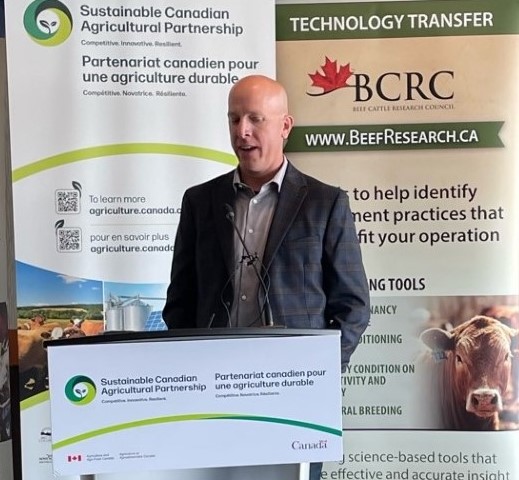
CALGARY, July 12, 2023 – The Beef Cattle Research Council (BCRC) is welcoming more than $12 million in funding from the Government of Canada for Canada’s Beef and Forage AgriScience Cluster under the Sustainable Canadian Agricultural Partnership – AgriScience Program. Francis Drouin, Parliamentary Secretary to the Minister of Agriculture and Agri-Food, made the funding announcement today while attending the Calgary Stampede.
The AgriScience Cluster funding will bolster the Canadian beef sector’s environmental and economic sustainability and resilience as the sector adapts to changing climates and evolving marketplaces. This investment will support sector goals to meet the Government of Canada’s greenhouse gas reduction targets by reducing emission intensity, sequestering additional carbon and maintaining native grasslands in the care of Canadian beef producers.
“The Government of Canada recognizes the importance of Canadian beef,” said Parliamentary Secretary Drouin. “Today’s announcement will help contribute to the continued success of the industry, while keeping it strong and resilient for the future. The results from these innovation, research and technology activities will transform into real results on farms.”
Parliamentary Secretary to the Minister of Agriculture and Agri-FoodFrancis Drouin
BCRC Chair Craig Lehr, Alberta
Alberta beef producer and BCRC Chair Craig Lehr said the results from this AgriScience Cluster will benefit farmers, ranchers, processors, retailers and consumers, as well as the broader Canadian population.
“The demand for beef is expected to grow by 10 percent in the next 10 years and, with one of the lowest environmental footprints for beef production in the world, Canadian producers are well-positioned to responsibly meet growing global beef demand,” Lehr said. “Canada’s Beef and Forage AgriScience Cluster drives research and technology transfer that supports producer profitability with on-farm improvements in things like animal health and performance, feed production and efficient feed use so we can continue to supply high-quality, nutrient-dense protein.”
Canada’s beef industry will contribute more than $9.6 million, primarily through the research allocation of the Canadian Beef Cattle Check-Off, bringing the total AgriScience Cluster investment to more than $21.7 million. BCRC Vice Chair Ron Stevenson, a beef producer from Ontario, said this AgriScience Cluster builds on the success of three previous Beef Science Clusters.
BCRC Vice Chair Ron Stevenson, Ontario
“The Science Clusters recognize the beef sector’s determined leadership and encourage producers in their pursuits of innovation and ingenuity,” Stevenson said. “The Cluster will help the Canadian beef industry realize its tremendous opportunity to increase production and exports while ensuring the maintenance of soil health, water quality, air quality and biodiversity.”
Twenty-three projects will be funded between April 1, 2023, and March 31, 2028, under three themes: climate change and environment; economic growth and development, and sector resilience and societal challenge. The balanced research portfolio, led by respected scientists through collaborative arrangements between academia, government and industry, will work to achieve objectives with the greatest potential to advance the Canadian beef sector. Some projects will explore improved diagnostic tests and vaccines to manage cattle diseases, new forages that can thrive across Canada and food safety technologies in beef processing facilities that reduce water and energy use, while others will develop practical, science-based resources and economic decision-making tools for the industry.
– 30 –
For further information, contact:
Tracy Herbert Extension and Communications Director Beef Cattle Research Council C: 306-850-5026, herbertt@beefresearch.ca
Sharing or reprinting BCRC posts is welcome and encouraged. Please credit the Beef Cattle Research Council, provide the website address, www.BeefResearch.ca, and let us know you have chosen to share the article by emailing us at info@beefresearch.ca.
The BCRC is funded by a portion of the Canadian Beef Cattle Check-Off.
Your questions, comments and suggestions are welcome. Contact us directly or spark a public discussion by posting your thoughts below.
BCRC Announces $2 Million in Funding for 12 Beef Research Projects
Twelve research projects have been awarded a total of $2 million in funding by the Beef Cattle Research Council (BCRC) through the 2022/2023 annual call. Through these projects, the $2 million of industry funding will be leveraged with over $4 million in matching funding through government and industry partners.
BCRC Chair Craig Lehr, Alberta
As an Alberta beef producer, including a backgrounding feedlot and cow-calf operation, BCRC Chair Craig Lehr sees first-hand how applied research improves the productivity and profitability of Canadian beef production.
“We are able to leverage producer dollars from the Canadian Beef Cattle Check-Off to support research that truly matters to the day-to-day management of our herds,” says Lehr. “This is important work. The BCRC not only funds the research but develops practical resources to support producers in making informed decisions to improve profitability, keep Canadian beef competitive and continue our ability to operate with a social license.”
“Research matters. It moves the needle on best practices used across the industry, from animal health and productivity to nutrition, forage and grazing management, soil health, and the list goes on,” says Ron Stevenson, BCRC vice chair and Ontario cow-calf producer, who values industry-funded research not only as producer, but also through his experiences working in the veterinary industry.
“The investment in these projects will lead to outcomes that have an impact, providing tools for farmers and ranchers to continuously improve.”
Projects funded under the 2022/2023 BCRC call include:
The known unknowns – Pulling back the cover on macrolide resistance in feedlots. Project Lead: Dr. Ruzzini, University of Saskatchewan
Does supplementing pregnant cows with protein during winter grazing improve calf health? Project Lead: Dr. Malmuthuge, Agriculture & Agri-Food Canada, Lethbridge
Can genomic tests identify the infectious causes of reproductive losses better than traditional diagnostics? Project Lead: Dr. Huang, Prairie Diagnostic Services Inc.
Boosting calf immunity with early-life management. Project Leads: Dr. Malmuthuge, Agriculture & Agri- Food Canada, Lethbridge and Dr. Erickson, University of Saskatchewan
Turning lemons into lemonade and cattle hide into snacks. Project Leads: Dr. Bruce and Dr. Roy, University of Alberta
Cracking the code on early life management of crossbred dairy-beef calves. Project Lead: Dr. Steele, University of Guelph
Can natural malate production in forages reduce methane emissions in grazing cattle? Project Lead: Dr. Block, Agriculture & Agri- Food Canada, Lacombe
Burn baby burn – Can prescribed fire be a tool for pasture rejuvenation and improved soil health? Project Lead: Dr. Bainard, Agriculture & Agri- Food Canada, Agassiz
Maximizing pasture’s grazing potential by sod-seeding alfalfa mixes. Project Lead: Dr. Lardner, University of Saskatchewan
Testing new forage varieties to improve production and reduce our carbon hoofprint. Project Lead: Dr. Ribeiro, University of Saskatchewan
Forage for climate action – Can grazing perennial forages improve environmental sustainability and animal health? Project Lead: Dr. Poudel, Agriculture & Agri- Food Canada, Lethbridge
Understanding rest-recovery and grazing management for native prairie to improve grassland and animal productivity. Project Lead: Dr. Kelln, University of Saskatchewan
The BCRC is Canada’s national industry-led funding agency for beef, cattle and forage research. The BCRC’s mandate is to determine research and development priorities for the Canadian beef cattle industry and to administer Canadian Beef Cattle Check-Off funds allocated to research. A division of the Canadian Cattle Association, the BCRC is directed by a committee of 15 beef producers from across the country. The BCRC is funded in part through a portion of the Canadian Beef Cattle Check-Off which is then leveraged with government and industry partner funding.
Sharing or reprinting BCRC posts is welcome and encouraged. Please credit the Beef Cattle Research Council, provide the website address, www.BeefResearch.ca, and let us know you have chosen to share the article by emailing us at info@beefresearch.ca.
The BCRC is funded by a portion of the Canadian Beef Cattle Check-Off.
Your questions, comments and suggestions are welcome. Contact us directly or spark a public discussion by posting your thoughts below.
A Year in Review: Results of Industry Investment in Research and Extension
Do you ever wonder how your Canadian Beef Cattle Check-Off research dollars are used? The Beef Cattle Research Council’s 2021-2022 Year in Review highlights how the BCRC and its partners are tackling industry priorities while generating the most value from every research dollar.
This new report is a concise, graphical summary of the latest BCRC Results Report, which is submitted annually to the Canadian Beef Cattle Check-Off Agency. It spotlights the BCRC’s key research and extension projects and outcomes from the fiscal year beginning July 1, 2021, through June 30, 2022.
“While the BCRC is perpetually looking forward, I think it also is beneficial to take a moment to look back, reflect and report on the significant strides that have been made in beef and forage research through producer investments in the Canadian Beef Cattle Check-Off,” said BCRC Executive Director Andrea Brocklebank. ”This report is both a summary and a celebration of our industry’s commitment to effective research, technology transfer and innovation in 2021-2022.”
The 2021-2022 Year in Review reports funding, project spotlights and preliminary findings for:
18 research and extension projects from the current Beef Cattle Industry Science Cluster,
eight priority research projects,
six proof of concept projects and
four knowledge and technology transfer projects.
The report outlines new long-term research capacity through three university research chair positions, four surveillance network projects and updates from the Verified Beef Production Plus (VBP+) program that the BCRC continues to fund and oversee. It also unveils new vision and mission statements developed by the BCRC’s 15-member Council of beef producers from across Canada.
As an Ontario beef cattle producer and Chair of the BCRC, Matt Bowman has a front-row seat to observe how applied research and extension is improving productivity and profitability for Canada’s beef producers. “I am encouraged by the preliminary outcomes of this important work,” he said. “By leveraging producer-paid Canadian Beef Cattle Check-Off dollars and listening to the industry’s needs, the BCRC continually develops practical resources to help farmers and ranchers make informed decisions that improve profitability, reduce risks and enhance consumer confidence in Canadian beef production.”
The 2021-2022 Year in Review provides a broad funding overview, outlining funding by source and by program area. In the past fiscal year, the BCRC received on average $0.67 of every $2.50 of the Canadian Beef Cattle Check-Off collected by provincial beef cattle associations. The funding was leveraged under various programs to maximize producer returns on Check-Off investments.
All of the BCRC’s activities are guided by core principles defined by the beef industry in the renewed Five-Year Canadian Beef Research and Technology Transfer Strategy. The BCRC works closely with other industry and government funding agencies to increase coordination, reduce duplication and ensure priority research outcomes are addressed for the benefit of Canadian beef cattle producers.
Sharing or reprinting BCRC posts is welcome and encouraged. Please credit the Beef Cattle Research Council, provide the website address, www.BeefResearch.ca, and let us know you have chosen to share the article by emailing us at info@beefresearch.ca.
The BCRC is funded by a portion of the Canadian Beef Cattle Check-Off.
Your questions, comments and suggestions are welcome. Contact us directly or spark a public discussion by posting your thoughts below.
Attn Researchers – Genome Alberta and RDAR Soliciting Statements of Interest
Genome Alberta is supporting Results Driven Agriculture Research (RDAR) in identifying innovative projects capable of advancing the application of genomics technology (including other -omics and bioinformatics) for the benefit of Alberta’s agriculture & agri-food sectors.
Up to $750 K per year is available with a 1:1 co-funding requirement from eligible sources. Projects must have a direct impact on Alberta’s agricultural industry (e.g., livestock, crops, food safety), addressing priority areas including but not limited to:
enhance productivity, profitability and competitiveness;
sustainable and responsible agricultural production; and
Genome Alberta is hosting an information session webinar for this funding opportunity on Wednesday, December 8, 2021 at 10 am MST. Additional context will be provided and some common questions for prospective applicants will be addressed. Register here!
Click here tosubscribeto the BCRC Blog and receive email notifications when new content is posted.
The sharing or reprinting of BCRC Blog articles is welcome and encouraged. Please provide acknowledgement to the Beef Cattle Research Council, list the website address, www.BeefResearch.ca, and let us know you chose to share the article by emailing us at info@beefresearch.ca.
We welcome your questions, comments and suggestions. Contact us directly or generate public discussion by posting your thoughts below.
A Year in Review: Outcomes of Your Investments in Canadian Beef Research and Extension
Where exactly are my Canadian Beef Cattle Check-Off funds allocated to research going? How have the circumstances of the past year impacted beef research and extension? What has the Beef Cattle Research Council (BCRC) been up to lately?Answers to these questions and more can be found in the BCRC’s new report.
The 2020-2021 Year in Review provides a visual representation of the BCRC Results Report, which is submitted annually to the Canadian Beef Cattle Check-Off Agency. The new report offers a reader-friendly snapshot of the fiscal year’s activitiesand results.
“So much has happened during the past year – from the COVID-19 pandemic to the drought that impacted cattle producers across much of the country,” said BCRC Executive Director Andrea Brocklebank. “While there has been much uncertainty in the industry in 2020-2021, Canada’s beef producers remain tenacious, researchers have proven to be innovative and the Beef Cattle Research Council is resolute to move forward as a leader in beef research and extension.”
The 2020-2021 Year in Review spotlights a few of the key research and extension projects that were funded during the past year. There were 23 research and extension projects reporting activities between April 2020 and March 2021 through the current Beef Cattle Industry Science Cluster, as well as 25 priority research projects. While most results will be presented upon completion, the new report features a few of the preliminary findings. The BCRC also funded 14 short-termproof of concept projects to gather initial results to help determine the validity of full-scale research trials. A couple promising recent POC projects — high-protein legume and corn intercropping for beef cattle grazing and potential bioprotective agents to improve beef safety and shelf-life — are featured. “I am intrigued by program outcomes and preliminary findings from the research projects underway in 2020-2021,” said Ontario beef cattle producer and BCRC Chair Matt Bowman. “Today’s research will help resolve tomorrow’s challenges, allowing the beef industry to remain sustainable and resilient.”
In addition to funding research, the BCRC plays a leading role in increasing industry uptake of relevant innovations across a broad audience of producers, researchers, funders, government and other industry organizations. The report recaps some of the past year’s Knowledge and Technology Transfer activities and reveals BCRC’s most popular video of 2021.
The BCRC’s 2020-2021 Year in Reviewalso outlines new long-term research capacity through three university research chair positions, four surveillance network projects and updates from the Verified Beef Production Plus (VBP+) that the BCRC continues to fund and oversee.
The report provides a broad funding overview, outlining funding by source and program area. In the 2020-21 fiscal year, the BCRC received on average $0.67 of every $2.50 of the Canadian Beef Cattle Check-Off collected by the provincial beef cattle associations. The funding was leveraged under various programs to maximize producer returns on their Check-Off investments. Typically for every $1 in producer Check-Off invested, BCRC looks to leverage $2-$3 in other direct funding in addition to indirect leverage through in-kind and other funding. Each section of the report highlights examples of how BCRC and its research partners are tackling industry priorities while generating the most value from every research dollar.
Click here tosubscribeto the BCRC Blog and receive email notifications when new content is posted.
The sharing or reprinting of BCRC Blog articles is welcome and encouraged. Please provide acknowledgement to the Beef Cattle Research Council, list the website address, www.BeefResearch.ca, and let us know you chose to share the article by emailing us at info@beefresearch.ca.
We welcome your questions, comments and suggestions. Contact us directly or generate public discussion by posting your thoughts below.
Advancing Innovation in Canada’s Beef Sector with a $14 Million Federal Investment
NEWS RELEASE For immediate release July 11, 2018
Calgary, AB – The Beef Cattle Research Council (BCRC) welcomed today’s announcement of $14 million in funding for the Sustainable Beef and Forage Science Cluster under the Canadian Agricultural Partnership AgriScience Program. Announced by Agriculture and Agri-Food Canada (AAFC) Minister Lawrence MacAulay while attending the Calgary Stampede, the Science Cluster funding will support the sustainable advancement of Canadian beef and forage production and help position the industry as a leader in export and economic development.
Ryan Beierbach, BCRC Chair and Owner and Manager of High Plains Ranch Ltd. near Whitewood, SK, said the results from this Science Cluster will benefit farmers, ranchers, processors, retailers and consumers, as well as the broader Canadian population.
“The Sustainable Beef and Forage Science Cluster aims to grow beef exports and supply growing global beef demand by supporting research and technology transfer that advances Canadian beef and forage production while enhancing industry competitiveness and the public’s trust in responsible production of this high quality, nutrient-dense food.”
Canada’s beef industry will contribute more than $7.6 million to the Science Cluster, primarily through the research allocation of the Canadian Beef Cattle Check-Off, bringing the total investment to more than $21 million. The industry contribution includes a commitment of $1.5 million in in-kind contributions in the form of cattle, equipment, and materials.
BCRC Vice-Chair Matt Bowman, a producer from Thornloe, Ontario, said this Science Cluster builds on the success of the Beef Science Clusters under the Growing Forward and Growing Forward 2 frameworks.
“The BCRC has spent years preparing for this third Cluster through numerous consultations with experts and stakeholders across the country, as well as economic and practical analyses. The Cluster will help the Canadian beef industry realize its tremendous opportunity to increase production and exports while ensuring the maintenance of critical pasturelands that contribute to carbon sequestration, biodiversity, and wildlife habitat.”
Activities will be funded between April 1, 2018 – March 31, 2023 under five themes: beef quality and food safety; animal health, welfare, and antimicrobial use; feed production and efficiency; forage productivity and environmental sustainability; and knowledge and technology transfer. The activities will be carried out through collaborative arrangements between academia, government and industry.
– 30 –
For further information, contact:
Stacey Domolewski Science and Extension Coordinator Beef Cattle Research Council O: (403) 295-5582 C: (403) 635-1847 domolewskis@beefresearch.ca
or
Tracy Herbert Extension and Communications Director Beef Cattle Research Council C: 306-850-5026 herbertt@beefresearch.ca