Make informed decisions for your operation with information delivered right to your inbox.
Get the latest tools, innovations and science-based information for the Canadian beef industry, including seasonal production considerations and economic analyses.
Over the last two decades, great strides have been made in standardizing beef cattle injection techniques and methods. Today, there are animal injection best practices that have become widely known in the beef industry as “just the right thing to do.” These cattle injection techniques are recommended to help farmers produce safe beef for the consumer and maintain Canada’s high reputation for beef quality.
How to Inject a Beef Animal
Securely restrain the animal.
Use the appropriate size and length of needle.
Use the subcutaneous route whenever the product label allows.
Only inject 10 ml (cc) maximum into any one site, or as per label.
Change needles when bent or dull and after every 10-15 uses.
Never straighten or reuse a bent needle.
Leave a hand-width of space between injections.
Never inject in the armpit of the animal (i.e. branding, spring processing).
Source: Verified Beef Production Plus Producer Manual
Route of Administration for Beef Cattle Injections
When label recommendations are followed, a beef animal’s ability to absorb, distribute, break down and excrete a drug are predictable. It is when those label directions are not followed that we run into concerns. There are distinct differences in the rate of absorption of drugs depending on how they are delivered. If a product is given incorrectly, there is no guarantee that the drug will be effective.
Route of Administration (ROA): The route by which a drug is taken into the body (i.e. subcutaneous, intramuscular, oral, intravenous, topical, intranasal).
Incorrect ROA could lead to underdosing, which is an animal welfare and production concern when a therapeutic level may not be achieved. This will leave cattle vulnerable to the disease being treated or prevented. Underdosing is also a concern from an antibiotic stewardship standpoint, as chronically underdosing antimicrobial drugs can lead to resistance.
The ROA also determines a beef animal’s ability to eliminate the product, affecting withdrawal recommendations, and potentially leading to drug residues being detected in meat.
Subcutaneous injections (Sub-Q or SQ) are placed just under the skin, as opposed to an intramuscular injection where the medication is placed directly into the muscle. Subcutaneous injections are generally less irritating and are the preferred ROA.
Pharmaceutical companies are continually updating products and labels, so become familiar with the current label recommendations and use the subcutaneous route whenever possible.
Volume Recommendations for Cattle Injections
The recommended maximum volume per injection site is 10 ml (cc) per site. Increasing the volume of medication injected into one location will impede a beef animal’s ability to absorb and excrete the medication.
An increased volume can lead to a pocket of unabsorbed medication being left in the tissue. This decreases the efficacy of the treatment and could also be detected as drug residue in the carcass of a beef animal.
A lower volume injection also ensures that the tissue can effectively recover from the irritation of the medication, decreasing the chances of the animal developing an injection site lesion.
Injection site lesions (ISL) cost the beef industry $0.56/head or $1.63 million in 2016 compared to $0.21/hd or $662,951 in 2011 due to higher prevalence rates. There are many steps that can be taken to reduce or even eliminate ISL’s.
Proper Location for Beef Cattle Injections
Only inject beef animals in the recommended safe zone on the neck, never in the rump or loin. This ensures that, if an animal has a reaction to the product and develops a lesion, it can easily be trimmed away from the less valuable chuck, rather than damaging the more valuable round cuts.
Injecting outside of the safe zone in the neck can potentially cause injury and even death to the animal being treated. The nuchal ligament is responsible for supporting the head of a beef animal, and if it is damaged via an injection that animal can suffer severe and permanent paralysis. The same result can occur if the spinal cord is inadvertently hit. The jugular furrow contains the jugular vein and carotid artery. If medications are mistakenly injected directly into the bloodstream, animals may suffer severe drug reactions.
A hand-width of space between medication injections will ensure the tissue can adequately recover from the injection and prevent medications from comingling. If medications mix within the animal, they can interact and cause drug reactions, or even inactivate each other, rendering them useless.
Best Needle Size for Beef Cattle Injections
Choose the appropriate needle size to ensure the product can be delivered while causing the minimum disruption to the tissue. Always choose the smallest gauge needle that can still effectively deliver the type of medication needed. Disposable needles with an aluminum hub, rather than plastic, are preferred.
Class of Cattle
Route of Injection
Needle Gauge
Needle Length
Calves less than 500 pounds
Intramuscular
20-18
1 inch
Subcutaneous
20-18
½ – ⅝ inch
Cattle >500 pounds
Intramuscular
18-16
1 – 1½ inch
Subcutaneous
18-16
½ – ¾ inch
Good Hygiene Methods for Cattle Injections
Keep equipment clean and in good working order to prevent unnecessary tissue trauma and the possibility of localized abscesses.
Never inject through a dirty hide, which will only drag bacteria and debris into the tissue and create a perfect environment for abscesses.
Burred, bent and dull needles will also increase the likelihood of damage and abscessing. This can be prevented by using a quality disposable needle that can be changed anytime damage is evident, every 10-15 injections and every time you enter a multidose vial.
Safe Restraint for Cattle Injections
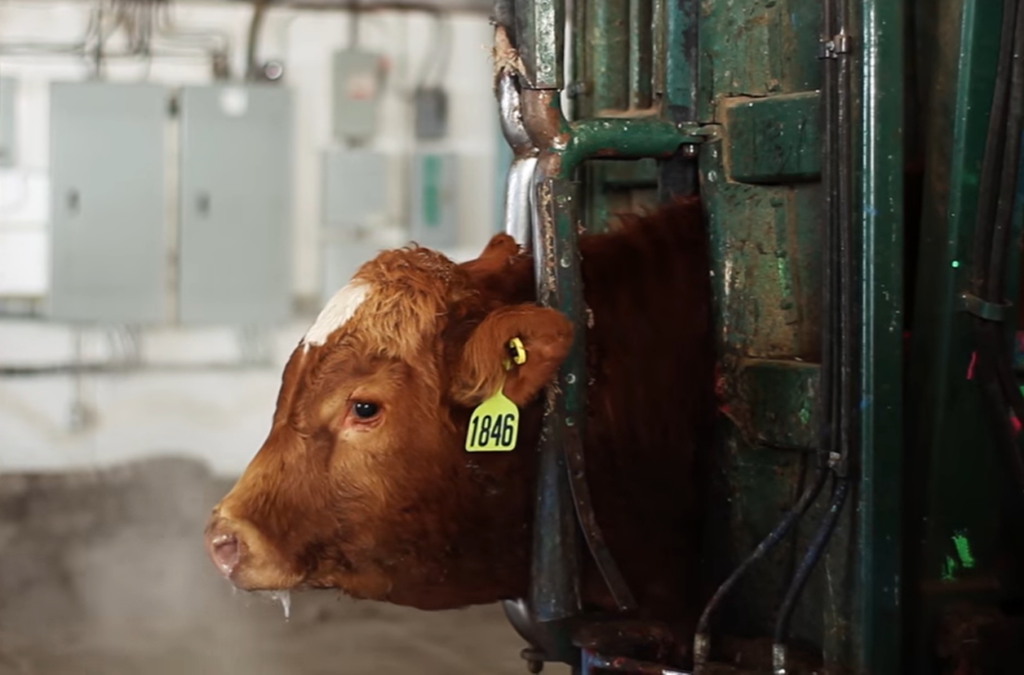
Cattle that are not properly restrained are more likely to suffer from tissue trauma, incorrect injection technique and location, and are at a higher risk for needle breaks. Ensure that all animals being treated are safely restrained in a chute that allows the processor easy access to the neck and prevents unnecessary movement in the animal being treated.
A little knowledge goes a long way, and understanding the reasoning behind each recommendation can help instill accountability and ensure producers are diligent in the day-to-day tasks involved in raising cattle for food. Little things done right every day safeguard food quality and ensure Canadian food safety remains at a high standard.
Sharing or reprinting BCRC posts is welcome and encouraged. Please credit the Beef Cattle Research Council, provide the website address, www.BeefResearch.ca, and let us know you have chosen to share the article by emailing us at info@beefresearch.ca.
The BCRC is funded by a portion of the Canadian Beef Cattle Check-Off.
Your questions, comments and suggestions are welcome. Contact us directly or spark a public discussion by posting your thoughts below.
Remote Drug Delivery Devices -- What You Need to Know 🎙️▶️
This post is written by Dr. Roy Lewis, a veterinarian in Alberta.
Cattle producers and their veterinarians see the need for remote drug delivery devices (RDDDs) when animals can’t be caught or there is severe risk to the handler, and timing of treatment is critical for a favourable outcome.
When a worked-up bull is in the bush a long way from any handling facility and needs medication, it is less stressful on the bull and safer for the handler to dart it. When dealing with younger stock, it may depend on the roping ability of the producer or the amount of open terrain as to whether darting or another method of treatment gets chosen. There is an advantage to treating young calves with pneumonia by darting because it is less stressful than handling those calves. With contagious diseases, darting may be appropriate because gathering a group of animals together increases the risk of spreading the disease, like a case of pinkeye in one animal for example.
RDDDs have evolved from the pole syringe to the long bow, the crossbow and finally to the dart gun. Most new purchases of equipment by cattle producers for remote drug delivery are dart guns. Through a veterinary-client-patient-relationship (VCPR) with a prescription for extra label use, dart guns are primarily used by cattle producers to deliver antimicrobials.
A recent survey in Western Canada found producers and many veterinarians agree RDDD use is their third choice when treatment is necessary; their first choice is to use a handling facility, followed by roping or using a calf hook. The survey also found producers and veterinarians agree on the importance of using the devices properly and closely following proper injection techniques. Survey respondents indicated that the most common products they use in RDDDs are the low-volume macrolides, some of which have pneumonia, foot rot and pinkeye on the label.
Dart guns have pros and cons. Concerns include their accuracy in delivering the proper dosage through the proper route of administration.1,2
The Beef Cattle Research Council (BCRC) has developed resources to help with decisions on RDDD use to stay within beef quality guidelines while being safe and avoiding any drug residues. Resources for producers, available at www.BeefResearch.ca/RDDD, include a five-minute video, decision tree and a review of drug delivery best practices.
Click here to download a one-page PDF for beef producers featuring best practices for remote drug delivery.
For veterinary clinics, the webpage also includes information about printed copies of a best practices brochure and a QR code that leads to RDD resources for use on printed drug labels.
The BCRC’s RDDD decision tree provides guidance on whether to treat the animal and when it’s appropriate to use a RDDD versus a handling facility. You may do this intuitively, but it is always good to conscientiously think about the dos and don’ts when considering using the dart gun. Stick to beef quality guidelines and be sure to have an accurate diagnosis for prudent usage of antimicrobials.
One of the most overtreated things in cattle production is lameness caused by foot rot. There is no doubt foot rot is very responsive to antibiotics, but most times lameness is not actually foot rot, so we all need to be very conscious of that.
By adhering to proper dart selection, needle size and dosage, the product should be administered correctly. In reviewing Canadian sales, over 95% of the darts are half-inch needles for subcutaneous usage. The ¾-inch may be used for subcutaneous in large bulls. That tells me everyone is trying to give products subcutaneously as that is what the label is stating.
Veterinary clinics can share these RDDD resources with beef clients by using this QR code on prescription labels.
Use the targets supplied with the gun and make sure you have got that down pat before attempting your first darting of an animal. If accuracy is good, you don’t get too far away (4-9 meters or 13-30 feet) and only shoot when animals are stationary, your accuracy in the side of the neck can be very good, especially when using the guns with scopes. It is felt that about 200 lbs should be the minimum-sized animal to dart, as the target is very small and the dart could cause damage in smaller animals.
The darts are getting better at full discharge and administering the product subcutaneously if the right length needle is selected. The goal is to try and give the product the same way as we would in a squeeze chute or if the animal was caught.
When two darts are necessary, one could use the other side of the neck to make sure the shots are spread apart much as one often uses both sides of the neck if a calf is treated in the chute. Even though we are delivering the drug with a RDDD, we want to adhere to the same principles we do when delivering drugs by normal injection.
To mitigate risks with specific drugs, there are a couple products toavoid using in RDDDs:
Tilmicosin should never be used in an RDDD because of human safety concerns, and
a product like Excede should never be administered remotely because it needs to be given behind the ear.
It should be noted that all pharmaceutical companies that make these products have been very strong advocates for them NOT to be used in any RDDD device.
Just like with any treatment, record-keeping is necessary. Also, try to recover any dispelled darts and dispose of them in a sharps container as you would any sharps used in cattle production. Discuss the right approach with your veterinarian for any medical or preventative procedure you are doing with your cattle.
Producing quality, wholesome and safe meat should be everyone’s goal. Darting for treatment is a last option and should be pretty infrequent, but if you utilize RDD, do so following the guidelines as close as possible.
1. Coetzee, JF, et al. Pneumatic dart delivery of tulathromycin in calves results in lower antimicrobial concentrations and increased biomarkers of stress and injection site inflammation compared with subcutaneous injection. J Anim Sci. 2018 Jul 28;96(8):3089-3101. Available here.
2. Rivera, JD, et al. Pharmacokinetics of tulathromycin following administration to stocker cattle with remote delivery devices. J Anim Sci. 2019 Nov 4;97(11):4482-4487. Available here.
.
Sharing or reprinting BCRC posts is welcome and encouraged. Please credit the Beef Cattle Research Council, provide the website address, www.BeefResearch.ca, and let us know you have chosen to share the article by emailing us at info@beefresearch.ca.
The BCRC is funded by a portion of the Canadian Beef Cattle Check-Off.
Your questions, comments and suggestions are welcome. Contact us directly or spark a public discussion by posting your thoughts below.