Prenez des décisions éclairées pour votre opération avec des informations livrées directement dans votre boîte de réception.
Obtenez les derniers outils, innovations et informations scientifiques pour l'industrie canadienne du bœuf, y compris des considérations sur la production saisonnière et des analyses économiques.
Restez informé des dernières nouvelles, mises à jour et informations du Beef Cattle Research Council.
Optimiser les performances des veaux : quelle place occupent les implants dans une exploitation vache-veau ?
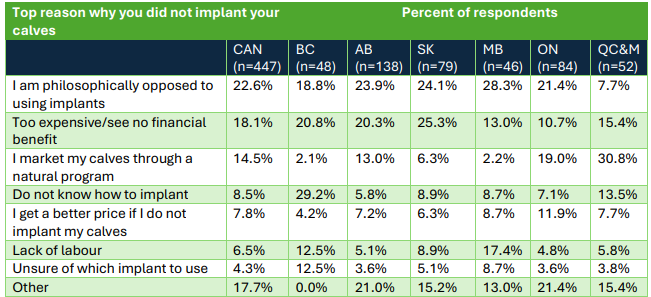
Les implants de croissance comptent parmi les technologies les plus étudiées et les plus rentables de l’industrie du bœuf ; pourtant, leur adoption dans les exploitations vache-veau canadiennes reste faible, bien qu’ils offrent des performances et des avantages économiques similaires à ceux observés chez les bovins en semi-finition et en parc d’engraissement. Les questions relatives à la main-d’œuvre, aux aspects économiques, à la santé animale et à la confiance concernant la procédure d’implantation influencent souvent la décision (figure 1).
Figure 1. Principales raisons de ne pas poser d’implant chez les veaux, par province
Ces questions ont été au centre d’un récent webinaire du Conseil de recherche sur les bovins de boucherie intitulé « Implanter ou ne pas implanter ? Ce que les producteurs vache-veau doivent savoir », auquel ont participé la Dre Lauren Younker, de TELUS Agriculture, et Betty Green, productrice de bovins de boucherie du Manitoba au G7 Ranch. Les discussions ont mêlé recherche, conseils pratiques et expériences concrètes afin d’aider les producteurs à déterminer si les implants sont adaptés à leur exploitation.
Que sont les implants de croissance ?
Les implants de croissance sont de petites pastilles contenant des hormones, placés juste sous la peau, derrière l’oreille de l’animal. Les composés qu’ils libèrent imitent les hormones naturelles et favorisent la croissance musculaire maigre ainsi qu’une meilleure efficience alimentaire. Il n’y a pas de délai d’attente, car les oreilles sont toujours retirées au moment de la transformation et ne pénètrent jamais dans le système alimentaire.
En expliquant comment les implants fonctionnent dans les systèmes basés sur le pâturage, la Dre Younker a souligné que ceux-ci aident les bovins à mieux profiter des nutriments qu’ils consomment déjà.
Elle a également souligné que les implants ne remplacent pas les bonnes pratiques de gestion et qu’ils constituent un outil à utiliser en complément de programmes de vaccination adéquats, de protocoles de biosécurité et d’une nutrition équilibrée.
« Essentiellement, ça aide vos veaux à utiliser les nutriments qu’ils consomment dans les pâturages pour se transformer en viande plus maigre et peser plus lourd pour vous, en tant que producteur, au moment du sevrage. » — Dre Lauren Younker
Comprendre les différents types d’implants
Tous les implants de croissance ne se valent pas. Il existe trois principaux composés hormonaux utilisés dans les implants, chacun présentant une puissance et un moment d’application idéal différents :
Progestatifs : progestérone synthétique, considérée comme la moins puissante et produisant des effets plus subtils. Ils sont souvent utilisés chez les veaux allaitants.
Œstrogènes : imitent les œstrogènes naturels et sont considérés comme des implants de puissance moyenne.
Androgènes : imitent la testostérone et ont la puissance la plus élevée. Ils sont plus efficaces lorsqu’ils sont associés à des rations à haute teneur énergétique et sont souvent utilisés en semi-finition ou en finition en parc d’engraissement.
Compte tenu de ces différences, la Dre Younker encourage les producteurs de bœuf intéressés à utiliser des implants à discuter des différentes options avec leur vétérinaire et à adapter le choix de l’implant au stade de production.
« La plupart des producteurs vache-veau implantent leurs animaux au moment du marquage, en utilisant soit un implant de type progestatif ou œstrogénique », a-t-elle déclaré, ajoutant que les implants androgéniques sont à réserver de préférence aux stades de production plus avancés, lorsque l’apport énergétique de l’animal est plus élevé.
Les aspects économiques de l’implantation
L’un des meilleurs arguments en faveur des implants est le rendement du capital investi (RCI). Les implants peuvent augmenter le gain moyen quotidien (GMQ) de 10 à 30 %, tout en améliorant l’efficience alimentaire de 5 à 15 %.
« Dans le monde des parcs d’engraissement, mais aussi dans celui de l’élevage vache-veau, nous considérons toujours les implants comme l’un des investissements ayant le meilleur rendement » a déclaré la Dre Younker, ajoutant qu’« ils constituent la source de profit la plus constante qui soit ».
Pour les producteurs vache-veau, cette amélioration des performances se traduit généralement par des veaux plus lourds au sevrage, sans augmentation significative des coûts.
Outre les avantages économiques, des recherches de l’Université du Manitoba ont montré que l’utilisation d’implants entraînait une réduction de 3 à 10 % des émissions de gaz à effet de serre, une réduction de 5 à 11 % de l’utilisation des terres, une réduction de 5 à 11 % de la consommation d’eau et une réduction de 3 à 8 % des émissions d’ammoniac.
What Makes Implants Work and What Doesn’t
Ce qui fait que les implants fonctionnent ou qu’ils ne fonctionnent pas
Des veaux en bonne santé
Une nutrition adéquate
Un stress minimal
Un choix du moment et une technique appropriés
« Les bovins bénéficiant d’un meilleur niveau de nutrition réagiront mieux à cet implant. »
— Dre Lauren Younker
Un placement correct est essentiel car une mauvaise technique d’implantation peut réduire l’efficacité et affecter le bien-être des animaux.
Les étapes d’implantation adéquates sont les suivantes :
Préparez-vous avant de commencer en lisant les instructions figurant sur l’étiquette, vous procurant les produits appropriés et vous familiarisant avec l’applicateur d’implantation.
Immobilisez correctement le veau.
Inspectez l’oreille pour vous assurer qu’il n’y a pas déjà d’implant et que la surface de l’oreille est propre.
Essuyez ou lavez-vous les mains si elles sont sales avant de manipuler l’applicateur.
Essuyez l’aiguille avec une éponge pour la désinfecter.
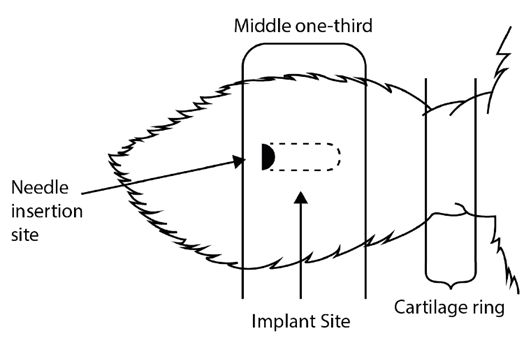
Pincez le haut de l’oreille du veau entre votre index et votre pouce. Placez l’applicateur contre l’oreille en formant un léger angle, le côté biseauté vers le haut.
Insérez l’aiguille à angle plat et faites-la glisser complètement dans l’oreille, entre la peau et le cartilage.
Retirez l’aiguille de l’oreille (sur une longueur environ équivalente à celle de l’implant).
Appuyez sur la gâchette pour injecter l’implant, puis retirez complètement l’aiguille.
Palpez le site d’implantation pour vous assurer que la pastille est correctement insérée.
Nettoyez l’aiguille en la trempant dans une solution de chlorhexidine.
Implantation chez les génisses : réponse aux préoccupations liées à la fertilité
Malgré certaines préoccupations, les génisses qui sont ou pourraient devenir des animaux de relève peuvent recevoir des implants en toute sécurité, sans impact significatif sur le taux de conception ou la facilité de mise bas, à condition qu’elles ne soient implantées qu’une seule fois dans le délai recommandé par l’étiquette (généralement au moins 45 jours) et jamais après le sevrage.
Les génisses implantées à la naissance, à plusieurs reprises avant le sevrage ou après le sevrage ont présenté des taux de conception nettement inférieurs à ceux des génisses non implantées et des génisses implantées une seule fois avant le sevrage.
La perspective d’une éleveuse sur les implants de croissance : G7 Ranch
Betty Green, copropriétaire et exploitante du G7 Ranch au Manitoba, utilise des implants dans son exploitation depuis plus de 30 ans. Elle souligne que « la constance dans les procédures d’implantation et le souci du détail sont essentiels pour garantir à la fois le bien-être des animaux et l’obtention de bons résultats en termes de performance ». Son expérience renforce l’idée que les implants donnent les meilleurs résultats lorsqu’ils s’inscrivent dans un système de gestion plus large afin d’atteindre les objectifs de production.
Prendre une décision éclairée concernant les implants de croissance
La pertinence des implants dans une exploitation vache-veau dépend des objectifs individuels, de la main-d’œuvre disponible, des stratégies de commercialisation et du niveau d’aisance personnel avec cette pratique. Comme l’ont souligné la Dre Younker et Betty Green, les implants ne constituent qu’un outil parmi d’autres et devraient être évalués dans le cadre de la gestion globale du troupeau.
Le partage ou la réimpression des publications du BCRC sont les bienvenus et sont encouragés. Veuillez mentionner le Beef Cattle Research Council, fournir l’adresse du site Web, www.BeefResearch.ca/fr, et nous faire savoir que vous avez choisi de partager l’article en nous envoyant un courriel à info@beefresearch.ca.
Le BCRC est financé par une partie du prélèvement national sur les bovins de boucherie.
Vos questions, commentaires et suggestions sont les bienvenus. Contactez-nous directement ou lancez une discussion publique en publiant vos idées ci-dessous.