Bœuf tendre, coupes budgétaires dures 🎙️
CLIQUEZ SUR LE BOUTON « PLAY » POUR ÉCOUTER CET ÉPISODE (article offert en anglais seulement):
Écoutez d’autres épisodes sur BeefResearch.ca, Spotify, Apple Podcasts, Amazon Music ou Podbean.
Cet article rédigé par le Dr Reynold Bergen, directeur scientifique du BCRC, a été initialement publié dans le numéro de mai 2026 du magazine Canadian Cattlemen et est reproduit sur BeefResearch.ca avec la permission de l’éditeur.
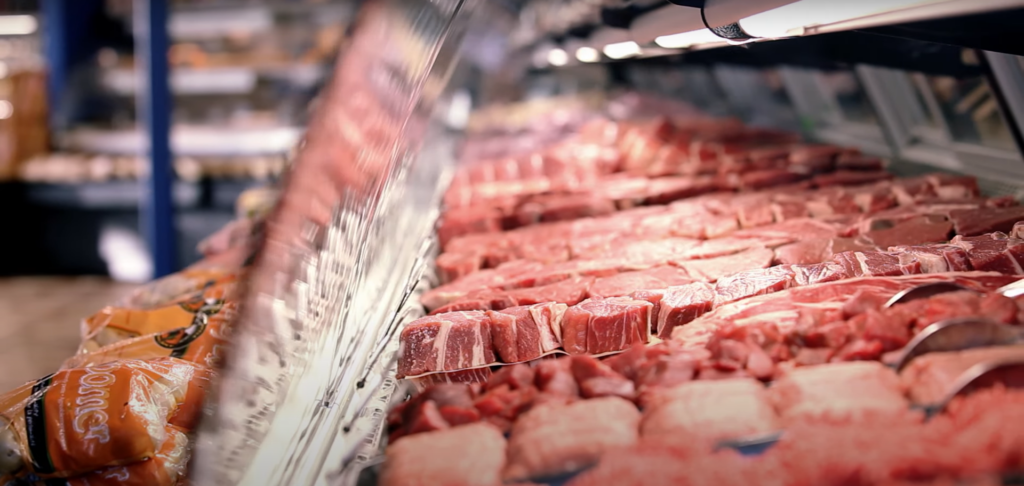
Les biftecks de faux-filet ou de contre-filet sont presque toujours les protéines les plus chères en magasin ou au menu ; il est donc essentiel que ces coupes de grande valeur offrent au consommateur une expérience de consommation excellente et constante à chaque fois. Les catégories de qualité du bœuf canadien (A, AA, AAA et Prime) sont basées sur le persillage. La cote de persillage est un moyen rapide, facile et peu coûteux d’estimer la quantité de graisse intramusculaire présente dans le muscle du faux-filet lui-même.
En règle générale, plus le persillage est élevé, plus le bifteck sera juteux et tendre. Cependant, une cote de persillage élevée ne suffit pas à elle seule à garantir une expérience de consommation exceptionnelle : de nombreux autres facteurs, tels que les caractéristiques de la structure protéique et la teneur en collagène, influencent également la tendreté du bœuf. Le problème est que mesurer directement la tendreté du bœuf signifie sacrifier un bifteck afin qu’il puisse être cuit et soumis à des mesures de « force de cisaillement » en laboratoire, ou présenté à un panel de goûteurs experts. Ces options sont trop coûteuses, trop gruge-temps et trop peu pratiques pour être utilisées dans la pratique commerciale.
Une nouvelle option pour évaluer la tendreté du bœuf pourrait provenir du domaine de la médecine contre le cancer. Le scalpel intelligent (iKnife) utilise un laser pour exciser les tumeurs. Il ressemble à un kit de pyrogravure relié à un long tube mince menant à un appareil d’analyse. À mesure que le scalpel intelligent découpe autour d’une tumeur, la « fumée » s’échappe par le tube vers un spectromètre de masse à ionisation par évaporation rapide (REIMS) qui évalue les types de tissus traversés. Si des cellules cancéreuses sont détectées, l’incision doit être élargie afin de s’assurer que la totalité de la tumeur est retirée. Cette technologie pourrait également permettre d’analyser les gaz d’échappement pour identifier des marqueurs protéiques individuels liés à la dureté ou à la tendreté du bœuf. La très bonne nouvelle, c’est que la technologie iKnife est rapide, peut être utilisée sur du bœuf cru et ne laisse que de petites traces de brûlure sur le bifteck — qui reste toutefois entièrement comestible par la suite.
Une équipe de recherche dirigée par Jerrad Legako, de l’université Texas Tech et des universités de Guelph, d’Alberta et d’État de l’Ohio a collaboré avec Cargill afin de déterminer si la technologie REIMS pouvait potentiellement évaluer la tendreté des biftecks à la vitesse de la chaîne de production (Evaluation of rapid evaporative ionization mass spectrometry (REIMS) for the prediction of slice shear force and quality grades in beef longissimus lumborum steaks et Evaluation of rapid evaporative ionization mass spectrometry (REIMS) relationships with biochemical markers of tenderness in beef longissimus lumborum steaks).
Ce qu’ils ont fait
L’équipe a collecté 1 497 biftecks de contre-filet de catégorie AA et 1 356 de catégorie AAA provenant d’usines de conditionnement situées en Alberta et en Ontario. Chaque bifteck a été utilisé pour des tests iKnife et REIMS (à l’état cru) ainsi que pour des tests de force de cisaillement (après cuisson). Des échantillons biochimiques ont été prélevés sur un sous-ensemble de biftecks avant leur cuisson.
Ce qu’ils ont appris
Les biftecks AAA sont-ils plus tendres que les biftecks AA ? Oui. Les tests de force de cisaillement ont montré qu’un bifteck AAA moyen était plus tendre qu’un bifteck AA moyen. Mais il existait un chevauchement considérable entre les deux catégories. De nombreux biftecks AAA étaient plus durs que certains biftecks AA, et plusieurs biftecks AA étaient plus tendres que certains biftecks AAA. Le persillage ne garantit pas la tendreté.
La méthode REIMS peut-elle distinguer les biftecks tendres des biftecks durs ? Oui. Lorsque les biftecks ont été répartis, d’après leurs mesures de force de cisaillement, dans les catégories « extrêmement durs », « durs », « moyens », « tendres » et « très tendres », les résultats obtenus par la méthode REIMS ont permis de classer correctement plus de 99 % des biftecks appartenant aux catégories « durs » et « extrêmement durs ».
Que mesure la méthode REIMS ? Certains des métabolites détectés dans les gaz évacués sont reconnus comme étant étroitement associés à la tendreté du bœuf. Par exemple, la longueur des sarcomères permet de mesurer le degré de contraction ou de relâchement d’un muscle. Des sarcomères plus courts, donc plus contractés, donnent une viande plus dure. Certains signaux obtenus par la méthode REIMS étaient étroitement associés à la longueur des sarcomères. D’autres étaient associés à la teneur en collagène (tissu conjonctif), tandis que d’autres encore étaient liés à des formes de protéines musculaires libérées au cours de la maturation de la viande, à mesure que celle-ci s’attendrit. Cela laisse entendre que les signaux mesurés par la technologie REIMS ne sont pas aléatoires : ils sont systématiquement associés à des facteurs reconnus comme étant liés à la qualité gustative du bœuf. Cette technologie semble donc très prometteuse. À terme, elle pourrait permettre d’intégrer une évaluation de la tendreté au système canadien de classement du bœuf.
Le BCRC a financé ces travaux de recherche aux États-Unis parce que la technologie REIMS n’était pas disponible au Canada. La récente fermeture, par le gouvernement fédéral, du centre de recherche de Lacombe a créé une importante lacune dans la recherche canadienne sur la qualité du bœuf et la salubrité alimentaire. Comme il n’existe plus au Canada de programme actif de recherche sur les carcasses de bovins, nous devrons nous appuyer sur des travaux réalisés à l’étranger, qui ne seront peut-être pas entièrement pertinents pour notre système. L’industrie canadienne du bœuf déploie d’importants efforts pour préserver l’expertise, l’équipement et les données du centre de Lacombe et rétablir cette capacité de recherche dans une université canadienne.
Qu’est-ce que cela signifie pour vous ?
Les éleveurs et les transformateurs de boeuf canadiens font concurrence au bœuf importé sur le marché canadien et au bœuf provenant d’autres pays sur les marchés d’exportation. Investir dans la recherche afin d’améliorer continuellement la qualité gustative du bœuf canadien renforce la confiance des consommateurs et la compétitivité internationale de notre industrie.
Conclusion
Trouver des moyens de démontrer que le bœuf canadien offre de façon constante une excellente qualité gustative contribue à renforcer notre réputation auprès des consommateurs d’ici et d’ailleurs. Notre industrie dépend de la volonté continue des consommateurs d’acheter du bœuf. Lorsqu’ils paient le prix fort pour un bifteck de qualité supérieure, ils sont en droit d’obtenir la qualité attendue, et notre industrie ne peut se permettre de les décevoir.
Le Beef Cattle Research Council est une organisation industrielle à but non lucratif financée par le Prélèvement national sur les bovins de boucherie. Le BCRC s’associe à Agriculture et Agroalimentaire Canada, aux groupes provinciaux de l’industrie bovine et aux gouvernements afin de faire progresser le transfert de la recherche et de la technologie à l’appui de la vision de l’Industrie canadienne du bœuf, qui est d’être reconnue comme un fournisseur privilégié de bœuf, de bovins et de génétique sains et de haute qualité. Apprenez-en davantage sur le BCRC sur le site www.beefresearch.ca/fr.
Le partage ou la réimpression des articles du www.BeefResearch.ca/fr est généralement bienvenu et encouragé, mais cet article nécessite l’autorisation de l’éditeur d’origine.
Le BCRC est financé par une partie du prélèvement national sur les bovins de boucherie.

Vos questions, commentaires et suggestions sont les bienvenus. Contactez-nous directement ou suscitez un dialogue public en publiant vos réflexions ci-dessous.