L'hiver semble s'annoncer long et froid 🎙️
CLIQUEZ SUR LE BOUTON « PLAY » POUR ÉCOUTER CET ÉPISODE (article offert en anglais seulement):
Écoutez d’autres épisodes sur BeefResearch.ca, Spotify, Apple Podcasts, Amazon Music ou Podbean.
Cet article rédigé par le Dr Reynold Bergen, directeur scientifique du BCRC, a été initialement publié dans le numéro de juin 2026 du magazine Canadian Cattlemen et est reproduit sur BeefResearch.ca avec la permission de l’éditeur.
Voici une mise à jour de la chronique d’août 2022 intitulée « Alfalfa for Canada’s Climate ».
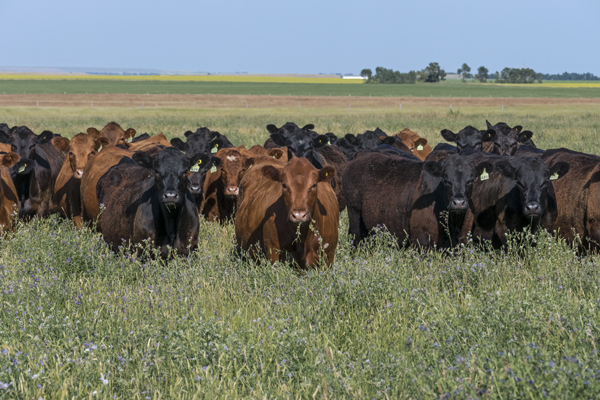
Les légumineuses constituent le moyen le plus économique pour les éleveurs d’augmenter la productivité des pâturages et des bovins (à condition que le risque de ballonnement soit géré en utilisant des espèces ou des variétés à faible risque de ballonnement, des agents anti-ballonnement, en ajustant les horaires de pâturage ou en recourant à des peuplements mixtes de légumineuses et de graminées). La luzerne a fait l’objet de la plupart des efforts de sélection et est la légumineuse la plus courante et la plus productive qui soit. Les producteurs de bovins canadiens ont besoin d’une luzerne résistante à l’hiver qui offre un bon rendement et supporte la pression de pâturage. Il est difficile de réunir ces trois caractéristiques dans une même variété.
Tout commence à se préparer pour l’hiver à l’approche de l’automne et à mesure que les journées raccourcissent. Les écureuils font des réserves de noisettes. Les ours se gavent de baies. Les veaux sont sevrés, les provisions et la qualité des aliments pour animaux sont évaluées, et les vaches et génisses gestantes sont réparties en groupes d’alimentation hivernale en fonction de leur âge et de leur note d’état corporel. Mon beau-père fait appel à nous pour l’aider à fendre et à transporter le bois de chauffage jusqu’à la remise à bois. Toutes ces activités visent à garantir que nous disposions de suffisamment d’énergie pour passer l’hiver et le début du printemps.
La luzerne fait de même. À l’approche de l’automne, elle entre en dormance. Elle passe alors de la photosynthèse, qui alimente la croissance du fourrage en surface, au stockage de sucres dans ses racines. Les indices de dormance vont de 1 à 11 et indiquent l’ampleur de la repousse automnale à laquelle on peut s’attendre. Les variétés présentant un indice de dormance automnale plus faible (plus dormantes) repoussent moins que celles dont l’indice est plus élevé (reprise de croissance plus importante). La dormance automnale favorise la survie hivernale mais réduit le rendement fourrager.
Les cotes de survie à l’hiver vont de 1 (extrêmement résistante au froid) à 6 (non résistante au froid). La tolérance au pâturage joue également un rôle à cet égard. Le pâturage de la luzerne pendant la période critique d’adaptation automnale prive la plante des feuilles qui assurent la photosynthèse et permettent de reconstituer les réserves énergétiques hivernales du système racinaire.
Depuis plus de 30 ans, Agriculture et Agroalimentaire Canada (AAC) sélectionne la luzerne afin d’améliorer sa survie à l’hiver. Une équipe dirigée par Vern Baron (Lacombe) et Annie Claessens (Québec) a présenté un résumé de ses derniers progrès lors d’une conférence scientifique l’année dernière (Winter Hardiness, Dormancy and Grazing Tolerance in Alfalfa Populations Suitable for Northern Climates).
Ce qu’ils ont fait
Ils ont étudié 25 variétés différentes de luzerne canadienne à fleurs jaunes et violettes présentant un indice de dormance automnale inférieur à 3 (très dormante). Il s’agissait de variétés établies, de cultivars en cours de développement et de souches spécifiques prélevées dans des pâturages ensemencés il y a plusieurs décennies. Ils ont évalué les relations génétiques entre ces luzernes. Ils ont établi des parcelles à Normandin, au Québec, et à Lacombe, en Alberta, en 2016, puis ont évalué la dormance automnale et la survie hivernale de 2017 à 2019. Dix-huit variétés de luzerne ont été semées en 2019 et 2020 pour des essais de pâturage à Lacombe. Elles ont été pâturées de 2021 à 2023, et le rendement fourrager ainsi que la survie ont été évalués en 2024.
Ce qu’ils ont appris
Relations génétiques. Les variétés de luzerne à fleurs jaunes et à racines traçantes et les variétés violettes à racine pivotante appartenaient à deux groupes génétiquement distincts. Les luzernes jaunes se répartissaient en deux groupes génétiques selon qu’elles étaient diploïdes (deux jeux de chromosomes) ou tétraploïdes (quatre jeux de chromosomes). Les variétés violettes étaient toutes tétraploïdes, mais regroupées en trois groupes génétiques correspondant à de légères différences dans les indices de dormance automnale (reprise de croissance).
Le taux de survie hivernale, tous types génétiques confondus, était plus élevé à Lacombe (75 à 95 % de survie après trois ans) qu’à Normandin (66 à 81 %). À Lacombe, le taux de survie avait tendance à être plus faible chez les groupes les moins dormants (92 % de survie en 2017, 78 % en 2018, 75 % en 2019) que chez le groupe le plus dormant de luzernes violettes (95, 93 et 91 %). La luzerne jaune diploïde présentait généralement un taux de survie plus élevé (96, 96 et 95 %) que la luzerne jaune tétraploïde (98, 88 et 83 %). À Normandin, la survie hivernale ne différait pas entre les luzernes violettes en 2017 (96 à 99 %) ni en 2018 (88 à 96 %), mais le groupe le moins dormant avait tendance à présenter un taux de survie plus faible en 2019 (66 % contre 73 à 77 %). La luzerne jaune diploïde et tétraploïde présentaient des taux de survie identiques (98 % en 2017, 93 % en 2018, 81 % en 2019).
Dormance automnale. Bien que les 25 variétés aient toutes été classées comme présentant une dormance très élevée, les différents groupes génétiques avaient tendance à présenter des différences en termes de repousse automnale. Ce phénomène était lié à la survie hivernale : les rendements diminuent lorsque moins de plantes survivent. Parmi les luzernes à fleurs violettes, le rendement de repousse avait tendance à être plus faible dans les groupes présentant des indices de dormance automnale plus bas, comme on pouvait s’y attendre. Parmi les luzernes à fleurs jaunes, le groupe diploïde était plus dormant (moins de repousse) que le groupe tétraploïde. Les tendances étaient similaires entre les variétés Lacombe et Normandin. Dans l’ensemble, l’éventail des indices de dormance automnale se recoupait entre les luzernes à fleurs violettes (1,0 à 2,3) et celles à fleurs jaunes (0,9 à 2,4).
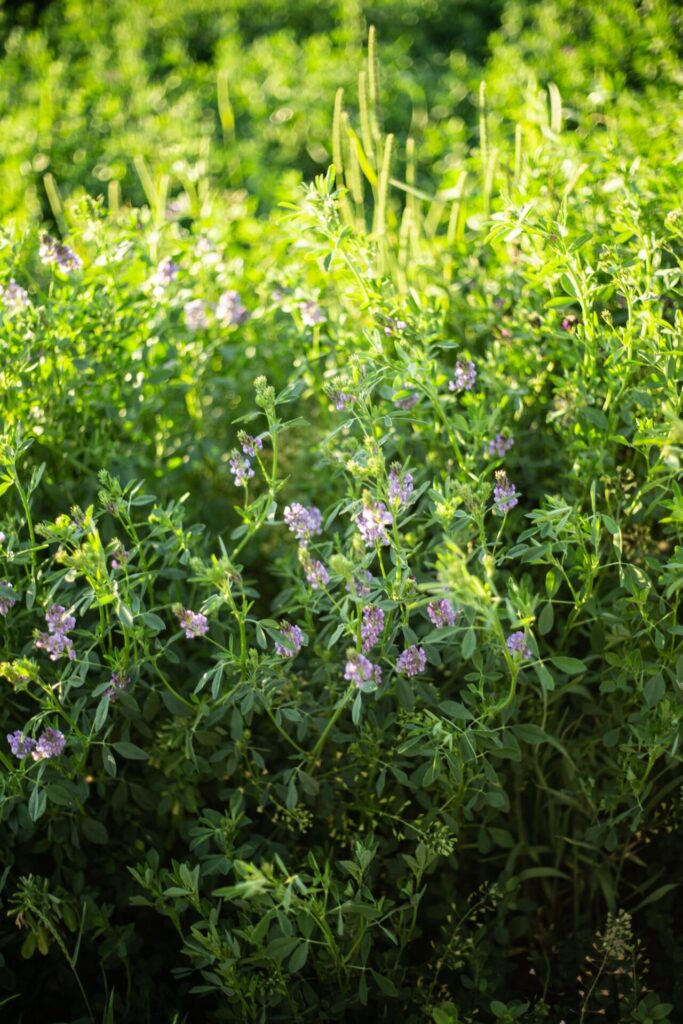
Le rendement et la tolérance au pâturage ont été évalués pour 11 cultivars/populations distincts. Deux variétés de luzerne présentaient à la fois le rendement le plus élevé et la meilleure tolérance au pâturage. Il s’agissait toutefois de plantes très différentes. La variété Yellowhead est une luzerne tétraploïde à racines traçantes et à fleurs jaunes. L’autre était une souche à racine pivotante et à fleurs violettes qui poussait dans un champ du nord-ouest de l’Alberta. On considère souvent que les luzernes à fleurs jaunes sont mieux adaptées aux climats nordiques, mais ce n’est pas toujours le cas.
Des recherches supplémentaires sont nécessaires pour continuer à évaluer les variétés prometteuses en termes de dormance automnale, de tolérance au pâturage et de survie hivernale, pour comparer ces luzernes aux variétés disponibles sur le marché, pour déterminer si elles peuvent rivaliser dans des peuplements mixtes de graminées et pour analyser leurs performances dans différentes régions, etc.
Qu’est-ce que cela signifie pour vous ?
Ce projet n’a pas été mené à terme, mais il est désormais terminé. En janvier, AAC a supprimé les stations de recherche de la ville de Québec et de Lacombe, ainsi que leurs programmes consacrés aux fourrages et ces équipes de recherche.
En bref
L’Agence canadienne d’inspection des aliments (ACIA) a homologué 31 nouvelles variétés de luzerne au Canada depuis 2022, mais celles-ci ont toutes été mises au point aux États-Unis, dans des régions situées entre 312 et 1 200 km au sud de Normandin et entre 715 et 1 611 km au sud de Lacombe. Ces variétés n’ont pas été testées dans le cadre de cette étude, mais elles n’auraient peut-être pas donné de bons résultats aussi loin au nord. Les grandes sociétés multinationales de sélection végétale concentrent leurs efforts de sélection sur leurs plus grands marchés, et non sur le développement de variétés à haut rendement et résistantes à l’hiver destinées à de petits marchés régionaux comme le Canada. Si ces chercheurs d’AAC ne sont pas réaffectés, le programme de développement de variétés fourragères pérennes de l’Université de la Saskatchewan deviendra le seul du genre au Canada. Il commence à sembler que les éleveurs de bovins et les producteurs de fourrage canadiens s’apprêtent à affronter des hivers longs et froids.
Le Beef Cattle Research Council est une organisation industrielle à but non lucratif financée par le Prélèvement national sur les bovins de boucherie. Le BCRC s’associe à Agriculture et Agroalimentaire Canada, aux groupes provinciaux de l’industrie bovine et aux gouvernements afin de faire progresser le transfert de la recherche et de la technologie à l’appui de la vision de l’Industrie canadienne du bœuf, qui est d’être reconnue comme un fournisseur privilégié de bœuf, de bovins et de génétique sains et de haute qualité. Apprenez-en davantage sur le BCRC sur le site www.beefresearch.ca/fr.
Le partage ou la réimpression des articles du www.BeefResearch.ca/fr est généralement bienvenu et encouragé, mais cet article nécessite l’autorisation de l’éditeur d’origine.
Le BCRC est financé par une partie du prélèvement national sur les bovins de boucherie.

Vos questions, commentaires et suggestions sont les bienvenus. Contactez-nous directement ou suscitez un dialogue public en publiant vos réflexions ci-dessous.