Découpes nettes : peut-on améliorer le nettoyage dans les usines de conditionnement ? 🎙️
CLIQUEZ SUR LE BOUTON « PLAY » POUR ÉCOUTER CET ÉPISODE (article offert en anglais seulement):
Écoutez d’autres épisodes sur BeefResearch.ca, Spotify, Apple Podcasts, Amazon Music ou Podbean.
Cet article rédigé par le Dr Reynold Bergen, directeur scientifique du BCRC, a été initialement publié dans le numéro de juillet 2026 du magazine Canadian Cattlemen et est reproduit sur BeefResearch.ca avec la permission de l’éditeur.
Les microbes sont partout, tout le temps. Votre corps contient environ 30 000 milliards de cellules humaines, et encore plus de cellules microbiennes. La bouffée d’air que vous venez de prendre a probablement fait entrer quelques microbes dans vos poumons – et même plus que quelques-uns si vous êtes en présence d’autres personnes, d’animaux de compagnie ou de bétail. Cela signifie que les microbes circulent également dans les usines de conditionnement. La plupart des microbes sont inoffensifs, mais certains peuvent réduire la durée de conservation du bœuf, et quelques-uns (comme les E. coli producteurs de shigatoxines, ou STEC) peuvent provoquer des intoxications alimentaires.
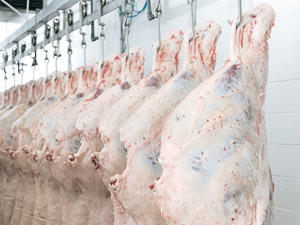
Le bœuf est une excellente source de nutriments pour les humains. C’est également une excellente source de nutriments pour les microbes. Si des microbes s’installent sur les convoyeurs à courroie et autres équipements de transformation, ils disposent d’une source de nourriture immédiate pour soutenir leur croissance. C’est pourquoi les usines de conditionnement canadiennes travaillent très, très fort pour maintenir la propreté de leurs installations et la salubrité de leurs produits de bœuf. Les installations sont nettoyées après chaque quart de travail. On commence par gratter les salissures visibles, puis on lave à haute pression les convoyeurs à courroie, les équipements et les planchers (étape 1). À l’étape 2, on applique un détergent pour dissoudre les résidus de graisse, puis on rince. Enfin, on applique un désinfectant pour éliminer les microbes qui n’auraient pas été éliminés par le lavage (étape 3).
La Dre Xianqin Yang, de la station de recherche de Lacombe d’Agriculture et Agroalimentaire Canada (AAC), et ses collaborateurs ont étudié l’évolution de la densité microbienne au cours du processus de nettoyage en trois étapes (Effects of Sanitation Practices on Microbial Dynamics in Meat Processing Environment).
Ce qu’ils ont fait
En collaboration avec une grande usine de conditionnement du bœuf, l’équipe a prélevé des échantillons sur les convoyeurs à courroie, dans les drains de sol et dans l’air avant le début du nettoyage, après l’étape 1 (lavage à haute pression), après l’étape 2 (détergent) et après l’étape 3 (désinfection). Les bactéries ont été dénombrées et identifiées dans chaque échantillon.
Ce qu’ils ont appris
À tous les moments d’échantillonnage, les échantillons prélevés dans l’air et sur le convoyeur à courroie contenaient moins de bactéries que ceux prélevés dans le drain. Cela fait du sens : la gravité entraîne l’eau de lavage et les bactéries vers le drain.
Le nombre de bactéries a changé au fur et à mesure que le nettoyage progressait des étapes 1 à 3, mais pas comme on aurait pu s’y attendre. Le nombre de bactéries dans les échantillons prélevés dans le drain était élevé avant le début du nettoyage et après l’étape initiale de grattage et de lavage à haute pression. Cela n’est pas surprenant : un grand nombre de bactéries provenant des équipements et du sol étaient entraînées dans le drain. Mais le nombre de bactéries sur les convoyeurs à courroie était plus élevé après l’étape 1 qu’avant le début du nettoyage ! Le même phénomène s’est produit avec la quantité de bactéries dans les échantillons d’air après l’étape 1. Cela permet d’expliquer ce qui s’est passé. Quiconque a déjà utilisé un nettoyeur haute pression (ou bouché le bout d’un tuyau avec son pouce) pour nettoyer quoi que ce soit sait que la pression de l’eau déloge et élimine la crasse et la saleté collées. Mais il crée également une brume. Cette brume n’est pas seulement de l’eau ; elle transporte également de fines particules de crasse, de saleté et – vous l’avez deviné – de bactéries. L’étape de nettoyage à haute pression a délogé certaines bactéries des convoyeurs et des drains et les a projetées dans l’air. L’équipement semblait sans aucun doute plus propre après l’étape 1, mais à mesure que la brume se déposait, les bactéries présentes dans l’air ont recontaminé les convoyeurs. Heureusement, la charge bactérienne est revenue aux niveaux d’avant le nettoyage après l’application et le rinçage du détergent (étape 2) et est restée faible après l’application du désinfectant (étape 3).
La bonne nouvelle, c’est que les étapes de nettoyage se sont révélées particulièrement efficaces contre les bactéries (telles que Pseudomonas et Acinetobacter) susceptibles de provoquer l’altération et de réduire la durée de conservation du bœuf emballé. Plus important encore, la concentration d’E. coli sur les convoyeurs a diminué de manière continue au fur et à mesure que le nettoyage progressait, des étapes 1 à 3. En effet, de nombreux échantillons prélevés sur les convoyeurs ne contenaient absolument pas d’E. coli, et aucune trace de cette bactérie n’a été détectée dans les échantillons d’air. De plus, moins de la moitié des échantillons prélevés dans les drains de sol contenaient des E. coli. Cela incluait toutes les souches d’E. coli, et pas seulement les E. coli producteurs de shigatoxines (STEC) qui constituent un risque pour la santé humaine. Il existe des centaines de souches d’E. coli ; les STEC n’auraient représenté qu’une infime fraction des très rares E. coli détectés ici.
Qu’est-ce que cela signifie pour vous ?
Les conditionneurs de bœuf canadiens nettoient leurs usines très efficacement. Le bilan en matière de salubrité des aliments le confirme. En 2025, 263 rappels alimentaires ont été enregistrés au Canada. Six de ces rappels (2,3 %) concernaient du bœuf, et seuls deux (0,8 %) étaient dus à une contamination microbienne. Il s’agissait dans les deux cas de STEC, mais aucun n’a été associé à une maladie chez l’homme, et les deux impliquaient un supermarché, et non une usine de conditionnement de bœuf.
De futures recherches pourraient permettre de mettre au point des méthodes améliorées de nettoyage à haute pression qui réduiraient au minimum le nombre de microbes se dispersant dans l’air et se déposant à nouveau sur les équipements. Mais il s’agit là d’une recherche très risquée pour les conditionneurs commerciaux : ceux-ci hésitent à tester de nouvelles méthodes de nettoyage tant qu’ils ne sont pas certains qu’elles ne risquent pas d’aggraver accidentellement la situation. Ce type de travaux de recherche, de développement et de démonstration doit être mené dans un centre de recherche à échelle pilote avant que l’industrie ne l’adopte.
En bref
La Dre Yang a été transférée à la station de recherche de Lethbridge afin de poursuivre ses travaux en microbiologie lorsqu’AAC a procédé à des coupes budgétaires dans le domaine de la recherche en janvier. Nous sommes reconnaissants qu’AAC ait reconnu l’importance de son travail. Cependant, l’abattoir de recherche de Lacombe devrait prochainement fermer ses portes. Il sera donc extrêmement difficile de transformer les nouvelles connaissances en matière de salubrité alimentaire issues de son laboratoire en pratiques commerciales permettant de renforcer la salubrité du bœuf canadien et de protéger ses consommateurs.
Le Beef Cattle Research Council est une organisation industrielle à but non lucratif financée par le Prélèvement national sur les bovins de boucherie. Le BCRC s’associe à Agriculture et Agroalimentaire Canada, aux groupes provinciaux de l’industrie bovine et aux gouvernements afin de faire progresser le transfert de la recherche et de la technologie à l’appui de la vision de l’Industrie canadienne du bœuf, qui est d’être reconnue comme un fournisseur privilégié de bœuf, de bovins et de génétique sains et de haute qualité. Apprenez-en davantage sur le BCRC sur le site www.beefresearch.ca/fr.
Le partage ou la réimpression des articles du www.BeefResearch.ca/fr est généralement bienvenu et encouragé, mais cet article nécessite l’autorisation de l’éditeur d’origine.
Le BCRC est financé par une partie du prélèvement national sur les bovins de boucherie.

Vos questions, commentaires et suggestions sont les bienvenus. Contactez-nous directement ou suscitez un dialogue public en publiant vos réflexions ci-dessous.