Why are my weaning weights lower than last year?
Which cows are paying their way?
Am I feeding too much hay?
Is my herd performing above or below average?
The answer to all of these questions starts with records.

Disclaimer: While every effort is made to include the most relevant and economical records to keep, the decision is ultimately what works best for your operation. Not every record mentioned in these modules must be kept.
Record-keeping is more than paperwork—it’s a tool for improving farm performance. By collecting and analyzing accurate information, beef producers can make better decisions, measure progress and identify opportunities for improvement.
A good record-keeping system helps take the guesswork out of management decisions. Accurate records provide the information needed to evaluate performance, identify opportunities for improvement and measure the impact of management changes over time.1
Beef cattle producers who maintain high-quality records are better positioned to make informed decisions that improve efficiency and profitability. To be useful, records should be complete, simple, appropriate for the operation and accurate.
While collecting, maintaining and analyzing records requires an investment of time, the ability to make decisions based on reliable information is valuable. By comparing current performance to previous years, producers can identify trends, evaluate the results of management changes and focus their efforts on the factors that have the greatest influence on profitability.
Not every operation needs to keep every record discussed in these modules. The most effective record-keeping system is one that captures the information needed to support management decisions and fits the goals, resources and management style of the operation.
☐ I know my conception rate.
☐ I know my weaning rate.
☐ I know my feed inventory.
☐ I know my cost of production.
☐ I compare this year’s performance to previous years.
Score:
- 0–1: Start with Level 1
- 2–3: Explore Level 2
- 4–5: Explore Level 3
Record-Keeping Pays
100 cows × 60 extra lbs weaned = 6,000 more lbs of calf
Potential value: $600/cwt to $670/cwt is $36,000 to $40,200.
Good records help turn management decisions into measurable results.
Farm record-keeping can feel like a big task, especially when it seems like everything needs to be documented at once.
Many beef producers already keep valuable information in notebooks, calendars, spreadsheets, apps or other day-to-day records. The next step may simply be identifying which information is most useful for supporting management decisions and meeting program requirements.
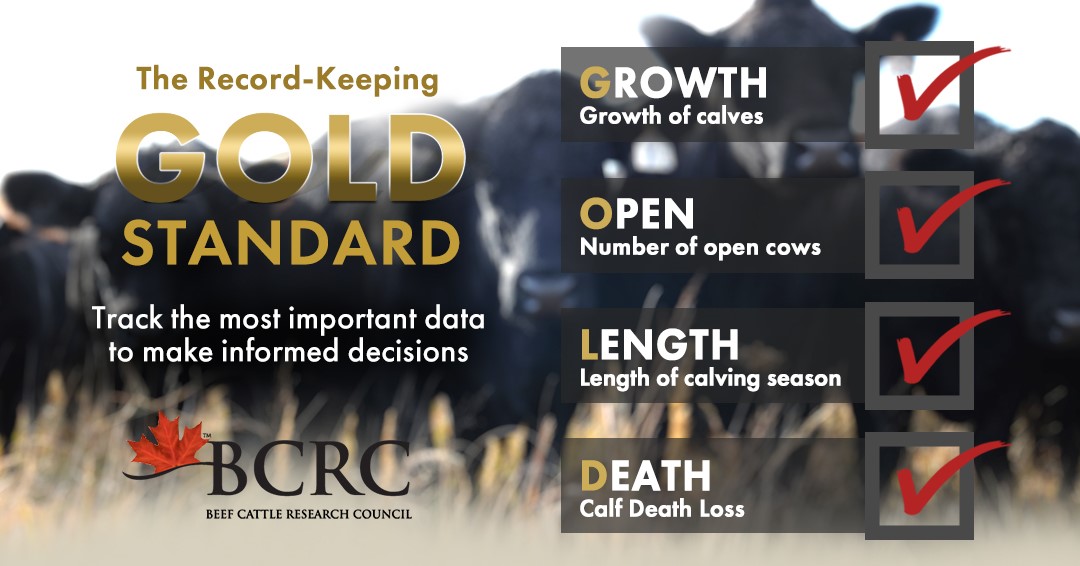
There are four steps to animal health and performance records that are sometimes referred to as “GOLD Management Indicators.” The acronym GOLD stands for:
- G = Growth of calves
- O = number of Open cows
- L = Length of calving season
- D = calf Death loss
These records provide the foundation for measuring herd performance and making management decisions.
Benchmarking on Cow-Calf Operations
Benchmarks such as calving rates, weaning rates and death loss can be used as a guideline for measuring an operation’s performance. Do you know where your operation compares to industry and regional benchmarks? Try entering your data into the Cow-Calf Production Indicators Calculator.
Benchmarking involves collecting data to generate production or performance averages for managers and producers to compare themselves against past performance or other producers in their area to identify strengths and weaknesses in their operation and to improve performance.2
Once data has been recorded, industry benchmarks may be used as a guideline to determine how an operation is performing and accurate adjustments can be made accordingly. By comparing and benchmarking against other operations, producers can identify gaps and learn from top performers.3
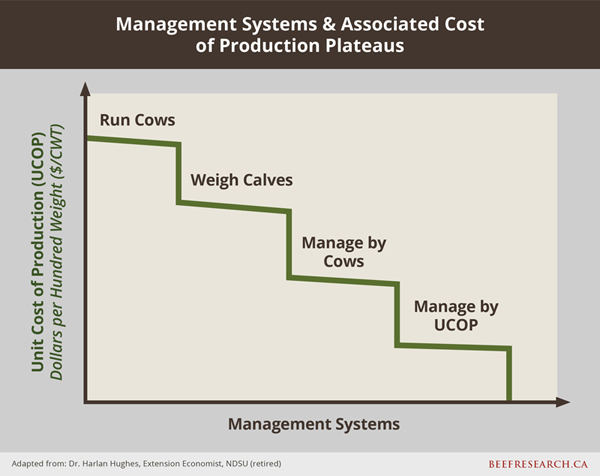
Dr. Harlan Hughes’ analysis of North Dakota cow-calf operations showed that those actively using their own farm data tended to have lower unit costs of production per pound of calf weaned (Figure 1). The operations that were using their own data were also the most profitable over time. The more information producers gather on their operations, the more efficient the knowledge and herd management becomes.4
Figure 1: Management systems and associated cost of production plateaus.
Recent studies suggest that beef producers who keep records and use industry benchmarking have higher production with an average of up to 60 more pounds of calf weaned per cow exposed.3 Assuming a herd with 100 exposed cows, this is equivalent to an additional 6,000 lbs weaned for the herd (+11%), valued at $31,500 per year in a high price environment (550 lb calf at $525/cwt).1
Setting Goals for the Beef Operation
From a management perspective, having goals is like following a road map—they help beef producers plan how to get to where they want to go. Keeping and analyzing records are important for accomplishing a goal. One of the most important purposes of goal setting is to improve performance as well as financial success. Keeping records is a key tool for measuring and tracking goal setting and business success.5
- Start by thinking about your end result. If you don’t know where you’re going, it will be very difficult to get there. Developing a plan will help identify where some of your stops or detours might be.
- Develop SMART Goals. SMART goals are Specific, Measurable, Attainable, Realistic and Time-based.
- Prioritize your goals. After a list of goals has been developed for your operation, prioritize them.
- Implement goals. To meet these goals, time must be invested into goal planning. Break each goal into smaller chunks that are easier to handle and set a timeline for completion.
- For example, one way to achieve greater production is to improve weaning weights (Table 1). What management practices may be changed in the next six months to improve weights? Implement creep feeding? Improve grazing management? Mineral supplementation? Parasite control? Improve genetics? Improve water quality? The list goes on. Each of these tasks can be set to a timeline.
- Track progress. If time is taken to map out goals and to keep good records, progress can be monitored towards achieving these goals. From the example in Table 1, progress is monitored toward increasing weaning weights over the next five years.
Table 1: Setting a goal to increase weaning weights by 20 lbs. by the year 2030.
| Goal | Date | Progress | What changed? | Mitigating Factors |
|---|---|---|---|---|
| Increase Avg WW by 20 lbs by 2030 | Nov 2026 | 550 lbs. | Baseline | |
| Nov 2027 | 560 lbs. | New bull | ||
| Nov 2028 | 545 lbs. | Creep feed | Drought | |
| Nov 2029 | 565 lbs. | Creep feed + pasture rejuvenation with legumes | ||
| Nov 2030 | 570 lbs. | Nothing |
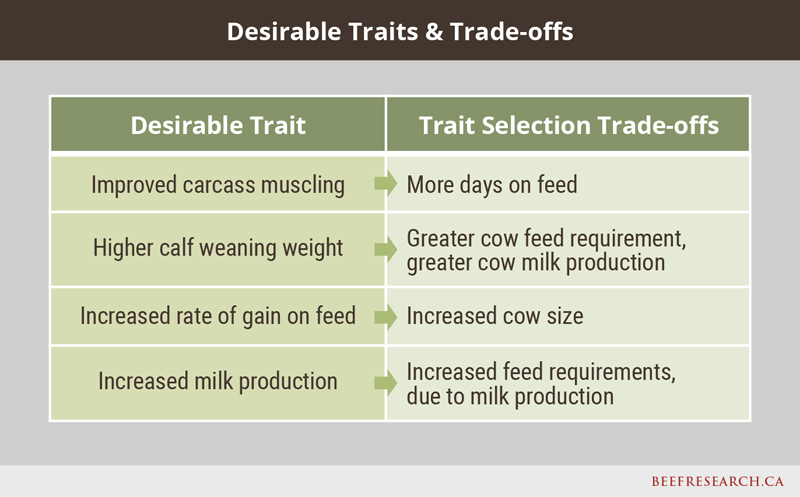
When making improvements to a production system, it is also good be aware of the potential for trade-offs of the changes implemented. A trade-off is when something is given up in favour of another. These trade-offs may not always be negative, but they could affect production or management practises. Examples of trade-offs can include those in Table 2.4
Table 2: Desirable traits and trade-offs.
The following modules are designed for use across a wide range of producers and management systems. Some operations may not fit perfectly into a single level across all topics. For example, an operation’s financial record-keeping may already be at the intermediate or advanced level but may be more of a beginner in the forage and grassland area. Each of the levels has been developed to target a level of experience where level 1 is a good starting point for beginners and level 3 is designed to be the most advanced level. Your current record-keeping practices may be a combination of levels depending on the topic, which is to be expected!
Where Are You Today?
Just Getting Started?
Already Keeping Some Records?
Ready for Deeper Analysis?
- References
-
- Manglai X. Examining Record-Keeping and Benchmarking Effects on the Production and Performance of Cow-Calf Farms in Canada. Agricultural and Food Sciences. 2016. Available here.
- Voss CA, Åhlström P, and Blackmon K. Benchmarking and operational performance: some empirical results. International Journal of Operations & Production Management. 1997. Vol. 17 No. 10, pp. 1046-1058. Available here.
- Canfax Research Services. Production & Management Practices that Drive Profitability. September 2017. Available here.
- The Beef Cow Calf Manual. Alberta Agriculture and Food. 2008.
- Five Tips for Setting Farm Goals. Farm and Dairy. January 2017. Available here.
Feedback
Feedback and questions on the content of this page are welcome. Please e-mail us.
This content was last reviewed July 2026.