Prenez des décisions éclairées pour votre opération avec des informations livrées directement dans votre boîte de réception.
Obtenez les derniers outils, innovations et informations scientifiques pour l'industrie canadienne du bœuf, y compris des considérations sur la production saisonnière et des analyses économiques.
Nestled in the arid South Okanagan, Thomas Ranches is a multigenerational operation that balances ranching with conservation. In 2000, the Thomas family sold their land to The Nature Trust of British Columbia, preserving natural habitat while continuing cattle operations under a lease agreement. Today, Brian Thomas manages 200 head of cattle on 350 acres, with the remaining 1,650 acres dedicated to wildlife habitat. Effective water management is crucial to sustaining both livestock and the surrounding ecosystem in this dry region.
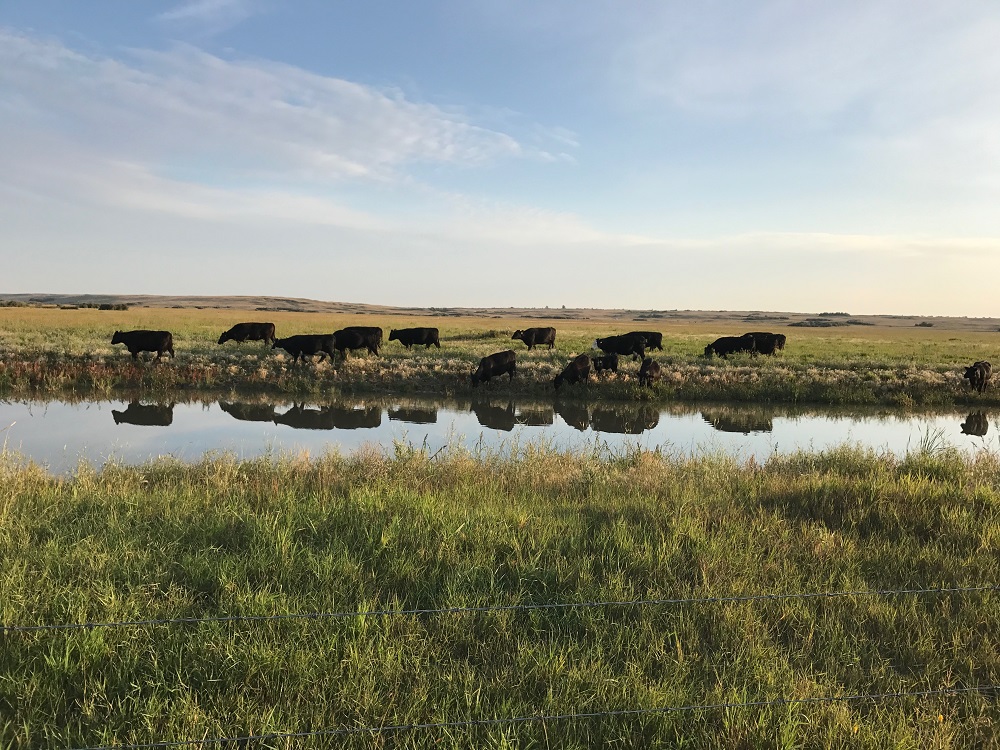
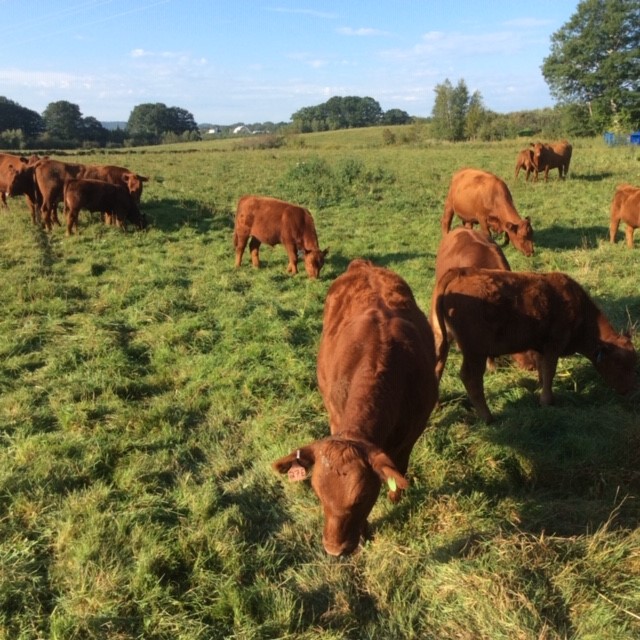
Cattle on Crown rangeland. Photos courtesy of Brian Thomas.
Cattle on Thomas Ranches in the South Okanagan, BC
Thomas Ranches relies on a creek-fed storage dam and an extensive irrigation system. This helps them manage water shortages in a dry climate that gets less than a foot of annual rainfall. Frequent droughts have intensified competition for water resources, and the impacts of increasing population growth, tourism and conservation efforts place additional demands on an already limited supply.
Wildfires also pose ongoing risks. A wildfire in 2021 burned nearly half the ranch’s land. However, the resulting reduction in tree cover ultimately increased water availability by reducing vegetation uptake.
Wildlife protection adds complexity, as the ranch’s rugged terrain supports species like California bighorn sheep, elk and mule deer, necessitating careful water stewardship. Despite scrutiny of agricultural water use, Brian underscores that broader water use by humans is a major driver of water shortages, not cattle consumption. This reinforces the need for proactive water management to ensure long-term sustainability. These pressures have shaped Brian’s mindset, strengthening his focus on planning, advocacy and preparedness.
Water Storage and Distribution
The ranch’s storage dam, originally built in 1943 and expanded over the years, is vital for maintaining water availability throughout the year. The earthen embankment dam creates a reservoir that collects and holds water during wetter periods, like during spring snowmelt or heavy rainfall. The stored water can then be used during drier months. Additionally, springs and roadside ditches provide secondary water sources for cattle on Crown rangeland where cattle graze from May to October.
To reduce irrigation water waste, the ranch has transitioned from above-ground aluminum pipes to underground PVC pipelines, significantly lowering water loss through leaks and evaporation. Additionally, pivot irrigation systems are replacing older hand-line and reel irrigators, further improving efficiency. These improvements have significantly reduced overall water consumption, which helps ensure the cattle have the water they need, even in drier periods.
This practical water analysis guide for beef producers outlines key questions and considerations to support decision-making around different watering solutions for cattle.
Off-Stream Watering Systems
Historically, cattle drank directly from creeks, but all riparian areas on the ranch are now fenced off to protect the watercourses from contamination and erosion. Instead, water is delivered via underground gravity-fed pipes to troughs, ensuring a consistent supply while protecting water quality. This change was supported by federal and provincial funding through the Species at Risk program, benefiting both cattle and local wildlife. Additionally, this practice enhances the ranch’s image, as the public appreciates seeing natural water sources protected.
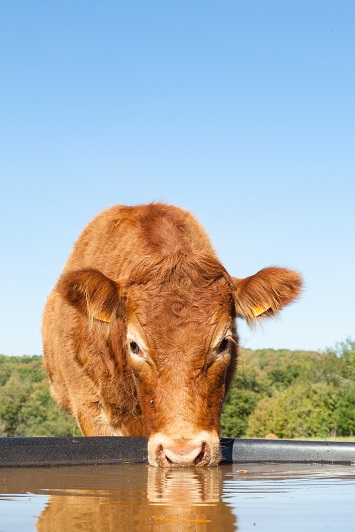
A storage dam is the primary water source for Thomas Ranches.
Water Access and Security
The ranch holds historic water licenses dating back to the 1870s, ensuring legal access to water from McLean Creek and the storage dam. However, regulatory challenges persist, particularly regarding water rights in British Columbia, with concerns about stock water rights on Crown land.
The BC Cattlemen’s Association is advocating for improved stock water regulations to provide greater security for ranchers, ensuring reliable water sources for their cattle. In collaboration with industry groups, Brian is actively involved in discussions about policies that recognize the importance of agricultural water use and support cattle health and productivity.
Key Water Management Takeaways
Plan for Drought: Water storage infrastructure is essential during dry periods.
Protect Natural Water Sources: Fencing off creeks and utilizing off-stream water systems improves water quality for both cattle and wildlife.
Monitor and Adapt to Changing Conditions: Wildfires, drought and increasing human activity require continuous adjustments to water management strategies.
Work Collaboratively: By working together, beef cattle producers can ensure their water needs are understood and considered in provincial planning.
Acknowledgements
Thanks to the following individuals for contributing their time and expertise to review this article and related resources:
Dr. Mary-Jane Orr, General Manager, Manitoba Beef & Forage Initiatives
Dwayne Summach, Livestock and Feed Extension Specialist, Saskatchewan Ministry of Agriculture
Jaclyn Horenburg, Producer Relations Specialist, Beef Farmers of Ontario
Geoff Larkin, Climate Change Adaptation Coordinator, Agri-Commodity Management Association
Kaley Segboer-Edge, VBP+ Coordinator and ABP Stewardship Lead, Alberta Beef Producers
Sharing or reprinting BCRC posts is welcome and encouraged. Please credit the Beef Cattle Research Council, provide the website address, www.BeefResearch.ca, and let us know you have chosen to share the article by emailing us at info@beefresearch.ca.
The BCRC is funded by a portion of the Canadian Beef Cattle Check-Off.
Your questions, comments and suggestions are welcome. Contact us directly or spark a public discussion by posting your thoughts below.
Mise en commun des ressources : un pâturage communautaire modernise ses systèmes d’abreuvement pour des bovins de boucherie en meilleure santé
Claire Sampson-MacDonald est présidente de Maple Brook Co-operative Pastures Ltd., un pâturage communautaire situé sur l’île du Cap-Breton, près de Maple Brook, en Nouvelle-Écosse. En Nouvelle-Écosse, les pâturages communautaires ont vu le jour dans les années 1960 et ont été gérés par les gouvernements provinciaux pendant des décennies ; mais aujourd’hui, la province est propriétaire des terres et la gestion de chaque pâturage est assurée par des organismes communautaires ou des coopératives.
Maple Brook Co-operative Pastures Ltd compte actuellement 22 membres et dispose d’environ 106 acres de terres défrichées consacrées au pâturage. La coopérative fait paître de 75 à 80 têtes de mai à novembre, mais souhaite augmenter ses effectifs à mesure que des améliorations sont apportées aux infrastructures et aux terres.
Infrastructures vieillissantes
Le pâturage de Maple Brook est situé sur une colline, avec un ruisseau qui traverse la partie la plus basse du pâturage. Pendant de nombreuses années, ce ruisseau a constitué la principale source d’eau pour l’ensemble de la zone de pâturage.
Cette approche de la gestion de l’eau a entraîné plusieurs problèmes :
Les bovins ne gagnaient pas autant de poids qu’ils auraient pu : l’unique point d’eau, situé dans un coin du pâturage, les obligeait à parcourir une longue distance pour s’abreuver, tandis que la zone près du ruisseau était pâturée de façon intensive, ce qui entraînait une utilisation inégale du terrain.
Avec des étés de plus en plus secs, le niveau d’eau du ruisseau baissait à la fin de l’été.
Le fait que les bovins aient un accès direct au ruisseau n’était pas idéal pour la protection de l’environnement et la propreté de l’eau.
Moderniser les infrastructures pour répondre aux besoins d’aujourd’hui
Vue aérienne du pâturage communautaire de Maple Brook. Photo gracieusement fournie par Claire Sampson-MacDonald.
À la suite du regain d’intérêt de la province pour les pâturages communautaires à travers la Nouvelle-Écosse, Maple Brook a été mise en relation avec Perennia Food and Agriculture Corporation, une agence provinciale de développement. L’équipe de Perennia a recommandé de développer des sources d’eau supplémentaires afin de pouvoir diviser le pâturage en parcelles plus petites, ce qui permettrait un pâturage plus intensif. Ils ont également recommandé de clôturer le ruisseau afin d’en limiter l’accès aux bovins, de préserver la qualité de l’eau et de réduire au minimum les risques pour l’environnement. En réponse, le gouvernement provincial a alloué des fonds aux pâturages dans le cadre du Programme de soutien aux pâturages communautaires, ce qui a permis à la coopérative de commencer à mettre en œuvre les changements nécessaires.
Un effort collectif
Les membres de la coopérative ont consacré du temps et de l’énergie à la mise en œuvre de ces changements, en complétant le financement reçu par Maple Brook. Ils ont également sollicité les conseils de Perennia concernant les pompes solaires et la conception d’un système d’approvisionnement en eau à partir de matériaux facilement accessibles.
Trois étangs ont récemment été aménagés pour capter les eaux de ruissellement de surface, avec des talus éviter qu’ils ne se comblent. L’eau est pompée depuis ces étangs à l’aide d’une pompe solaire équipée d’une batterie de secours, puis acheminée vers des réservoirs et enfin vers des abreuvoirs pour les bovins. De plus, le ruisseau est désormais en grande partie clôturé, ce qui limite l’accès des bovins.
L’un des trois nouveaux bassins de rétention des eaux de surface et de ruissellement à Maple Brook. Photo gracieusement fournie par Claire Sampson-MacDonald..
Les membres de la coopérative ont travaillé ensemble pour apporter des modifications au réseau d’alimentation en eau.
Ajustements et projets pour l’avenir
Disposant désormais de plus d’une source d’eau, Maple Brook est en mesure de pratiquer le pâturage en rotation dans ses enclos, ce qui permet de mieux exploiter l’ensemble de ses pâturages. Cela a également amélioré l’état des pâturages grâce à une meilleure répartition du pâturage et du passage des animaux. La première année, il a été difficile de maintenir un débit suffisant pour que les abreuvoirs restent pleins, mais des modifications apportées à l’équipement afin d’augmenter le débit ont permis de résoudre le problème. Le nouveau système nécessite également une surveillance quotidienne sur place afin de résoudre tout problème éventuel. Les améliorations futures porteront sur l’optimisation de l’accès et du drainage autour de l’abreuvoir, ainsi que sur l’augmentation de sa capacité.
Dans l’ensemble, Maple Brook a rapidement constaté les avantages du nouveau système : « Ce qui m’a le plus surpris, c’est la rapidité avec laquelle nous avons constaté les effets bénéfiques sur la santé du troupeau. Dès le mois de juin de cette première année où nous avons installé les étangs, on voyait clairement que les bovins avaient pris plus de poids que les années précédentes, alors que nous n’étions même pas encore à la moitié de la saison de pâturage. »
Il est très utile de faire appel à des conseillers dont l’expertise peut aider à orienter le processus. Pour les producteurs ou les groupes confrontés à des défis similaires, adopter les changements recommandés par les experts peut rapidement s’avérer bénéfique.
Points clés à retenir en matière de gestion de l’eau
Veillez à ce que les bovins aient facilement accès à de l’eau propre et, si possible, alimentez un abreuvoir à l’aide d’une pompe.
Surveiller régulièrement les sources d’eau et les systèmes afin de résoudre tout problème qui pourrait survenir.
Installez des clôtures autour des points d’eau pour empêcher les bovins d’y accéder et éviter toute contamination.
Des conseillers sont à votre disposition pour vous aider à moderniser vos réseaux d’alimentation en eau.
Remerciements
Merci aux personnes suivantes d’avoir consacré temps et expertise à la révision du présent article et des ressources connexes :
Kaley Segboer-Edge, coordonnatrice de VBP+ et responsable de l’intendance environnementale chez Alberta Beef Producers
Dre Mary-Jane Orr, directrice générale, Manitoba Beef & Forage Initiatives
Dwayne Summach, spécialiste de la vulgarisation en élevage et alimentation animale, Ministère de l’Agriculture de la Saskatchewan
Jaclyn Horenburg, spécialiste des relations avec les producteurs, Beef Farmers of Ontario
Bree Patterson, spécialiste des programmes de conservation – Agriculture, Canards Illimités Canada
Katie Trottier, Spécialiste en élevage de ruminants, Perennia Food & Agriculture
Geoff Larkin, coordonnateur de l’adaptation au changement climatique, Agri-Commodity Management Association
Le partage ou la réimpression des publications du BCRC sont les bienvenus et sont encouragés. Veuillez mentionner le Beef Cattle Research Council, fournir l’adresse du site Web, www.BeefResearch.ca/fr, et nous faire savoir que vous avez choisi de partager l’article en nous envoyant un courriel à info@beefresearch.ca.
Le BCRC est financé par une partie du prélèvement national sur les bovins de boucherie.
Vos questions, commentaires et suggestions sont les bienvenus. Contactez-nous directement ou lancez une discussion publique en publiant vos idées ci-dessous.
Clôtures, filtres et gouttières : initiatives innovantes relatives à l'eau afin d'améliorer la santé du troupeau
Brian Windover et son fils Scott sont propriétaires et exploitants de Bayview Farms à Napanee, en Ontario. Leur exploitation comprend un troupeau commercial de 90 têtes de bovins Gelbvieh et Gelbvieh x Charolais certifié par Verified Beef Production Plus (VBP+).
La ferme comprend 250 acres de pâturages avec des clôtures arborées et ouvertes. Deux des pâturages bordent Hay Bay, une baie du lac Ontario, et sont clôturés pour empêcher les bovins d’accéder à la baie.
Le maintien d’une bonne qualité de l’eau a toujours été une priorité absolue pour Bayview Farms, les amenant à mettre en œuvre plusieurs changements afin de réduire la contamination par le fumier et d’assurer un approvisionnement abondant en eau potable pour leurs bovins.
Un problème lié à la qualité de l’eau de réserve
La principale source d’eau potable pour les bovins provient d’un étang alimenté par une source qui alimente un puits. L’eau est pompée du puits vers des abreuvoirs dans la grange. Les bovins sont tenus à l’écart de l’étang par un talus de terre et des barrières en béton. Malgré cela, Brian et Scott ont remarqué que l’eau était décolorée et malodorante, en particulier après de fortes pluies.
Au fil du temps, à mesure que la ferme changeait et que les bâtiments étaient modifiés, de plus en plus de fumier s’accumulait dans la cour de la grange. Un point bas s’est formé près de la grange et à proximité de l’étang, où l’eau s’est accumulée. Le fumier a contaminé l’eau de surface, qui s’est infiltrée dans le sol et a affecté la qualité de l’eau de l’étang et du puits.
Sachant qu’une mauvaise qualité de l’eau peut nuire à la santé et à la prise de poids des bovins, les Windover ont trouvé une solution raisonnable et rentable :
Un lit filtrant a été construit pour évacuer l’eau contaminée de l’étang et la filtrer.
Ajout de gravier clair de ¾ pouce dans le point bas près de la grange, ainsi que d’un tuyau perforé de 250 pieds avec du gravier clair de ¾ pouce.
Brian était un peu sceptique quant à l’efficacité de leur plan, mais à sa grande surprise, celui-ci a eu un impact immédiat. « Grâce au système de filtration que nous avons installé, la qualité de l’eau s’est améliorée presque instantanément. L’eau n’était plus brune, décolorée et malodorante », a-t-il déclaré.
Brian et Scott ont réalisé les travaux eux-mêmes, achevant la construction du lit filtrant pendant les mois d’été, alors qu’il n’y avait pas de bovins dans la cour. Les principaux coûts du projet comprenaient l’achat d’un tuyau Big “O” perforé, d’un chargement de roches propres et le temps qu’ils ont consacré à ce projet. Brian estime que cet investissement a été rentable, car l’amélioration de la qualité de l’eau a permis d’améliorer la santé et les performances des bovins.
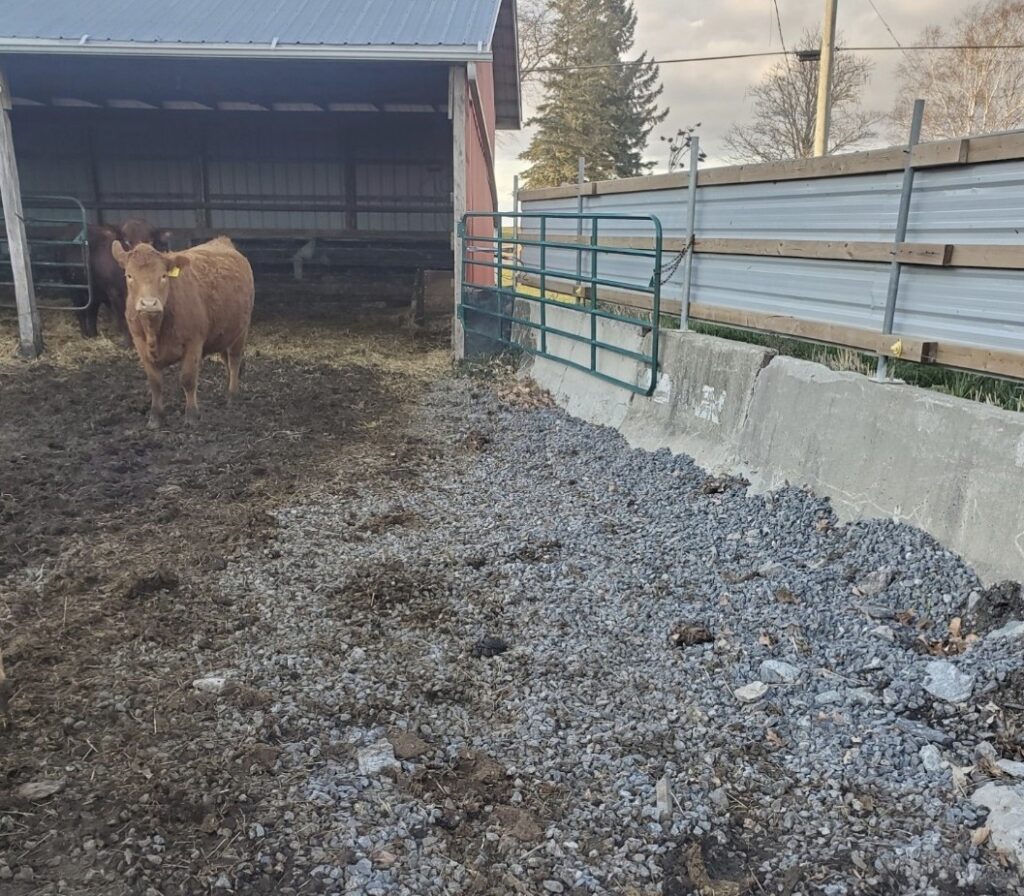
La ligne pointillée délimite la zone du lit filtrant qui s’étend en diagonale devant la grange. L’étang se trouve à gauche, au-delà des hautes herbes. Photo gracieusement fournie par Brian Windover.Barrières en béton et brise-vent avec de nouvelles pierres propres visibles contre la barrière (délimitées par la ligne pointillée). Auparavant, l’eau s’accumulait à ce point bas de la cour. Désormais, elle s’écoule à travers les pierres dans un tuyau perforé et s’évacue par le lit filtrant. Photo gracieusement fournie par Brian Windover.
Améliorer l’accès à l’eau de réserve : récupération de l’eau de pluie
Bien que Bayview Farms soit à deux pas de Hay Bay et du lac Ontario, le forage d’un puits dans ce secteur ne garantit pas un approvisionnement abondant en eau. Le secteur connaît également parfois des périodes de sécheresse. Cela a incité Brian à trouver une autre façon d’améliorer l’accès à l’eau en installant un système de captage d’eau sur deux des granges de l’exploitation : une grange principale de 50 pi x 100 pi et une annexe de 24 pi x 48 pi.
L’eau de pluie provenant des toits des granges est captée dans une gouttière, évacuée par un tuyau solide, puis pompée dans l’étang. Ce système simple a été couronné de succès, car il a permis d’augmenter la quantité d’eau disponible dans l’étang et de garder les zones autour de la cour au sec.
Points clés à retenir en matière de gestion de l’eau
Clôturer les étangs et autres sources d’eau afin d’empêcher les bovins d’y accéder directement et de les contaminer.
Surveiller les sources d’eau et traiter la contamination afin d’éviter des problèmes à long terme.
Des mesures rentables, telles que les systèmes de filtration et la récupération de l’eau de pluie, peuvent améliorer considérablement la qualité et la disponibilité de l’eau.
Remerciements
Nous remercions les personnes suivantes d’avoir consacré leur temps et leur expertise à la révision de cet article et des ressources connexes :
Dre Mary-Jane Orr, directrice générale, Manitoba Beef & Forage Initiatives
Dwayne Summach, spécialiste en vulgarisation sur le bétail et des aliments pour animaux, ministère de l’Agriculture de la Saskatchewan
Jaclyn Horenburg, spécialiste des relations avec les producteurs, Beef Farmers of Ontario
Bree Patterson, spécialiste des programmes de conservation – agriculture, Canards Illimités Canada
Katie Trottier, spécialiste du bétail ruminant, Perennia Food & Agriculture
Geoff Larkin, coordonnateur de l’adaptation aux changements climatiques, Agri-Commodity Management Association
Kaley Segboer-Edge, coordonnatrice VBP+ et responsable de l’intendance chez ABP, Alberta Beef Producers
Le partage ou la réimpression des publications du BCRC sont les bienvenus et sont encouragés. Veuillez mentionner le Beef Cattle Research Council, fournir l’adresse du site Web, www.BeefResearch.ca/fr, et nous faire savoir que vous avez choisi de partager l’article en nous envoyant un courriel à info@beefresearch.ca.
Le BCRC est financé par une partie du prélèvement national sur les bovins de boucherie.
Vos questions, commentaires et suggestions sont les bienvenus. Contactez-nous directement ou lancez une discussion publique en publiant vos idées ci-dessous.
Réservoirs de résilience : construire des systèmes de réserve d'eau fiables à travers des années de sécheresse
Bluestone Stock Farms, située près de Mortlach et Parkbeg, en Saskatchewan, a dû faire face à d’importants défis en matière de gestion de l’eau en raison de la sécheresse et des tendances météorologiques changeantes au cours des dernières années. Bluestone est une entreprise familiale, et la famille Hicks gère ensemble 15 000 acres répartis sur trois sites. La ferme est également certifiée VBP+, et Karla fait partie du comité provincial VBP+ de la Saskatchewan. Avec un troupeau de plus de 800 vaches Black Angus, la ferme se fie au pâturage en rotation pour maximiser la santé des pâturages et les occasions de pâturage, comblant 90 % de ses besoins en aliments pour animaux avec des aliments et des pâturages cultivés sur place.
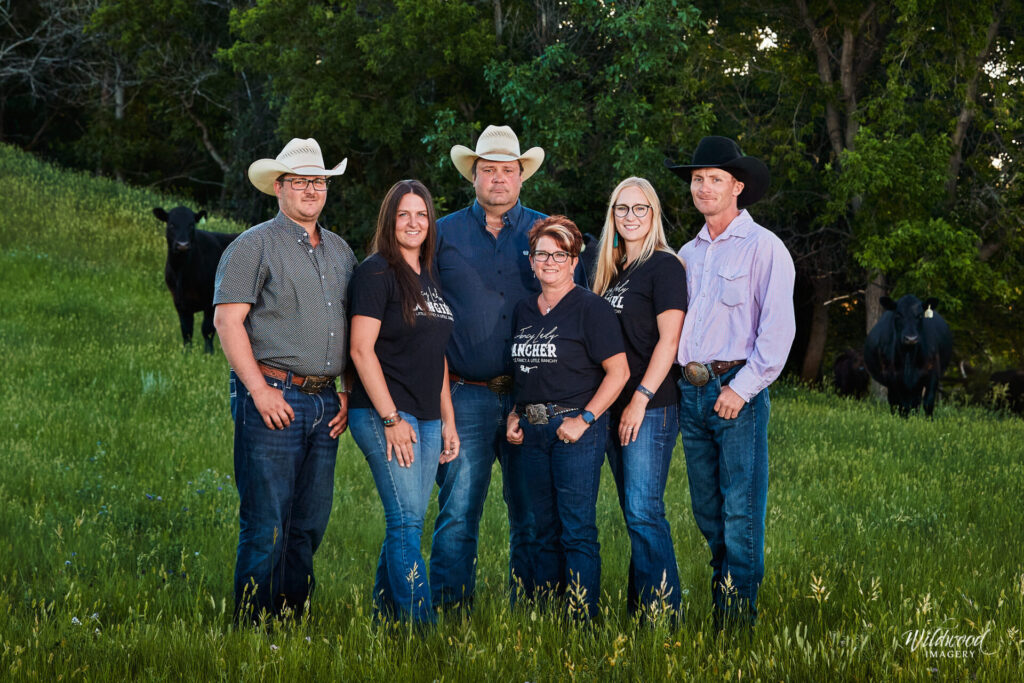
De gauche à droite : la famille Hicks, composée de Tyrell et Nicole Hicks, Jason et Karla Hicks, ainsi que Lexi et William Macza. Photo gracieusement fournie par Karla Hicks.
Les systèmes de réserve d’eau avant la sécheresse
Avant la sécheresse de 2019, Bluestone Stock Farms disposait d’un système d’approvisionnement en eau bien établi, comprenant une installation solaire avec une turbine, dix mares-réservoirs et deux sources naturelles d’eau. Le terrain, avec sa topographie légèrement vallonnée et ses marécages naturels, fournissait un approvisionnement en eau abondant pendant l’hiver et au début du printemps, avec seulement quelques défis occasionnels.
La ferme fonctionnait selon la supposition que les cycles naturels de neige, de pluie et de soleil suffisaient à maintenir les bovins en bonne santé et hydratés. Cependant, avec peu de neige pendant l’hiver 2018-2019 et aucune pluie au printemps, les terres ont commencé à s’assécher et les sources d’eau à se tarir. Au départ, la famille n’a pas réalisé l’ampleur du problème et a attribué le poids plus léger des vaches cette année-là à d’autres facteurs environnementaux liés à la sécheresse.
La crise se poursuit
L’hiver suivant (2019-2020), la situation de Bluestone liée à l’eau avait empiré. Les mares-réservoirs et les marécages s’asséchaient, et les faibles chutes de neige hivernales n’ont pas mené à un réapprovisionnement suffisant en eau. L’absence de pluie printanière n’a pas permis de remplir les petits plans d’eau, et même les grands plans d’eau qui n’avaient pas séché depuis des décennies ont commencé à baisser. La croissance des pâturages était clairsemée et aucune trace d’animaux sauvages n’était visible près des plans d’eau, constituant un autre changement par rapport aux années précédentes. Le plus inquiétant était que les bovins montraient des signes de détresse: perte de poids, apparence rugueuse et diarrhée sévère.
La famille a commencé à analyser ses sources d’eau et a découvert des niveaux élevés de sulfates, certaines sources d’eau présentant des niveaux dangereusement élevés, dans la plage de 19 000 ppm, bien au-dessus du seuil de sécurité pour la consommation bovine et causant de graves effets sur la santé. (Voir l’interprétation des résultats d’analyse de l’eau pour les bovins de boucherie pour plus de directives.) En réponse, le ranch a commencé à utiliser des suppléments de minéraux chélatés pour aider à atténuer ces effets et a limité l’utilisation des sources d’eau présentant les niveaux de sulfate les plus élevés.
Cliquez pour lire l’étude de cas complète (cette page web n’est actuellement disponible qu’en anglais.)
L’un des plus grands systèmes de la ferme, équipé d’énergie solaire et éolienne. Photo gracieusement fournie par Karla Hicks.
Innovations dans la gestion des réserves d’eau
Les conditions de sécheresse ont persisté et, en 2021, la situation ne s’était pas améliorée. Les sources d’eau naturelles et les mares-réservoirs n’ont pas été réapprovisionnées en raison du manque de pluie printanière et l’humidité du sol était complètement épuisée.
Déterminée à traverser une nouvelle saison difficile et consciente de l’intérêt à long terme de rendre la ferme plus résistante aux problèmes liés à l’eau, Bluestone a investi dans de nouveaux équipements, y compris une excavatrice, un camion d’eau et trois nouveaux systèmes de réserve d’eau à énergie solaire. Elle a également ajouté des éoliennes et des batteries pour compléter les systèmes solaires en cas de pénurie d’électricité.
La famille transportait chaque jour de l’eau vers plusieurs pâturages, et les vaches et les animaux sauvages affluaient vers le camion d’eau. Onze nouvelles mares-réservoirs ont été ajoutées, chacune conçue pour recueillir l’eau de pluie et fournir une source d’eau fiable pour les bovins, et une source à débit naturel a été agrandie. Bien que ces changements aient permis au ranch de répondre aux besoins en eau des bovins, les nouveaux systèmes et le transport de l’eau nécessitaient un entretien et un travail constants.
En 2022, la famille a connu une autre année difficile, marquée par une chaleur extrême et une sécheresse persistante, mais elle a continué à améliorer ses systèmes en ajoutant trois mares-réservoirs supplémentaires et en perfectionnant ses systèmes existants.
Creusement d’une nouvelle mare-réservoir en 2021 à l’aide de l’excavatrice. Bien que la mare-réservoir se soit remplie d’elle-même, l’eau présentait une teneur trop élevée en sulfates et en magnésium pour être immédiatement utilisable. Photo gracieusement fournie par Karla Hicks.
Analyse et surveillance de la qualité de l’eau
Les analyses de la qualité de l’eau sont devenues un élément essentiel de la stratégie mise en place par Bluestone pour garantir la santé de ses bovins. Avant la sécheresse, la famille n’avait jamais envisagé de procéder à des analyses régulières de l’eau, mais la crise l’a poussée à adopter cette pratique. Elle a commencé à analyser plusieurs sources et sites, y compris la même source plusieurs fois par an afin de suivre la détérioration de la qualité de l’eau.
Les analyses ont révélé que plusieurs de leurs sources d’eau présentaient régulièrement des taux élevés de sulfates. Avec l’aide d’un spécialiste en vulgarisation du ministère de l’Agriculture de la Saskatchewan, ils ont pu poser des questions, interpréter les résultats et prendre des mesures pour éviter ou atténuer les effets d’une mauvaise qualité de l’eau.
Des analyses régulières ont permis à la famille de prendre des décisions éclairées quant aux sources d’eau à utiliser et à celles à éviter. Elle a également commencé à mélanger l’eau de mauvaise qualité avec de l’eau de meilleure qualité, acheminée par camion depuis d’autres sources, afin de diluer les contaminants et d’offrir une hydratation plus sûre à ses bovins.
Investir dans la sécurité hydrique pour l’avenir
Un réseau diversifié de marécages, de mares-réservoirs et de sources naturelles, appuyé par des systèmes alimentés à l’énergie solaire et soutenu par des génératrices, assure un approvisionnement constant en eau, quelles que soient les conditions. Cependant, la tâche d’entretenir des sources d’eau éloignées demeure incessante, exigeant à la fois de la prévoyance et de la persévérance.
« C’était un investissement important en peu de temps, mais nous ne le regrettons pas », affirme Karla. « Nous serons riches en eau, et cette tranquillité d’esprit n’a pas de prix. Maintenant, mes petits-enfants seront prêts pour la prochaine. »
À mesure que les tendances météorologiques deviennent plus imprévisibles, Bluestone Stock Farms reste vigilante dans la gestion de ses systèmes de réserve d’eau, continuant à recourir à des analyses de l’eau et aux conseils d’experts. Malgré les défis posés par les étés chauds, des améliorations stratégiques et des connaissances durement acquises ont permis de renforcer la ferme contre le manque d’eau.
Principaux points à retenir en matière de gestion de l’eau
Des analyses régulières de la qualité de l’eau permettent de détecter des problèmes tels qu’une teneur élevée en sulfates ou une contamination avant qu’ils ne s’aggravent.
Dans les secteurs caractérisés par des précipitations irrégulières ou la sécheresse, il est essentiel de développer plusieurs sources de réserve d’eau, telles que des mares-réservoirs, des sources et des systèmes alimentés à l’énergie solaire, afin de garantir un approvisionnement fiable.
Soyez prêt pour l’entretien. Certains systèmes d’abreuvement des animaux d’élevage nécessitent une surveillance et un entretien fréquents afin de garantir leur bon fonctionnement, en particulier pendant les périodes de conditions météorologiques extrêmes.
Surveillez attentivement la santé et le comportement des bovins. S’ils présentent des signes de déshydratation ou de maladie, vérifiez immédiatement la qualité de l’eau.
Sachez quand demander de l’aide. Consultez des conseillers, des programmes gouvernementaux et des agriculteurs voisins pour vous aider à prendre des décisions en matière de gestion de l’eau.
Remerciements
Nous remercions les personnes suivantes d’avoir consacré leur temps et leur expertise à la révision de cet article et des ressources connexes :
Dre Mary-Jane Orr, directrice générale, Manitoba Beef & Forage Initiatives
Dwayne Summach, spécialiste en vulgarisation sur le bétail et des aliments pour animaux, ministère de l’Agriculture de la Saskatchewan
Jaclyn Horenburg, spécialiste des relations avec les producteurs, Beef Farmers of Ontario
Bree Patterson, spécialiste des programmes de conservation – agriculture, Canards Illimités Canada
Katie Trottier, spécialiste du bétail ruminant, Perennia Food & Agriculture
Geoff Larkin, coordonnateur de l’adaptation aux changements climatiques, Agri-Commodity Management Association
Kaley Segboer-Edge, coordonnatrice VBP+ et responsable de l’intendance chez ABP, Alberta Beef Producers
Le partage ou la réimpression des publications du BCRC sont les bienvenus et sont encouragés. Veuillez mentionner le Beef Cattle Research Council, fournir l’adresse du site Web, www.BeefResearch.ca/fr, et nous faire savoir que vous avez choisi de partager l’article en nous envoyant un courriel à info@beefresearch.ca.
Le BCRC est financé par une partie du prélèvement national sur les bovins de boucherie.
Vos questions, commentaires et suggestions sont les bienvenus. Contactez-nous directement ou lancez une discussion publique en publiant vos idées ci-dessous.
Register Now for the BCRC's Free Webinars for Beef Producers and Veterinary Teams
Registration is now open for the Beef Cattle Research Council’s 2025-2026 four-part webinar series. Each session will dig into topics that have an impact on your bottom line, including whether hormone implants are the right fit for your calves, how water quality and systems lead to better herd performance and what you can do to reduce the risk of calf losses.
Speakers: Dr. Lauren Younker, TELUS Agriculture, and Betty Green, G7 Ranch
Hormone implants are one of the most researched and cost-effective tools available to beef producers, yet uncertainty and misconceptions often keep them from being used. This webinar will break down the facts – what implants are, why they work, how to administer them and where they can benefit cow-calf operations.
Speakers: Dr. Cheryl Waldner, Western College of Veterinary Medicine, and Karla Hicks, Bluestone Stock Farms
Even water that looks clean and clear can be poor quality — and insufficient access to good-quality water can reduce beef cattle performance faster and more dramatically than any other nutrient deficiency. This webinar will explore the hidden risks of poor-quality water, discuss its implications for herd health and productivity, and provide practical tools and strategies to ensure your cattle have clean, safe and adequate water supplies.
Speakers: Dr. Lisa Freeze, Field Veterinarian Supervisor with Government of New Brunswick; Dr. Van Mitchell, Metzger Veterinary Services, and Dr. Lauren Wilson, Peterborough Veterinary Services
Are you struggling with calf losses? Join this 90-minute webinar where vets who work with operations like yours discuss what is actually working on the ground to help prevent the most common causes of calf losses. There will be plenty of time to answer your questions with the extended Q & A session.
Speakers: Dr. Allison Pylypjuk, Beausejour Animal Hospital; Dr. Katie Waine, University of Calgary Faculty of Veterinary Medicine, and additional speaker TBD
Are you struggling with calf losses? Join this 90-minute webinar where vets who work with operations like yours discuss what is actually working on the ground to help prevent the most common causes of calf losses. There will be plenty of time to answer your questions with the extended Q & A session.
BCRC webinars are available free of charge thanks to guest speakers who volunteer their time and expertise to support advancements in the Canadian beef industry through the BCRC’s knowledge mobilization work funded by the Canadian Beef Cattle Check-Off and Canada’s Beef Science Cluster.
All four webinars will be available for continuing education (CE) accreditationfor veterinarians and registered veterinary technologists and technicians across Canada. Learn more about CE credit opportunities and frequently asked questions.
Recordings of past presentations can be found on the BCRC’s webinars page.
Want to register but don’t know if you can attend?
Regardless of whether or not you attend the live sessions, by registering you will receive links to attend or watch the webinar recordings after the event has ended. You will also receive event reminders and additional resources on each topic.
Sharing or reprinting BCRC posts is welcome and encouraged. Please credit the Beef Cattle Research Council, provide the website address, www.BeefResearch.ca, and let us know you have chosen to share the article by emailing us at info@beefresearch.ca.
The BCRC is funded by a portion of the Canadian Beef Cattle Check-Off.
Your questions, comments and suggestions are welcome. Contact us directly or spark a public discussion by posting your thoughts below.
Tap Into Savings: Comparing Water Systems for Better Beef Herd Performance 🎙️
Insufficient access to good quality water reduces beef cattle performance faster and more dramatically than any other nutrient deficiency. Consequences can be immediate and severe, especially in hot summer weather or during drought. Investment in a well-designed water system is critical, not only to maintain cattle productivity and health, but also to support pasture utilization and to conserve water during dry conditions.
Results of the Farm Management Survey (Statistics Canada, 2021) showed 71% of beef cattle operations allowed their cattle unlimited access to surface water sources, while only 28% reported limited or no access. Among those operations that reported limited or no access, 57% used remote or off-site water systems. These systems can lead to increased weight gain, improved reproductive performance and health as well as enhanced longevity of a water source. However, managing water systems can often be challenging, with various factors to consider such as the availability of water sources, infrastructure requirements and long-term maintenance costs.
Recognizing the importance of these factors, the Beef Cattle Research Council (BCRC) has updated the Economics of Water Systems Calculator, a tool designed to assist cattle producers in evaluating the initial cost, maintenance costs, potential economic benefits and pay-back period of their water system(s).
Features of the Updated Water Systems Calculator
Useful and versatile features of the newly updated livestock water systems calculator include:
Above-Ground Pipeline System Option: This option compliments the previous buried pipeline scenario. Above-ground systems can be less expensive and easier to install in certain situations compared to traditional buried pipelines. When terrain allows for drainage in the fall, this makes them a practical option for some operations.
Funding Opportunity Section: With funding available from various provincial government programs, this section provides examples of how access to funding can make water systems more affordable.
Cow-Calf and Yearling Interface: This new version maintains the cow-calf and yearling options, including the weight gain benefit for each class of cattle.
Windmill, Solar, Underground Pipeline and Aeration: As with the original version, this update maintains the three options for water systems along with aeration treatment for yearlings. It also allows producers to customize for surface water, like a dugout, or drilling a well and having a storage tank.
The tool provides default values for various water system costs as a reference. However, these costs can vary widely from region to region, so beef producers are encouraged to determine the specific costs for their own operations and input those values accordingly.
The economic benefits outputs are based solely on additional weight gain from pumped water compared to direct water access. However, water systems offer numerous other advantages with potential economic returns not addressed by this tool including:
Improvements in animal health due to reduced bacterial contamination, as well as a decrease in mastitis and foot rot from limiting cattle’s exposure to standing water.
Environmental benefits are also significant, including the protection of water sources, preservation of wildlife habitats and more efficient pasture utilization.
Pumping water into troughs can help extend the availability of water during dry years, when stock water resources may become limited throughout the grazing season.
“If you’re not taking a big picture view (of your water systems), you’re leaving money on the table.”
– Dr. Mary-Jane Orr, Manitoba Beef & Forage Initiatives
Using the Economics of Water Systems Calculator
To demonstrate the calculator’s functionality, we will use a cow-calf operation evaluating four off-site water system options:
Windmill pump system
Solar pump system
Aboveground pipe system (with pump)
Belowground pipe system (with pump)
Figure 1: Producer information for cow-calf pairs
This scenario assumes 100 cow-calf pairs (Figure 1). Ensure the projected sale price for calves is up to date, as it will directly impact the calculated economic benefits of the water system. Other assumptions include no requirement for a new water source and no purchase of new storage tanks. One new trough, priced at $1,750, is added for each system (Figure 2). This scenario sets all potential funding for off-site water to $0.
Figure 2. Assumptions for comparison of four water system types and the calculated total initial cost
Based on the numbers inputted and the rate of gain expected, additional weight gain is used to calculate the economic benefit of utilizing off-site watering systems (Figure 3).
In this scenario, the estimated economic benefit of using a pumped water source vs. direct access is $76/head.
Figure 3. Estimated economic benefits from increased calf weights due to the use of an off-site watering system
The calculated economic benefit is then compared to the cost of the water system (Figure 4). It is also used to calculate the number of years to pay off the initial cost of the water system (Figure 5). In this scenario, the solar-powered pump system is the only option that provides an economic benefit above the estimated initial cost of the system within the first year. The solar-powered system will pay off in less than one year, while the other systems will take up to two to three years, solely based on calf weight gain attributed to off-site watering.
Figure 4. Costs and benefits of implementing four off-site watering systems
Figure 5. Number of years required to pay off the initial cost of the off-site watering system
The Bottom Line
Water management is always vital. When water is scarce during drought, having a reliable system in place not only protects herd health but also supports pasture productivity and long-term sustainability. Proactive water planning today can help producers secure a resilient future for their operations.
Thanks to the following individuals for contributing their time and expertise to review the Water Systems Calculator and related resources found in this article:
Dr. Mary-Jane Orr, General Manager, Manitoba Beef & Forage Initiatives
Dwayne Summach, Livestock and Feed Extension Specialist, Saskatchewan Ministry of Agriculture
Jaclyn Horenburg, Producer Relations Specialist, Beef Farmers of Ontario
Sharing or reprinting BCRC posts is welcome and encouraged. Please credit the Beef Cattle Research Council, provide the website address, www.BeefResearch.ca, and let us know you have chosen to share the article by emailing us at info@beefresearch.ca.
The BCRC is funded by a portion of the Canadian Beef Cattle Check-Off.
Your questions, comments and suggestions are welcome. Contact us directly or spark a public discussion by posting your thoughts below.
Applications Are Now Being Accepted for the 2025 Regional Knowledge Mobilization Initiatives Funding Program
The Beef Cattle Research Council (BCRC) is pleased to announce that the funding program for regional knowledge mobilization initiatives has been renewed, and applications are now being accepted. The application deadline is June 13, 2025, at 11:59 PM MT.
Funding is available for, but not limited to, events. The knowledge mobilization events eligible for funding must involve beef producers and be aligned with the Canadian Beef Research and Technology Transfer Strategy. While recurring event sponsorship is not eligible, innovative knowledge mobilization activities held independently or in conjunction with existing events will be considered.
Preference will be given to:
New and innovative engagement ideas such as presenting information in a new format or demonstrating a new technology
Workshops and tours related to water quality, water management and winter and summer water system choices and maintenance
Demonstrations and workshops on biosecurity practices for improved calf health outcomes and disease prevention
Demonstrations and workshops related to record-keeping for tracking herd genetic improvements, replacement heifer and bull selection and breeding cow management
Applicants may apply to receive up to a maximum of $5,000 in funding per activity. Matching funding is encouraged, but not a requirement. Funding will be awarded to proposals that most closely meet the evaluation criteria. Activities must be completed by May 31, 2026, unless rationale is provided for a later completion date.
Applications are to be submitted using the online form no later than June 13, 2025. Successful applicants will be notified via email by mid-August 2025.
Sharing or reprinting BCRC posts is welcome and encouraged. Please credit the Beef Cattle Research Council, provide the website address, www.BeefResearch.ca, and let us know you have chosen to share the article by emailing us at info@beefresearch.ca.
The BCRC is funded by a portion of the Canadian Beef Cattle Check-Off.
Your questions, comments and suggestions are welcome. Contact us directly or spark a public discussion by posting your thoughts below.
Petits pas, grands gains : comment démarrer en douceur mène au succès des pâturages
Cet article fait partie d’une séries d’études de cas sur les pratiques de gestion bénéfique des fourrages de l’Alberta Agrisystems Living Lab et de Canfax. Il est reproduit sur le site BeefResearch.ca avec la permission de l’auteur.
Le pâturage en rotation peut avoir des significations différentes selon les personnes. Cette pratique de gestion bénéfique (PGB) est souvent adoptée à des niveaux d’intensité variables, en fonction du moment et de la quantité des précipitations, de la source d’eau ou de la disponibilité de la main-d’œuvre. Le pâturage en rotation présente de nombreux avantages, notamment un pâturage plus régulier, une meilleure santé du sol, une meilleure qualité de l’eau et la préservation de la productivité de vos pâturages. Les systèmes de pâturage en rotation peuvent également offrir plus d’options dans des conditions de sécheresse, mais les sécheresses successives, la disponibilité de l’eau, les clôtures et la main-d’œuvre peuvent rendre la mise en œuvre de cette PGB difficile.
Trois producteurs de l’Alberta ont partagé leur expérience de l’adoption du pâturage en rotation et les défis qu’ils ont relevés pour réussir. Ils espèrent qu’en partageant leurs histoires, d’autres producteurs pourront tirer des enseignements et des connaissances de leurs expériences :
Principaux points à retenir pour le pâturage en rotation :
Commencez lentement : Diviser un pâturage continu en deux parties et laisser une moitié du pâturage se reposer est un bon début.
Construisez un système autour de la source d’eau : Lors de la mise en place d’un système de pâturage en rotation, ne perdez pas de vue votre source d’eau, que ce soit avec un système d’eau solaire portatif et des clôtures mobiles, ou avec une source d’eau centrale entourée d’enclos permanents.
Commencez par des clôtures temporaires : Plutôt que de mettre immédiatement en place des clôtures permanentes, les clôtures temporaires peuvent constituer une mesure d’économie à court terme et permettre une plus grande flexibilité.
La planification des champs prend du temps
Photo courtoisie de Jill Burkhardt
Kelly et Jill Burkhardt ont commencé à exploiter une ferme de cinquième génération au milieu des années 2000, en commençant par un petit troupeau de vaches et une exploitation de semi-finition. Situés entre Wetaskiwin et Camrose, en Alberta, ils exploitent maintenant un mélange d’activités vache-veau, de semi-finition et de cultures agricoles. Ils ont triplé leur troupeau pour atteindre 175 vaches adultes, et leurs terres ont été agrandies par l’ajout d’acres louées. Ils ont triplé leur exploitation de semi-finition et doublé leurs terres céréalières. L’expansion les a aidés à atteindre leur objectif de rester à plein temps sur la ferme. Kelly et Jill sont tous deux diplômés en gestion des pâturages ; grâce à leur formation et à leur expérience, ils sont extrêmement compétents en matière de gestion des pâturages.
Chez les Burkhardt, le pâturage en rotation fait partie de l’exploitation depuis le début. Kelly a construit des clôtures pour leur système de pâturage en rotation sur l’un de leurs quarts de section alors qu’il était encore étudiant.
Tous leurs systèmes de pâturage rotatif sont entourés d’une clôture permanente, avec des clôtures mobiles pour diviser les parcelles. En général, Kelly et Jill maintiennent un chargement animal inférieur à la capacité des pâturages. Ils ne s’inquiètent donc pas du manque d’herbe lors des années sèches. « On dit toujours qu’on est là pour faire pousser de l’herbe, pas du bœuf. »
Photo courtoisie de Jill Burkhardt
Au fil des ans, ils ont augmenté la productivité des pâturages. Leurs rotations sont guidées par la croissance de l’herbe, ce que Jill décrit comme « l’art de la gestion des parcours. » Ils se fient souvent à la hauteur de l’herbe. Par exemple, si leurs vaches pâturent jusqu’à une hauteur de trois pouces, ils attendront pour faire pâturer cette section jusqu’à ce que l’herbe ait retrouvé une hauteur de cinq ou six pouces. Les pâturages et le moment du broutage varient d’une année à l’autre, et il faut du temps pour savoir à quelle vitesse l’herbe repoussera après le broutage.
Récemment, Kelly et Jill ont mis en place un système de pâturage adaptatif à plusieurs parcelles pour l’Alberta AgriSystems Living Lab dans un champ existant qui n’avait pas été incorporé auparavant dans leur système de pâturage en rotation. Cette parcelle de terre n’était pas continuellement pâturée mais ne faisait pas partie de leur système de pâturage intensif non plus. Auparavant, ils avaient deux petites sections d’environ 20 et 60 acres dans ce champ, passant de l’une à l’autre pour leur permettre de se reposer. Une aide financière extérieure a été utilisée pour installer une clôture électrique temporaire.
Photo courtoisie de Jill Burkhardt
Ils ont passé du temps à examiner une carte de leurs terres et à essayer de concevoir un système de clôtures et d’abreuvement. Le champ longe un lac, tout comme la terre adjacente appartenant à leurs voisins, et ils ont dû se procurer un système d’eau solaire pour que le pâturage en rotation fonctionne. Concevoir leur système de pâturage en rotation autour d’une source d’eau a été un défi, mais c’était nécessaire. Chaque enclos est en forme de tarte, menant à l’abreuvoir portatif. « Pour obtenir de l’eau, nous déplaçons simplement la clôture autour de l’abreuvoir, ce qui permet aux animaux d’y accéder. » Ils ont également la possibilité de déplacer l’abreuvoir entre toutes leurs parcelles de pâturage en rotation pour de futures installations en rotation.
Kelly et Jill conseillent aux producteurs de « sortir des sentiers battus et de ne pas se laisser limiter par ce que font les autres ». Mettez lentement en place le pâturage en rotation pour permettre à votre terre de s’adapter, même si cela ne fait que diviser une section de pâturage continu en deux parties. De cette façon, vous continuez à aider l’herbe et à la laisser se reposer et se rétablir. Vous éviterez ainsi de vous épuiser. Il faut du temps pour s’adapter aux nouveaux systèmes de pâturage et constater des améliorations.
Principaux conseils
Sortez des sentiers battus : Lorsque vous concevez votre système de pâturage en rotation, il ne doit pas nécessairement ressembler à ceux que vous avez déjà vus.
Soyez patient : Il faut du temps pour voir des améliorations.
Clôtures permanentes et temporaires
Assar Grinde et sa famille élèvent environ 300 couples vache-veau dans un système de pâturage en rotation, mis en place à l’origine par son père dans les années 1980. Ce dernier croyait fermement au pâturage en rotation et a rejoint la Grey Wooded Forage Association dans les années 1980, ce qui lui a permis d’en apprendre davantage sur les pratiques de pâturage en rotation et sur la mise en place de son système. Au départ, le père d’Assar avait commencé par le pâturage en bandes avec des bouvillons d’un an.
Assar a mis en place 30 enclos permanents d’une superficie comprise entre 10 et 20 acres, en utilisant une clôture à haute résistance à un seul fil pour un pâturage en rotation à long terme, ainsi que des clôtures temporaires pour un pâturage plus intensif. Ce grand pâturage unique permet aux bovins de se déplacer facilement vers chaque enclos sans avoir à les transporter vers de nouveaux pâturages. L’avantage est qu’il y a moins de groupes de troupeaux et que les parcelles sont plus proches les unes des autres, ce qui permet de déplacer les bovins pour les faire pâturer. Il garde ses paires vache-veau dans un seul groupe, ce qui économise de la main-d’œuvre, et a un groupe séparé de génisses de remplacement. L’avantage de garder les génisses de remplacement séparées est que cela leur permet d’accoupler leurs génisses avec un taureau sélectionné.
Chaque année, ils réservent certaines parcelles afin d’avoir de l’herbe en réserve pour la période de vêlage (entre la fin avril et le début juin). Vers la fin juin, alors que les dernières vaches terminent de vêler, le troupeau est intégré au système de pâturage en rotation. Ils effectuent généralement deux rotations sur l’ensemble de leurs terres de pâturage chaque été. Au cours d’une année normale, Assar déplace les bovins tous les trois ou quatre jours. Il s’agit d’une rotation plus rapide, mais qui permet des périodes de repos plus longues pour la récupération de l’herbe. Assar explique qu’il fait paître l’herbe jusqu’à la moitié de sa longueur avant de retirer les bovins et de laisser l’herbe repousser. Si la repousse est lente, il laisse les bovins dans certains enclos plus longtemps pour laisser aux autres enclos le temps de repousser. De même, à l’approche de l’automne, il laisse les bovins plus longtemps dans les sections de pâturage, ce qui leur permet de brouter davantage.
Photo courtoisie d‘Assar Grinde
Un ajout récent à leur système de pâturage en rotation a été la création d’enclos dans 290 acres de pâturages avec une certaine couverture de broussailles. À l’origine, ce pâturage était surnommé « le pâturage des vacances », afin de pouvoir quitter la ferme en sachant que les bovins disposeraient de suffisamment d’herbe. Auparavant, le champ était utilisé pour fournir 12 à 14 jours de pâturage, mais Assar l’a depuis converti pour qu’il corresponde au système de pâturage en rotation existant.
Assar a expliqué : « Cette parcelle que nous avons aménagée dans le cadre du projet Living Labs est traversée du nord au sud par un ruisseau, que nous avons utilisé comme source d’eau. Nous avons installé deux ou trois clôtures orientées est-ouest, et j’ai ajouté de chaque côté du ruisseau une clôture permanente à un seul fil, en fil électrique à haute tension. » Plutôt que de parcourir toute la vallée du ruisseau comme une parcelle de pâturage continue, les parcelles séparées permettent une plus grande rotation et un plus grand temps de repos.
Clôture appelée « tumble wheels » (qui sont de grands rouleaux en forme de rayons attachés à des clôtures en fil de fer) pour le pâturage en rotation; photo courtoisie d’Assar Grinde
Assar a fait remarquer que si un producteur loue ou possède des terres en petites sections et en plusieurs endroits, cela pose des problèmes pour le pâturage en rotation. Cela augmente les coûts du pâturage en rotation en raison de la main-d’œuvre et du carburant nécessaires pour transporter le bétail et peut avoir un impact sur l’adoption de systèmes de pâturage en rotation plus intensifs. En outre, les périodes de pâturage sont généralement plus longues avant de déplacer les bovins vers le pâturage suivant en raison du temps nécessaire pour se déplacer d’un endroit à l’autre.
Depuis qu’Assar pratique le pâturage en rotation, il est difficile de constater des améliorations dans la santé et la croissance des pâturages en les comparant d’une année sur l’autre. Les améliorations sont plus facilement perceptibles lorsqu’elles sont comparées sur une période plus longue. La repousse des pâturages peut être limitée les années où l’humidité est faible. Les précipitations de l’année auront un impact considérable sur le succès d’un nouveau système de pâturage en rotation ou d’un système plus intensif.
Dans l’ensemble, leur système de pâturage en rotation leur permet d’avoir plus de bovins sur leurs terres actuelles. Assar conseille aux producteurs de concevoir leurs clôtures rotatives en fonction de la source d’eau centrale. En outre, le fait d’avoir des enclos pré-clôturés est utile dans le cadre d’un système de pâturage en rotation à long terme pour limiter le temps nécessaire à l’installation et au démontage des clôtures. Comme l’a déclaré Assar, « il est utile de n’installer que quelques clôtures permanentes la première année ». Lors de la mise en place d’un système de pâturage en rotation, il est possible d’utiliser à la fois des clôtures permanentes et temporaires pour ajuster les rotations de pâturage d’une année à l’autre.
Principaux conseils :
Varier la taille des parcelles: Des enclos de tailles différentes permettent de varier les durées de pâturage, lesquelles peuvent être adaptées à la croissance du fourrage ou à d’autres engagements temporels.
Utiliser à la fois des clôtures permanentes et des clôtures temporaires : Cela peut aider à maintenir la rotation souhaitée, tout en offrant une certaine souplesse en ce qui concerne la taille des parcelles et la durée des rotations.
Un pâturage intensif pour un pâturage uniforme
Derek Friend, installé dans le centre de l’Alberta, est récemment passé d’un système de pâturage continu à une rotation intensive, déplaçant les bovins aussi souvent que chaque jour. Comme le dit le proverbe, « Un bon éleveur inspecte son troupeau tous les jours », ce à quoi Derek ajoute : « Pourquoi ne pas déplacer quelques clôtures pendant que vous êtes là ? »
Derek fait pâturer intensivement chaque parcelle par son troupeau avant de le déplacer pour obtenir un pâturage uniforme. Avec son ancien système de pâturage continu, les bovins avaient le temps de choisir les meilleures plantes et d’ignorer les moins désirables. Avec ce système de rotation fréquente, les bovins n’ont pas autant de temps pour chercher les meilleures plantes et consomment tout le fourrage disponible. Cela crée également une certaine concurrence pour les plantes les plus savoureuses dans chaque enclos, ce qui augmente la vitesse de pâturage. Derek a remarqué que son troupeau devenait progressivement plus docile après avoir mis en œuvre cette rotation plus fréquente parce qu’il travaillait plus souvent avec ses bovins.
Des clôtures électriques temporaires sont actuellement utilisées pour tous les enclos, mais il envisage d’ajouter des clôtures plus permanentes, en particulier sur les enclos qui bordent les routes. Pour l’instant, les clôtures temporaires offrent une grande souplesse pour déplacer le troupeau. Les clôtures temporaires permettent d’augmenter la taille des enclos pendant les semaines chargées et de la réduire pendant les périodes plus calmes de l’année où l’on peut passer plus de temps à déplacer le bétail. Des fonds externes ont été utilisés pour aider à financer les coûts des clôtures.
Un abreuvoir alimenté par 2000 pieds de tuyau de ¾ de pouce et déplacé dans chaque enclos suffit à fournir de l’eau au troupeau. Derek a estimé que ce système d’abreuvement conviendrait probablement pour un troupeau de 200 têtes, mais qu’ensuite, un système d’abreuvement plus rigoureux serait probablement nécessaire, en particulier si la taille des enclos augmentait.
Comme cette rotation plus intensive n’a été introduite que récemment, on ne dispose pas encore d’une comparaison avant-après de l’état corporel des vaches ou du poids des veaux. Bien qu’une rotation plus intensive exige plus d’heures dans les champs, Derek affirme que le plaisir d’être dehors et de déplacer les bovins fait que le changement en vaut la peine.
Principaux conseils :
Trouver des options de financement pour les frais de mise en place.
Utiliser le pâturage en rotation pour gérer les espèces végétales et la diversification des pâturages.
Le partage ou la réimpression des articles du www.BeefResearch.ca/fr est généralement bienvenu et encouragé, mais cet article nécessite l’autorisation de l’éditeur d’origine.
Le BCRC est financé par une partie du prélèvement national sur les bovins de boucherie.
Vos questions, commentaires et suggestions sont les bienvenus. Contactez-nous directement ou suscitez un dialogue public en publiant vos réflexions ci-dessous.
What Does It Cost (and Save) to Set Up a Livestock Water System?
Try BCRC’s Updated Water Systems Calculator
What if cattle producers could adopt a single practice that would improve livestock production, help conserve water and improve the environment? Developing an off-site or remote water system may achieve that.
Water is an essential nutrient for cattle, accounting for between 50 and 80 per cent of an animal’s live weight. For optimum health, cattle need a consistent source and adequate supply of water each day. Access to fresh, clean water increases animals’ water intake, which in turn, increases their feed intake and improves animal performance. On top of potential production benefits, producers often report improved animal health from reduced bacterial consumption. In addition, there are less instances of mastitis and foot rot when animals are not regularly standing in water.
Remote or off-site water systems are set-ups that pump water from the source (such as a dugout, pond or dam) into a trough. This reduces the number of cattle directly accessing water. And, if the source is fenced, it will remove cattle from the water source entirely. Water can be pumped using solar or wind power, gravity or even animal power.
To provide cattle with a safe, reliable supply of good quality water, many producers are using remote water systems. According to the Farm Management Survey 2017, 54 per cent of beef cattle operations where livestock had limited or no access to surface water used remote or offsite water systems.
Remote Pasture Water System Benefits:
water source protection, including extending stock water during dry conditions
improved herd health
potential increase in livestock gains
better pasture utilization
riparian habitat protection, which reduces the environmental impact of the livestock industry
remote winter water systems encourage livestock distribution away from the farmyard, which reduces manure buildup in calving areas and associated animal health problems as well as manure hauling costs
When designing a livestock water system, economic analysis and projections are helpful.The Beef Cattle Research Council’s Water Systems Calculator is a useful tool.
The calculator has a cow/calf and yearling grasser version that compares various water systems.
Cow/Calf Version
Yearling Grasser Version
Windmill pump
Windmill pump
Solar-powered pump
Solar-powered pump
Underground pipeline
Aerated windmill pump
Aerated solar-powered pump
use the BCRC’s Water Systems Calculator to:
compare costs of different livestock water systems, including initial set-up and maintenance costs
estimate potential economic benefits from additional weight gain compared to direct access to dugout water
calculate how much time it will take to pay off the system
The economics of water systems depend on initial costs, capacity, herd size and cattle prices. The updated calculator allows greater flexibility to reflect different situations and allows producers to:
use their own herd size and adjust cattle daily water consumption to calculate daily water requirement
change the infrastructure setting (e.g., number of wells, troughs and stock tanks)
choose to use the default prices or enter their own prices for different parts of the water system
use their projected sale price for the cattle being watered to estimate the potential economic benefit from additional weight gain
Click to enlarge.
Results are shown in interactive charts which help producers visualize the potential economic outcomes. To see examples of cost-benefit analysis based on this water system calculator, check out the Economics of Water Systems factsheet by Canfax Research Services.
Click to enlarge.
While the calculator focuses on the economics of three water systems, there are numerous water system options (e.g., gravity flow system, livestock powered nose pumps) available. Add-ons such as motion detectors, drones and cameras can assist producers in overall water system operation and monitoring. Given the variety in cost of different types of equipment, producers are encouraged to explore their options with considerations of the farm’s capital and labour availability.
In different regions, there are also financial assistance programs available for developing a livestock water system. Some examples are:
To select a water system that best fits the operation’s economic and environmental goals, producers need to give careful thought to matching herd water requirements with grazing management and site conditions. Experience and insights from other producers, especially those with similar production systems, management practices or site conditions, can provide valuable information for new adopters.
Producers’ Tips for Livestock Water systems:
If watering pairs, ensure the trough is low enough for calves to access.
Use of insulated tanks helps to keep water from freezing during cold weather.
When using a solar pump system, arrange the angle of your solar panels to capture the most sunlight possible. This needs to be adjusted according to winter or summer use.
Place your trough in a location where the topography naturally slopes away from the dugout. This prevents manure from draining back into the source.
When pumping water from a dugout or dam, cattle should have emergency access to the water source if the system fails.
“When given a choice, cattle will drink from a trough eight times out of ten, even if they have access to surface water.”
With a well-designed water system, producers can benefit from improved cattle productivity, sustain their valuable water resources and, at the same time, do their part to protect water and contribute to a more environmentally friendly cattle industry.
Sharing or reprinting BCRC posts is welcome and encouraged. Please credit the Beef Cattle Research Council, provide the website address, www.BeefResearch.ca, and let us know you have chosen to share the article by emailing us at info@beefresearch.ca.
The BCRC is funded by a portion of the Canadian Beef Cattle Check-Off.
Your questions, comments and suggestions are welcome. Contact us directly or spark a public discussion by posting your thoughts below.
When stock water appears abundant and water quality has been consistent in previous years, it’s easy to focus on other things but don’t overlook water testing. Poor quality stock water can lead to reproductive inefficiency, poor gains, disease and in extreme circumstances, death. Even when water supplies appear abundant, stock water may contain high levels of sodium, sulphates or other compounds that lead to toxicity.
Photo credit, Tamara Carter
Water quality can be especially variable in surface water sources, such as dugouts, ponds or dams, and weather doesn’t necessarily need to be hot and dry to warrant regular testing. Precipitation levels in the previous years, groundwater recharge, runoff conditions, evaporation levels and adjacent land use can all impact water quality in both the short- and long-term.
It’s also important to monitor well water conditions. Quality in well water can change quickly, even if wells have had suitable water in the past.
Take the Test
In a Bov-Innovation video presentation featured during the 2020 Canadian Beef Industry Conference, producer Carla Hicks of DC Land and Cattle near Mortlach, Saskatchewan, shared her perspective on why water testing is essential on their farm (watch the video at 10:43).
“It’s something we’ve always kind of paid attention to,” says Hicks, who adds that they live in an area where they’ve experienced water quality issues and now they regularly test dugouts. Hicks says they typically test water about once a month in the summer time, and a couple times throughout the winter on their winter water sources as well.Hicks says they will move cattle to a different pasture to alternate water, or even haul water if quality deteriorates. “We’re kind of limited into the water sources we have available so it’s kind of really just making sure we don’t have a surprise issue and that we can always come up with something if we have a water problem,” she explains.
Hicks describes a time when their cattle herd experienced problems drinking out of a dugout with elevated sulphate levels. “We ended up with cows coming down with polio and we also had some issues with nursing calves so that was really a light bulb moment for us,” she says.
“The year that we had the really bad water, we were aware of what was happening because of the water testing we were doing, so we were able to implement extra supplementation,” Hicks says. She adds that while breeding was delayed that year, their cows were still bred because they were able to intervene in time and prevent a total disaster, thanks to regular water testing.
Catherine Lang with the Saskatchewan Ministry of Agriculture, explains how to collect and perform a water sample (fast forward to 13:45):
To obtain a water sample, collect water in a clean, 1 litre container. It can be a designated sample container or even a glass jar or pop bottle that has been thoroughly cleaned.
Collect a sample that is representative of what the cattle are actually drinking. This may mean reaching in two to three feet or even using a retractable stick to safely get a sample. (Skip ahead to 14:15 for a demonstration).
Water samples are typically assessed for electrical conductivity which helps measure total dissolved solids (TDS) which provides an indication of sodium and sulphates. (See how conductivity is tested at 15:33).
Stock Water and Stockmanship
Every cattle farm is different. Some herds drink out of troughs their entire lives while other cattle are reared on the range, learning to walk a mile or more to water once a day out of a dugout or dam. When you move cattle to a new field, it is important to “settle” cattle on the best water source in the field. It may take extra time and effort to herd cattle to their water source, but producers can’t assume cattle will find stock water on their own. This is especially important in large fields with multiple water sources that may include smaller potholes that can dry up as the weeks go by.
Thirsty cattle can become confused and refuse to leave the only water source that is familiar to them, even if it has dried up and there is better water elsewhere in the field. Cattle can become stuck or bogged in the mud, making retrieval difficult and time consuming. Cows can also get muddy udders, causing nursing problems.
Stock Water Tips
Implement a water system, such as a solar- or wind-powered pump, to help extend the length of a dwindling stock water source as well as improve water quality and increase animal gains.
Work with your local agricultural extension office to obtain accurate test results, as well as learn about potential water development or testing rebates.
Test water prior to moving cattle to a new pasture. Even if there is an abundance of water present, don’t assume the water is good quality.
If cow-calf pairs are expected to drink water out of troughs, ensure that calves are able to reach the trough as well.
If cattle are watering solely on a water system or pipeline with no access to a back-up water source in case of failure, ensure those cattle are monitored daily especially during the summer heat.
Blue-green algae (i.e. cyanobacteria) can also cause toxicity. Monitor for an “oily” sheen, or something resembling spilled paint on the dugout surface, or “grass clippings” in the water. Both are signs of cyanobacteria which can cause toxicity.
Click here tosubscribeto the BCRC Blog and receive email notifications when new content is posted.
The sharing or reprinting of BCRC Blog articles is welcome and encouraged. Please provide acknowledgement to the Beef Cattle Research Council, list the website address, www.BeefResearch.ca, and let us know you chose to share the article by emailing us at info@beefresearch.ca.
We welcome your questions, comments and suggestions. Contact us directly or generate public discussion by posting your thoughts below.
Resources for Drought Management
Recurring droughtis a natural part of the climate in many areas of Canada and creates a challenge when managing grazing and forage resources. Although droughts are often unpredictable, they are inevitable, meaning they are often at the back of every producer’s mind. Long-term farm and ranch management must include planning for and consideration of how drought will affect the entire system – including plants, livestock and water sources.
Eight tips for drought management
When managing through a drought, consider combining groups of animals to encourage grazing of less desirable plants and grazing pastures with species that are more tolerant of increased grazing pressure. It is important to monitor for toxic or poisonous plants, which are more likely to be grazed during dry years.
Sources of water for grazing animals can quickly become limited or unavailable during drought periods. It is recommended that any pastures that could possibly run out of water be grazed first. In some cases, it may become necessary to use a portable stock water supply in order to continue grazing a forage source where water has become limited.
Producers should consider pumping water from the source to a trough to help extend water supplies, maintain water quality and prevent cattle from getting stuck in watering sites that are drying up.
Stock water quality can deteriorate rapidly. Even if water quantity appears adequate, poor water quality can quickly cause health and production problems and even death. Test stock water sources frequently when animals are grazing.
Consider planting annual crops, supplementing pastures with alternate feeds, or creep feeding, to help extend grazing resources. Feed testing is an important consideration during dry conditions.
Drought management strategies should be a permanent part of every grazing plan. The benefits of rotational grazing and managing pastures to retain litter (plant residue) are especially evident during drought.
Drought plans should identify the order of groups or classes of livestock to be de-stocked, if necessary, and at what point each group will be moved if the drought persists.
Resources
Following are some current drought management resources available for beef producers.
Click here tosubscribeto the BCRC Blog and receive email notifications when new content is posted.
The sharing or reprinting of BCRC Blog articles is welcome and encouraged. Please provide acknowledgement to the Beef Cattle Research Council, list the website address, www.BeefResearch.ca, and let us know you chose to share the article by emailing us at info@beefresearch.ca.
We welcome your questions, comments and suggestions. Contact us directly or generate public discussion by posting your thoughts below.
Water Systems: New Web Page
Editor’s note: Relevant and up-to-date information that had been available on Foragebeef.ca is gradually being added to BeefResearch.ca. (More information). The new Water Systems for Beef Cattle page, which is previewed below, is one example. Further webpages will be added or updated on BeefResearch.ca to include the valuable content from Foragebeef.ca, ensuring that information remains freely available online. Completion is expected by Spring 2020.
Water is an essential nutrient for cattle, accounting for between 50 and 80 percent of an animal’s live weight. For livestock to maximize feed intake and production, they require access to palatable water of adequate quality and quantity. Factors that determine water consumption include water quality, air and water temperature, humidity, moisture content of feed/forage, cattle type (calf, yearling, bull, cow) and the physiological state of the animal (gestation, maintenance, growing, lactating). Producers must consider individual grazing management strategies, site characteristics and economics when designing water systems.
For optimum health, cattle need a consistent source and adequate supply of water on a daily basis. Water quality and intake will affect cattle growth and performance. Access to fresh, clean water increases animals’ water intake, which in turn, increases their dry matter intake. This improves animal performance.
Water consumption will vary based upon water quality, air and water temperature, humidity, moisture content of feed/forage, class of livestock, animal weight, and the physiological state of the animal. Heavier cattle have greater total daily water intake requirements as do lactating cattle compared to non-lactating cattle. Minimum water requirements are needed for growth, fetal development or lactation, water loss through urine, feces, sweat, or evaporation from lungs or skin. Factors that influence these needs will impact water requirements. For example, if cattle consume a diet high in protein, salt, minerals or diuretic substances, water needs will increase. If environmental temperature or physical activity increases, water losses through evaporation and sweating will also increase, resulting in increased water needs.
As a key nutrient required by cattle, water of suitable quality must be provided consistently to meet drinking needs. While cattle can be maintained on lower quality water sources, their health and performance can be negatively affected. Conducting baseline water tests to determine important parameters of water quality will assist producers in identifying whether a water source is suitable.
Water quality can change from year to year, and in certain instances, can even change over the course of a season. Do not rely on past analysis. Conduct water tests regularly; annual testing is preferred during normal circumstances. Weather conditions such as drought, can quickly impact water quality. If changes in water such as smell, clarity and taste, or changes in animal performance, or eating and drinking habits are noticed, re-test immediately.
Water systems can be designed that utilize either ground water or natural sources. Water can then be pumped to a bowl or trough, through pipelines, to nose or other pumps, or to reservoirs. They can be powered by electricity, solar energy, windmills, gravity, gas or diesel engines, and even cattle, in the case of nose pumps.
Seasonal changes in weather will impact water sources and systems. While cattle are able to water from sources such as dugouts, lakes and sloughs during summer months, access to these sources is more difficult during winter months. Chopping frozen dugouts or lakes to water cattle requires more labour, creates challenges for cattle accessing the water, and has the additional risk of animals breaking through the ice and drowning. Water sources need to provide safe access, with solid footing to ensure cattle consume adequate amounts.
Click here tosubscribeto the BCRC Blog and receive email notifications when new content is posted.
The sharing or reprinting of BCRC Blog articles is welcome and encouraged. Please provide acknowledgement to the Beef Cattle Research Council, list the website address, www.BeefResearch.ca, and let us know you chose to share the article by emailing us at info@beefresearch.ca.
We welcome your questions, comments and suggestions. Contact us directly or generate public discussion by posting your thoughts below.
Three Producers Share Ideas That Improve Efficiency
Beef producers across the country are always looking to improve management and production practices that not only benefit cattle, but also reduce their workload, and help to save time and money.
It may involve improved calf identification measures, installing remote cameras to monitor watering systems, or adopting quiet livestock handling practices in a flexible year-round grazing system. They all help to improve beef production efficiency.
Here are some measures three beef producers say has benefited their operations:
Rob Somerville – Endiang, AB
Rob Somerville who ranches with family members in east-central Alberta is using both high and low-tech technology to help him manage cattle on the century old family farm near Endiang, about 90 minutes east of Red Deer.
On the low-tech side, noting “it may have been a good idea my wife had”, Somerville says for the past two calving seasons he has been using bright coloured dog collars to help him identify calves he needs to be watching.
“All our calves are given I.D. ear tags,” says Somerville who ranches with his wife Laurie. “But when you have a good sized herd and you need to find five calves out of about 300 head it can take a lot of looking to find the ones you want to check. Using these dog collars has made the job just so much easier.”
Photo submitted by Rob Sommerville
The brightly coloured dog collars are applied to calves that need some follow up attention. It could be a situation where Somerville just wants to find a calf to make sure it is nursing its mother, it may be a calf that needs to be fed morning and evening, or in another case, it may be a calf being treated for some health reason that needs to be watched or given a follow up treatment.”Say, for example, it is a calf and I just want to make sure it is nursing,” he says. “I’ll give it an orange dog collar and then when I’m checking the herd it is very easy to pick out. If there is another calf that needs to be fed twice a day I will give it a different coloured dog collar. And if it is a calf that needs to be given some sort of treatment I’ll give it another coloured collar. It makes it so much easier to find them.”
Acting on Laurie’s suggestion, Somerville found the collars at an outdoor sporting supply store. They are large, brightly coloured and made of durable plastic type material. He bought several in different colours.
“An important thing to remember, as soon as you are done trying to track a calf, make sure you take the collar off. They can be cleaned up and reused.”
Value of RFID tags
Another higher tech management tool Somerville began using during the 2019 calving season, is to outfit each calf with a CCIA-approved RFID ear tag as soon as it is born. “The dog collars help with management, but using these RFID tags on newborn calves has actually made me money,” says Somerville. With the RFID tags applied to the calf, almost as soon as it hits the ground, Somerville can usually match the calf RFID to the mother’s RFID, eliminating or reducing the risk of ending up with an orphan calf.
“At the peak of calving when you have 20 or 25 cows calving a day it can get crazy,” he says. “Most pairs mother-up very well, but every once in while you run into a calf on its own and you have to ask “who does this guy belong to?” So we try to be there and apply that RFID tag just as soon as the calf is born, and then we can come back later or the next day to dehorn calves as needed and attach a floppy ID tag in the ear.
Somerville bought a good quality Gallagher RFID tag reader, which also allows him to input management information into the reader right in the field.
“As soon as the calf is born it takes a few seconds to snap the RFID tag into place, you have the calf’s number in the reader and usually the mother is close by so you can capture her number as well and then move on to the next one.”
Somerville says he has had situations where soon after a cow gives birth, the mother wanders off and ignores the calf, in other situations he has had one cow calve but then she mothers up with another cow’s calf, and occasionally there are twins born with both calves needing to be linked to a single mother.
He said it would have been a really useful tool in the spring of 2018 when bad weather hit during calving. “Several calves were literally born in a snowbank so you rushed to get inside to be warmed up, but then it was a challenge to get them paired up with their right mothers later on,” he says.
Somerville says even with his new system of applying RFID tags at birth, if one calf does get missed it is easier to determine the mother of that calf through a process of elimination. “You can identify the ones that are paired up by RFID numbers, so that leaves just one or two that maybe haven’t been,” he says.
Along with the RFID tag number, he can also input calf birthweights and other management information into the reader, which is all useful as he follows that calf through their on-farm finishing feedlot.
“Information on how the calf performs is also useful in making decisions on which cows to cull,” he says. “If you’re short of pasture and need to cut down numbers, it is always good to know who the bottom-end cows are.”
Somerville says he has used the RFID tags for years, but “it was mostly because it was required,” he says. The calves would receive RFID tags at branding or just ahead of sale day. “I see now how they can be a valuable management tool right from birth in helping to keep cow-calf pairs mothered up. Using these RFID tags at calving will make us more money.”
TRAVIS PEARDON – OUTLOOK, SK
Travis Peardon likes to keep an eye on summer and winter watering systems as well as farmyard activities even when he might be some distance from home.
The southern Saskatchewan beef producer, who farms with family members near Outlook uses two camera systems to help him monitor and manage cattle helping him to maintain the beef herd and also saves time and reduces stress.
One camera system is used to monitor remote watering systems on summer pasture and winter feeding areas. The camera either confirms water is available to his 250 head cowherd, or can alert him to a supply problem.
“Actually I got the idea from colleague Alicia Sopatyk, (Saskatchewan Agriculture livestock and feed extension specialist at Tisdale) who had tested the camera idea through the ADOPT program, ” says Peardon, who himself is also a provincial livestock specialist at Outlook. ADOPT is an acronym for Ag Demonstration of Practices and Technologies program.
With their cattle wintered on a site about a half-mile from the farm headquarters, Peardon, for the winter of 2018/19, installed a game camera over the winter watering system. The winter-feeding site has a dugout with water transferred into a wet well and then pumped into a heated water bowl. He has electricity available from nearby irrigation systems to provide power to the watering system, although it can be hooked up to solar power as well.
Photo submitted by Travis Peardon
The $350 game camera is mounted on a post above the water bowl and is programmed to capture three photos per day and transfer those photos to Peardon’s cell phone.”You can set up the camera system to be motion activated or just program the camera to take photos at different times of the day,” he says. The game camera system provides 100 free photos per month. A fee is charged for any photos over the 100 limit.
“We know when our cattle usually head to the waterer so we have the camera programmed to send three photos daily at 10, 11 a.m. and 12 noon,” he says. “It’s a good clear picture of the bowl, so if we can see water in the bowl we know it is working.”
Similarly, they can move the camera to a solar powered watering system used on pasture in the summer.
“Before we had the camera we would need to check the watering systems every day,” he says. “This way we can regularly monitor the waterers and know they are working. You don’t want your cattle to run out of water at anytime, but particularly on a hot day in the summer water needs to be available.”
The game camera photos are transmitted to both Peardon’s cell phone as well as to his father’s cell phone. “That way we can both keep an eye on the watering system and check if there appears to be a problem,” he says.
“It saves time, it provides peace of mind being able to see the waterers are working, and also from a production standpoint you don’t want cattle running out of water,” he says.
Another calving camera system in the farmyard is also a useful tool, says Peardon. It can be monitored form his cell phone or portable tablet.
“The calving camera helps you monitor cattle that are about to calve in the yard,” he says. “You can scan over a group of cows and zoom in on a particular animal for a closer look. You can also zoom in on the waterer in the pen to make sure it is working. And I can also scan most of the farmyard to make sure everything is in order there.”
DEAN MANNING – FALMOUTH, NS
Variable weather is something Dean Manning is learning to work with on his mixed farming operation at Falmouth, NS about a 45 minute drive north of Halifax.
With a 75 to 80 head commercial beef herd being about one half of his farming operation and a market garden and vegetable production being about the other half, he’s been working to develop an extended, but flexible grazing system for his operation.
“I’ve always been interested in grazing management and probably focused more on getting the proper forage stand for a number of years,” he says. “Now I have more focus on extending the grazing system, which is often affected by increasingly variable weather patterns.”
Photo submitted by Dean Manning
And as he moves cattle through a grazing system that has them outside about 90 per cent of the time, he also pays attention to proper, gentle, handling practices, which makes management much easier.In recent years, he’s been working to extend winter grazing as long as possible. Through proper management of a rotational grazing system, he stockpiles forage on both native and tame pastures, he seeds some kale as an annual forage crop for fall and winter grazing, and has also saves part of his corn silage crop for winter grazing as well.
He says his cattle — a Red Angus based cowherd crossbred with continental breeds such as Limousin, Simmental and Charolais — are never really inside for winter feeding. “They are used to being outdoors so that is where they spend most of winter,” says Manning. “There is a loose housing barn they can use for shelter if the weather gets bad, but they come and go as they wish. And we have native pastures that are brushy and well treed so they use that as well if they need shelter from the weather.”
Manning runs both spring and fall calving herds. Calves from the spring herd are weaned in late October and sold as feeders, while calves from the fall herd are weaned in early April and sold in April and May. All calves are weaned with the Quiet Wean nose flap system. It is a system that allow calves to remain alongside their mothers, but once the nose flaps are attached they can no longer nurse. After three to five days of not nursing, the calves are weaned and can be separated from their mothers with considerably reduced stress on the cattle as well as humans who don’t want to listen to the bawling.
With most of the farm landbase devoted to forage production for winter feeding, Manning needs to haul cows to pasture. “We are sort of boxed in here where the farm is with little extra land available close by,” he says. “For summer grazing we need to haul cows to different pastures that may be one to two hours away.”
Tame pastures are a combination of mostly fine-leaf tall fescue, meadow fescue and festulolium, which is a cross between tall fescue and perennial ryegrass. Native pastures are a combination of native grasses, shrubs and trees. “The native pastures are fairly productive land for cattle but not suited for cultivation,” says Manning. “It provides good protection throughout the year if the cattle need shelter from the elements.”
Photo submitted by Dean Manning
In the rotational grazing system, the cattle move through the tame grass pastures three times over the growing season, while the native pastures are used once with maybe a second shorter or lighter grazing later in season.”We try to leave some of the pastures to regrow so the stockpiled forage provides some late fall grazing,” he says. “But once it gets colder we get snow and sometimes freezing rain, or snow melts and freezes and then the pastures get this layer of ice and cows can’t reach the grass. Once it thaws or as we get closer to spring and the ice melts they can go back on those pastures.”
Kale and standing corn remain above the ice layer so they provide grazing later into the winter. While the cattle are grazing these winter crops, Manning also provides supplemental feed in the form of round bale grass silage.
“Sometimes the weather co-operates and we can make hay, but usually we have frequent rains, so most of the grasses are cut and baled at higher moisture and put into in-line wrapping which produces a long sealed tube of bales that turn into silage.”
For winter feeding, along with kale and/or corn grazing, silage bales are hauled out and placed in roundbale feeders to minimize feed waste. “If they are grazing standing corn, for example, we limit feed the corn area they can graze with a moveable electric fencing and we’ll place the round bale feeders on the area that has already been grazed and haul out new bales every day or two as needed. We also keep moving the feeders to a new location to help with manure distribution.”
Manning says, although he’s only used winter corn grazing for a couple years it appears to work well. The cattle do well and it reduces the amount of feed he needs to haul. A downside can be the variable weather.
“If we have frozen ground, the cows can remain on the corn fields, but if we get a thaw they’d be up to their bellies in mud,” he says. When there is a thaw, he moves cows to other pastures with higher ground. He also moves the roundbale feeders to those areas. If it freezes up again, cows can go back to the corn.
“With the variable weather we really have to keep things flexible and move to areas where conditions are more suitable.”
With the need to move cattle by truck to pasture, or just to move animals through rotation in summer, or to fields with better footing in the winter, Manning says it is important to use proper cattle handling practices so moves go smoothly.
“You need to have an understanding of animal behaviour and also be calm when working around cattle,” he says. “We also cull cattle based on their temperament. If you go into a field and something gets their head in the air and ears pointing forward to take off, that’s an animal that isn’t going to stay around this farm. We use calm and quiet handling procedures when handling the cattle and we also want cattle with a quiet temperament.”
Click here tosubscribeto the BCRC Blog and receive email notifications when new content is posted.
The sharing or reprinting of BCRC Blog articles is welcome and encouraged. Please provide acknowledgement to the Beef Cattle Research Council, list the website address, www.BeefResearch.ca, and let us know you chose to share the article by emailing us at info@beefresearch.ca.
We welcome your questions, comments and suggestions. Contact us directly or generate public discussion by posting your thoughts below.
What’s in your (stock) water?
Beef producers often worry about having too much water or not enough on their farms. However water quality, particularly in fluctuating stock water sources, may go unnoticed. As the summer wears on, evaporation, low rainfall, and consumption can cause the quantity and quality of surface water to dwindle. Meanwhile, hot and dry conditions cause cattle to be at their peak water demand.
“Poor quality drinking water is often a factor that limits intake,” said Leah Clark, livestock specialist with the Saskatchewan Ministry of Agriculture. “When we limit intake we limit production,” she explained in a recent webinar, adding that poor stock water quality can impact animal performance through reduced gains and decreased reproductive success. In severe cases, water quality issues can lead to disease and death. Testing stock water may be particularly important during a drought, when minerals and nutrients can become concentrated as water tables drop in surface or ground water.
Recent producer surveys indicate most Canadian farmers need to test water more often. In western Canada, 59% of producers reported they don’t test their water, and only 17-41% of Quebec and Ontario producers reported testing water once every five years.
There are numerous water factors, such as sodium, sulphates, and nitrates, which can affect production (skip to 5:28 in the recording). Total dissolved solids (TDS) is a common measurement method used to assess these factors. TDS represents the sum of total inorganic salts dissolved in water and includes calcium, chloride, magnesium, iron, and others. Tolerance for TDS varies among classes and types of livestock however the maximum tolerable TDS limit for beef cattle is 4000-5000 mg/L.
Producers should test their stock water to prevent problems. Often producers use portable hand meters or submit a sample to a lab for analysis (skip to 7:52) but there are some key considerations between the two testing methods. Water tests typically measure electrical conductivity (EC), which is the ability of the water to carry an electric charge. “EC increases with ionic concentration so it can be related to TDS however it is not consistent, therefore each sample will be different. Conductivity is not the same as TDS,” cautioned Clark. A comparison of sample readings from both hand meters and lab units during the 2017 season revealed that there was a wide range of results among devices. Some testing take-home messages are that a lab test is the gold standard for accuracy, and that common conversion factors used to correlate TDS with EC are a weak link.
When beef cattle consume excess amount of sulphates, toxicity and metabolic interference can occur (skip to 14:03). Sulphur interacts with trace minerals, such as copper and molybdenum, which can lead to trace mineral deficiencies which cause fertility and weight gain issues. As well, excess sulphur impacts thiamine synthesis which leads to polio, a potentially deadly disease. Sulphates can be a cumulative problem with sulfur-containing feed ingredients as well, so it is important to consider all dietary sulfur to prevent a wreck.
Other components, such as nitrates, sodium, and iron, can cause trouble at elevated levels. With these factors, it’s also important to consider an animals’ total diet, like greenfeed, which can sometimes have elevated levels of nitrates, or salt and mineral supplements, which can compound a sodium problem.
Other anti-quality factors, including bacteria or algae, can cause palatability issues that lead to reduced water intake. Cyanobacteria, commonly referred to as blue green algae, releases a toxin when it dies or becomes stressed. As long as the bacteria is growing, the risk is low, however even a windy day can stress the cyanobacteria, causing it to produce toxins. Dugout treatment is possible however producers must keep animals off of treated water for 10-14 days following application.
While late summer conditions can cause good water to turn poor, and poor water to get worse, producers do have the ability to help prevent water quality problems by developing stock water systems. “It does require commitment and some money, but the biggest key is to test,” Clark maintained. Implementing a water system can benefit water quality, animal health, production, and the environment. Brenna Grant, manager of Canfax Research Services, shared insight on the benefits and financial opportunities that water systems can provide to livestock operations during the webinar. “Calves that have access to clean, pumped water were on average 18 lb heavier at weaning time,” Grant described, adding this is due in part to increased water palatability and intake. Developing a water system has many other potential benefits, such as:
improved herd health;
decreased disease risk;
water source protection;
increased longevity of the water source;
enhanced wildlife habitat;
improved pasture usage.
The Beef Cattle Research Council developed a water systems calculator for both cow-calf and yearling grasser operations. This decision making tool allows users to estimate the cost of alternative watering systems and determine how long it will take to pay off the initial investment. The calculator compares standard costs of a solar system, windmill system, and pipeline system. Grant is quick to point out, however, there are many different types of systems that can work, and creative producers may be able to reduce their costs by developing systems out of materials they have on hand.
There are many useful resources below, including interpretation tools, water system planning guides, and quality parameters. Being aware about potential water problems, regularly testing stock water, and investigating alternative water systems will provide producers with the information and ideas they need on how to best manage their water worries.
Click here tosubscribeto the BCRC Blog and receive email notifications when new content is posted.
The sharing or reprinting of BCRC Blog articles is welcome and encouraged. Please provide acknowledgement to the Beef Cattle Research Council, list the website address, www.BeefResearch.ca, and let us know you chose to share the article by emailing us at info@beefresearch.ca.
We welcome your questions, comments and suggestions. Contact us directly or generate public discussion by posting your thoughts below.