Prenez des décisions éclairées pour votre opération avec des informations livrées directement dans votre boîte de réception.
Obtenez les derniers outils, innovations et informations scientifiques pour l'industrie canadienne du bœuf, y compris des considérations sur la production saisonnière et des analyses économiques.
Annonce des participants au programme de mentorat 2024-2025 des chercheurs sur le bœuf.
Cette publication a été révisée en septembre 2024 pour refléter le retrait volontaire d’un mentoré du programme 2024-25 en raison de circonstances atténuantes.
Les chercheurs sont indispensables à l’industrie canadienne des bovins de boucherie. Il est mutuellement bénéfique d’établir des liens entre les chefs de file de l’industrie et les chercheurs qui étudient les bovins, la viande de bœuf, la génétique, les aliments pour animaux ou la production de fourrage. Ces liens permettent aux chercheurs d’être mieux informés sur les besoins de l’industrie et encouragent le partage des résultats de la recherche dans une optique pratique et axée sur la recherche de solutions.
Le Programme de mentorat des chercheurs sur le bœuf du Beef Cattle Research Council (BCRC) offre aux nouveaux chercheurs la possibilité d’être jumelés à deux mentors qui leur apportent des connaissances et des expériences utiles à leur carrière. Le programme comprend également un budget de voyage pour assister aux événements de l’industrie et participer activement à l’expérience de mentorat.
À l’issue d’un processus de candidature ouvert, cinq chercheurs de tout le Canada ont été sélectionnés. Chacun d’entre eux a été jumelé avec des leaders reconnus de l’Industrie canadienne du bœuf qui fourniront des opportunités précieuses pour un engagement plus important dans l’ensemble de l’industrie. Cette année marque également 10 ans de mentorat pour les chercheurs dans le domaine du bœuf, avec 38 mentorés et plus de 70 mentors au cours de la dernière décennie.
Les mentorés sortants 2023-24 photographiés lors de la Conférence 2024 de l’Industrie canadienne du bœuf qui s’est tenue du 19 au 22 août à Saskatoon, SK. De gauche à droite : Stephanie Lam (Université de Guelph), François Teste (AAC Swift Current) et Rodolpho Martin do Prado (Université Laval).
Le BCRC a le plaisir d’annoncer les participants suivants au programme de mentorat 2024-25 des chercheurs sur le bœuf :
Mentorée : Dre Katie Waine
Mentors : Drs Steve Hendrick et Shylo Penrod
Dre Katie Waine a grandi dans le sud de l’Angleterre où sa famille élevait des veaux de boucherie et laitiers. Elle s’est intéressée aux maladies et à la surveillance des ruminants après avoir constaté l’impact de la crise de l’ESB et de l’épidémie de fièvre aphteuse de 2001 sur l’industrie. Elle a obtenu son diplôme de vétérinaire à l’université de Bristol et a travaillé pendant cinq ans dans une pratique vétérinaire clinique. Elle a ensuite obtenu un doctorat en médecine vétérinaire fondée sur des données probantes à l’université de Nottingham, suivi d’une formation de trois ans en pathologie des animaux de ferme et d’un programme de maîtrise en médecine vétérinaire. En outre, elle est devenue diplomate du Collège européen des pathologistes vétérinaires en 2020. Dre Waine est restée à l’université où elle a mis en place un nouveau service de pathologie des animaux d’élevage, notamment en obtenant un appel d’offres du gouvernement pour les cas de surveillance. Elle a ensuite travaillé dans un laboratoire de diagnostic privé aux côtés d’une grande équipe de pathologistes expérimentés dans le domaine des animaux d’élevage. En 2023, Dre Waine s’est installée au Canada et travaille actuellement comme professeure adjointe en pathologie vétérinaire à la Faculté de médecine vétérinaire de l’Université de Calgary, dans l’unité des services de diagnostic. Elle continue également à rapporter des cas d’animaux de ferme pour un laboratoire de diagnostic privé. Ses recherches portent sur les maladies respiratoires bovines et les maladies infectieuses.
Dr Steve Hendrick a grandi dans une exploitation de naissage et d’engraissement dans le sud-ouest de l’Ontario. Il a obtenu un doctorat en médecine vétérinaire et un doctorat en sciences vétérinaires (en épidémiologie) du Collège vétérinaire de l’Ontario. Après avoir passé neuf ans à Saskatoon au Western College of Veterinary Medicine, il a quitté le monde universitaire pour devenir partenaire de Cattle Health Management (CHM) près de Lethbridge, en Alberta. Depuis avril 2024, CHM fait partie de Telus Agriculture & Biens de consommation et fournit des services vétérinaires, de recherche et de conseil à des clients du secteur de l’élevage dans l’ouest du Canada et à l’étranger.
Shylo Penrod a grandi à Strathmore, en Alberta, et s’est toujours intéressé à l’agriculture. Il a obtenu un baccalauréat spécialisé en sciences politiques de l’Université Carleton d’Ottawa en 1996. Il travaille dans l’industrie bovine depuis 25 ans, dont 20 ans dans l’industrie de l’alimentation. Il est directeur de Rimrock Feeders à High River depuis 2019. L’intérêt de Shylo pour l’industrie bovine est axé sur l’utilisation de la technologie et l’utilisation efficace des données pour prendre des décisions. Il a vu d’énormes gains de production et d’efficacité au cours de son temps dans l’alimentation des bovins. Il pense qu’il est important pour le succès à long terme du secteur de continuer à s’améliorer et de se concentrer sur une production durable qui soit socialement acceptable et économiquement viable. Shylo et sa famille vivent près de Claresholm, en Alberta. Il aime aider la prochaine génération de leaders agricoles à se développer. Il consacre du temps à son rôle de leader du bœuf au sein du Claresholm Beef 4H club et a déjà été mentor dans le cadre du programme des Jeunes leaders de l’industrie bovine canadienne (JLIBC).
Les racines du Dr Simon Lafontaine dans le domaine de l’agriculture sont profondes. Ayant grandi dans une exploitation vache-veau dans la région de l’Abitibi-Témiscamingue au Québec, il a développé une conscience aiguë des défis uniques auxquels font face les agriculteurs locaux. Sa passion pour l’agriculture et la durabilité environnementale découle de ces expériences formatrices. Tout en poursuivant sa maîtrise et son doctorat en sciences animales à l’Université Laval, et en se spécialisant dans les techniques de reproduction assistée et l’épigénétique bovine, le Dr Lafontaine a cofondé Écobœuf. Cette initiative vise à développer des méthodes agricoles pratiques et durables, adaptées aux réalités de l’agriculture boréale, dans le but d’atteindre la neutralité en carbone. En s’engageant activement dans tous les aspects de l’industrie, Écobœuf soutient non seulement la transition écologique de l’agriculture, mais fait également la promotion de produits de bœuf améliorés sur le plan environnemental. Récemment, le Dr Lafontaine s’est joint à l’équipe de l’Unité de Recherche et de Développement en Agroalimentaire en Abitibi-Témiscamingue (URDAAT) de l’Université du Québec en Abitibi-Témiscamingue (UQAT) à titre de professeur spécialisé en production bovine écoresponsable. Ses recherches visent à comprendre comment les pratiques agroécologiques et les facteurs épigénétiques influencent la durabilité à long terme des entreprises bovines. Dr Lafontaine se consacre à combler le fossé entre la recherche académique et les solutions pratiques pour l’agriculture. Son approche met l’accent à la fois sur la recherche scientifique et sur les expériences à la ferme, avec pour objectif de favoriser des pratiques respectueuses de l’environnement qui profitent à la fois aux agriculteurs et à la planète.
Leah Rodvang a grandi dans un ranch familial vaches-veaux dans le centre-est de l’Alberta. Leah a obtenu un baccalauréat en sciences agricoles à l’Université de l’Alberta, où elle s’est spécialisée dans la gestion des pâturages et des parcours. Pour mieux comprendre les autres pratiques de production et les considérations environnementales, Leah a travaillé dans une ferme ovine et bovine en Nouvelle-Zélande après l’université. En tant que technicienne de recherche chez Manitoba Beef & Forage Initiatives, Leah a travaillé avec des scientifiques et du personnel de vulgarisation pour gérer et produire des rapports sur des projets, collecter des données et gérer la santé du bétail et le pâturage. En 2022-23, elle a été la représentante du Manitoba au Conseil canadien des jeunes leaders de l’industrie bovine. Leah travaille avec le Beef Cattle Research Council en tant que gestionnaire intérimaire des opérations, où elle soutient le développement et la mise en œuvre de la planification des activités du BCRC, des processus budgétaires, de la gestion de projet et des rapports financiers et de résultats. Leah est également éleveuse avec ses parents à l’est de Coronation, en Alberta.
Fawn Jackson est une voix influente dans le domaine de l’agriculture canadienne, avec un intérêt particulier pour les systèmes agricoles durables. Fawn a récemment rejoint les Producteurs laitiers du Canada en tant que responsable de la durabilité, où elle dirige les équipes chargées de la santé animale, de la recherche, de la production animale et de la durabilité. Auparavant, elle était directrice des politiques et des relations internationales à l’Association canadienne des bovins. Fawn a été la directrice exécutive fondatrice de la Table ronde canadienne sur le bœuf durable. Parmi les principales réalisations de la TRCBD au cours de son mandat, on peut citer le développement du programme Bœuf durable certifié, le premier programme de certification du bœuf durable au monde, et la direction des premières stratégie et évaluation de l’industrie en matière de durabilité. Fawn a également contribué à la mise en place de l’un des principaux programmes de mentorat agricole pour les jeunes au Canada et de la Canadian Cattlemen’s Foundation, qui se consacre à la recherche, à la jeunesse et à l’environnement. Fawn a obtenu un diplôme de premier cycle en ressources naturelles et en économie agricole à l’université de l’Alberta et une maîtrise en agriculture internationale à l’université de l’Oklahoma. Fawn est membre du conseil d’administration de Canards Illimités Canada et de 4-H Canada. Fawn a grandi sur une ferme céréalière et d’élevage de bovins de race au Manitoba et réside aujourd’hui à Chelsea, au Québec, avec sa famille.
Mentoré: Dr Dinesh Dardawal
Mentor: Lance Leachman and TBD
Le Dr Dinesh Dadarwal est un chercheur clinicien qui a suivi des études vétérinaires de premier cycle et de maîtrise (thériogénologie) en Inde. Par la suite, Dr Dadarwal a été membre de la faculté de l’Université des sciences vétérinaires et animales Guru Angad Dev, dans le nord de l’Inde, où il a fourni des services cliniques de thériogénologie pour le bétail et les animaux de compagnie. Il a également dirigé une équipe de cliniciens chargée de mettre en place une installation de transfert d’embryons de bovins et de FIV. En outre, il a mené des recherches sur le terrain en se concentrant sur la gestion de l’infertilité et de l’anœstrus chez les bovins et les buffles d’Asie affectés par un mauvais état nutritionnel et le stress thermique. Son intérêt pour la reproduction des bovins l’a amené à poursuivre un doctorat, suivi d’une formation clinique post-doctorale en reproduction des animaux destinés à l’alimentation à l’université de Saskatchewan. Depuis 2017, Dr Dadarwal est un fier membre du département des sciences cliniques des grands animaux du Western College of Veterinary Medicine et est diplomate de l’American College of Theriogenologists. Au WCVM, il enseigne la reproduction des animaux de ferme, la palpation et l’échographie des vaches, l’obstétrique et l’évaluation de l’aptitude à la reproduction des mâles aux étudiants en troisième année de doctorat en médecine vétérinaire. Il participe activement aux rotations cliniques de quatrième année (imagerie des grands animaux, gestion néonatale et service de terrain pour les bovins) et à l’enseignement de troisième cycle. Il fournit des services cliniques primaires et de référence aux clients et aux vétérinaires de terrain en ce qui concerne les cas de thériogénologie (principalement pour les bovins, mais aussi pour les petits ruminants et les camélidés). Les recherches du Dr Dadarwal portent sur la synchronisation de l’œstrus, la qualité des œufs, la santé et l’immunité utérines, les stratégies d’élevage pour les génisses et les bovins, et les tests fœtaux prénataux chez les bovins.
Lance Leachman exploite actuellement le ranch familial, Big Gully Farms, avec sa femme et sa mère dans la région de Maidstone, en Saskatchewan, où ils élèvent des bovins Hereford enregistrés. Lance a été élevé à cet endroit et fait partie de la quatrième génération à exploiter le troupeau et de la troisième génération à élever des bovins Hereford. Ses deux grands-parents ont fondé des exploitations Hereford : les familles Leachman et Oddan. Pendant son enfance, Lance a participé aux 4-H et à la Canadian Junior Hereford Association. De 2003 à 2005, il a fréquenté le Dodge City Community College à Dodge City, au Kansas, pour participer à l’équipe d’évaluation du bétail et obtenir un diplôme d’associé en arts avec spécialisation en agriculture transférable. Il a ensuite rejoint l’université du Kansas à Manhattan, au Kansas, pour faire partie de l’équipe de jugement du bétail et a obtenu un baccalauréat ès sciences en sciences animales et industrielles. De 2007 à 2010, il a fréquenté l’université Virginia Tech à Blacksburg, en Virginie, et a terminé une maîtrise en sciences de l’élevage et de la génétique animale, tout en entraînant l’équipe de juges.
Mentorée: Dre Vanessa Cowen
Mentors: Shelby Corey and Jenifer Heyden
Dre Vanessa Cowan est professeure adjointe de toxicologie vétérinaire au département des sciences biomédicales vétérinaires du Western College of Veterinary Medicine. Résidante depuis toujours à Saskatoon (Saskatchewan), elle a étudié à l’Université de la Saskatchewan, où elle a terminé un baccalauréat en sciences (avec mention) en 2014 et un doctorat en toxicologie en 2020. Ses recherches doctorales ont porté sur les effets de l’exposition aux mycotoxines des alcaloïdes de l’ergot de seigle chez les vaches et les taureaux de boucherie. En 2023, Dre Cowan a obtenu son diplôme de docteure en médecine vétérinaire au WCVM et a rejoint son corps professoral en juillet 2024.
Shelby Corey et sa famille élèvent des bovins commerciaux dans leur ranch au sud-ouest de Saskatoon, ainsi que dans le sud de l’Alberta. Ayant grandi dans le domaine de l’élevage de bovins de race et de bovins commerciaux, c’est tout naturellement que Shelby s’est inscrite à l’université de la Saskatchewan, où elle a complété un baccalauréat en sciences de l’agroalimentaire. Shelby siège actuellement au conseil d’administration de la Saskatchewan Cattlemen’s Association et de Farm & Food Care Saskatchewan. Elle a déjà siégé au conseil municipal de sa ville et possède de l’expérience dans le secteur des organisations à but non lucratif et des entreprises. Elle se passionne pour l’engagement communautaire et, bien sûr, pour l’industrie agricole. Elle se réjouit de participer au programme de mentorat du BCRC et d’aider à mettre en relation les chercheurs et les producteurs afin de renforcer ensemble l’industrie du bœuf.
Jenifer Heyden a grandi sur une exploitation agricole mixte dans la vallée de la rivière Battle, près de Donalda, en Alberta. Elle a acquis un baccalauréat en sciences agricoles et une maîtrise en génomique des bovins de boucherie à l’Université de l’Alberta. Jenifer travaille dans le domaine de la vulgarisation depuis plus de 20 ans. Elle a amorcé sa carrière au sein du Battle River Research Group, une association de recherche agricole appliquée située près de Forestburg, en Alberta. Jenifer était une agronome spécialisée dans les fourrages et le bétail, impliquée dans la recherche en parcelles expérimentales, la vulgarisation des résultats de la recherche ainsi que la coordination et l’organisation d’événements pour les producteurs. Parmi ses plus beaux souvenirs et ses plus grandes réalisations en Alberta, elle a participé à l’organisation et à l’accueil de la Western Canadian Grazing Conference et de la Feed and Fodder Conference. Elle a rejoint le ministère de l’Agriculture de la Saskatchewan en 2009 en tant que spécialiste de la vulgarisation en matière d’élevage et d’alimentation animale à North Battleford. Jenifer est une source d’information pour les producteurs et l’industrie agricole sur la nutrition du bétail, l’utilisation par le bétail des ressources alimentaires et fourragères, la production et la gestion du bétail. Elle s’intéresse également de près aux plantes toxiques.
Le partage ou la réimpression des publications du BCRC sont les bienvenus et sont encouragés. Veuillez mentionner le Beef Cattle Research Council, fournir l’adresse du site Web, www.BeefResearch.ca/fr, et nous faire savoir que vous avez choisi de partager l’article en nous envoyant un courriel à info@beefresearch.ca.
Le BCRC est financé par une partie du prélèvement national sur les bovins de boucherie.
Vos questions, commentaires et suggestions sont les bienvenus. Contactez-nous directement ou lancez une discussion publique en publiant vos idées ci-dessous.
Meet the Council: Flexibility and Creative Solutions Provide Opportunity for These Beef Stakeholders
The Beef Cattle Research Council (BCRC) is made up of producer members from across Canada, appointed by each of the provincial beef organizations that allocate part of the Canadian Beef Cattle Check-Off to research. The number of members from each province is proportional to the amount of provincial check-off allocated to research.
The following is part five in a series to introduce you to this group of innovative thinkers that set BCRC’s direction by sharing practices, strategies, or technologies that they have integrated into their own operations. Read part one, part two, part three and part four of this series.
Regardless of what Canadian region beef producers are from, creative marketing strategies can help farmers profit as much as possible when they sell their cattle.
Keeping Things Flexible Lee Irvine – Alberta
Lee Irvine and his family raise cattle outside of Cochrane, Alberta. They purchased their new place just over a year ago and are still working on getting things transitioned from what was primarily a horse facility back to a working cattle operation. Their new place is 80 acres of pasture and they also have some lease land with Lee’s family that they run cattle on.
Lee works off the farm in the auction industry so having a production system that can accommodate his schedule is important. They choose the class of cattle that they run based on current markets and opportunities on their farm. This year they have been running grasser cattle.
One of the challenges Lee faced when moving to the new place was that the pasture — which includes some brush and grassland — had not been grazed in five or six years. This left a pasture where the litter was abundant and a lot of what was available was dead grass with low nutritional quality. Their goal for the first year running cattle was to get the pasture grazed down so that it could be better utilized in a rotational system in the future. This spring cattle were turned out to graze what they could as well as trample down the overgrown pastures. After adding fencing around the paddocks, Lee and his family rotated cattle through the two pastures, quickly at first and then slowed their movements through the summer as the pastures became more manageable.
When it comes to infrastructure, Lee chose free-standing panels over wood corals for flexibility and their resale ability. Lee pointed out that while permanent corals can become almost a liability when it comes to selling a place, free standing panels hold their value. Lee also chose free standing panels because it allowed for more trial and error as they set things up. “If we set up a system and notice the cows aren’t flowing through the way we want, or that they want to go out a certain corner we can just add a gate or panel to make things smoother for everyone,” he said.
Lee also likes the flexibility of a panel system. Using panels, he has the option to move where his handling facilities are located or change the whole system to suit what they are doing. It is easy to rearrange panels to build anything from a branding trap to a loading chute meaning they are not tied to doing something the way their facilities dictate.
Having a flexible attitude has been just as important as a flexible handling system. Lee points out that moving to a new place has given him the opportunity to set things up in a way that works for their family. Lee also points out that the system or class of cattle that work for them right now might not work in the future and the willingness to adopt to new ideas or opportunities is key. As they have been getting their place established, Lee has found it important to read and chat with other producers around what they are doing and what has worked or not worked for them in the past.
Increasing Producer Adoption Through Multiple Approaches Nathalie Coté- Québec
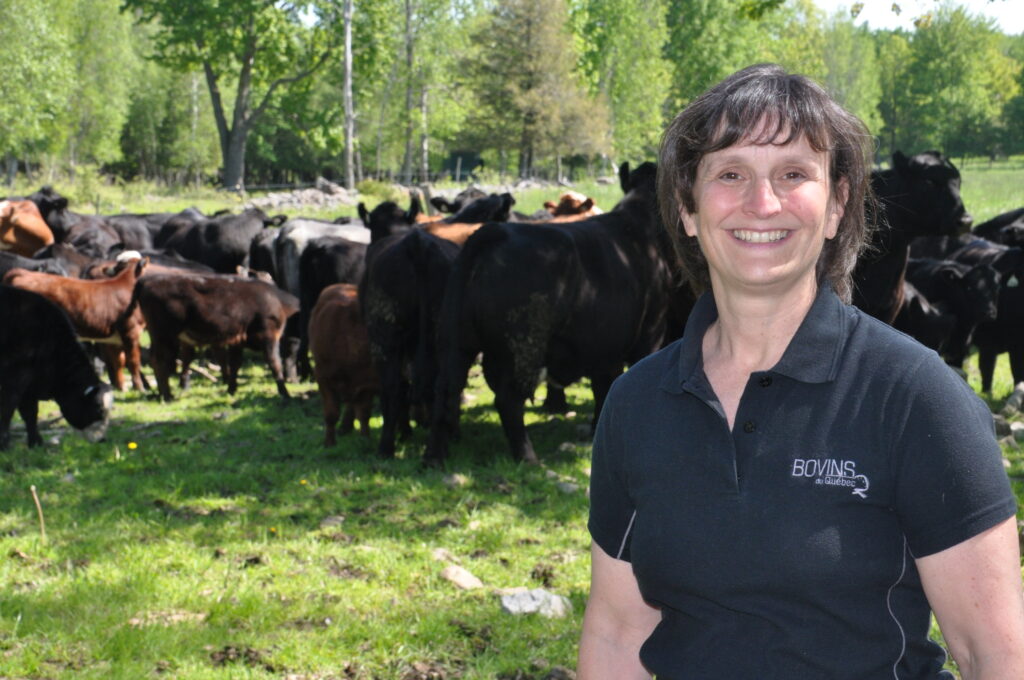
Nathalie Coté is the ex-officio council member that represents Les Producteurs de bovins du Québec. While Nathalie is not a beef producer herself, she works closely with producers through her role as an agrologist and with the Verified Beef Production Plus (VBP+) program.
The VBP+ program is a national program that enables certified beef cattle operations to prove to consumers and retailers that their operation adheres to the highest standards for food safety, animal care and environmental stewardship.
Nathalie has played a key role in reaching a broad range of producers who have decided to participate in the VBP+ program over the past year. Nathalie says that the success of the program has been due to several new initiatives and opportunities.
The first step was that they had both a dedicated staff as well as monetary support to help build the program. Nathalie and her team were able to offer in-person workshops, individual workshops over the phone, as well as online workshops. This allowed producers to choose their method of training and provided solutions that could work for most. Being flexible with how they offered training and thinking outside the box has helped to ensure all producers could have access to training.
Working directly with producers has been key to the success of Nathalie and her team. While she points out there is value to general advertising and promotion, the real changes start taking place when they can get one-on-one with producers to discuss their individual operations. She says that when they can walk producers through sample records and what the program looks like they are better able to see how it could work on their farm. Most producers quickly see that they are already doing many of the recommended practices. Formal participation in the program was simply about keeping records on the practices they were already doing.
Another thing Nathalie says that lead to increasing engagement with producers was partnering with other groups and organizations that were already involved with producers. This allowed them to increase awareness of the VBP+ program as well as build upon already existing events to provide training or interact with producers.
The commitment of end users such as packers, supply chains and restaurants has led to increased demand for VBP+-certified beef products which has also helped drive an increase in producer uptake.
For more information on the Verified Beef Production program including if it is a good fit for your operation check out: http://www.verifiedbeef.ca/
Click here tosubscribeto the BCRC Blog and receive email notifications when new content is posted.
The sharing or reprinting of BCRC Blog articles is welcome and encouraged. Please provide acknowledgement to the Beef Cattle Research Council, list the website address, www.BeefResearch.ca, and let us know you chose to share the article by emailing us at info@beefresearch.ca.
We welcome your questions, comments and suggestions. Contact us directly or generate public discussion by posting your thoughts below.
Eight beef producers share their recent changes
Canadian beef producers appear to be keeping up with the often heard axiom “the only constant in life is change”. With that in mind, these eight beef producers from across the country talk about recent changes they’ve made or are making in their farming operations.
Some of the changes are management related, others are operational, some involve getting a broader perspective of expert advice, and another was about how to make a job simpler when you’re wearing your mitts.
They are fairly easy to moderate, sometimes major changes – even a series of relatively small tweaks — these producers are making in management and production practices that either improve their management skills, increase forage or beef production efficiency, or just increase their knowledge to ultimately help them achieve the bottom line goals — save time or money, reduce costs, increase returns, improve profitability.
TREVOR WELCH GLASSVILLE, NB
Rotational Grazing and Forage Stand Improvements
Photo submitted by Trevor Welch
Trevor Welch has been developing a rotational grazing system on his western New Brunswick family farm over the past three years. Season long grazing was fairly successful with a small herd of beef cattle, but as he plans to expand the herd, he’s looking to increase the carrying capacity on a limited land base.
“We own most of our pasture land, and also rent some land as well,” says Welch, who is the fourth generation on the five generation farm — his son Taylor is interested in farming and his dad, Fred, is also still involved. As with most parts of Atlantic Canada a 40-acre pasture can produce enough forage to support a 30-cow beef herd for the season. “But with season-long grazing there were always some areas that would be underutilized and other areas that were overgrazed,” he says. The Welch’s run a herd of purebred and commercial Black Angus cattle.
In recent years, with the home pastureland for example, he has cross-fenced 40 acres into 12 paddocks. The perimeter of the field has a permanent fence, but most of the interior paddocks are created with portable electric fencing. The fencing has not only allowed Welch to move the cattle through the paddocks in sequence over the grazing season, but also gives him the opportunity to exclude cattle from certain paddocks as they are re-seeded to renew some 30-year old forage stands that had played out.
With the system he has developed each paddock is between two and three acres in size. During the grazing season, the herd is moved every two or three days to fresh grass. The rotation works so each paddock gets at least a 30-day rest to regrow before the herd returns.
While some areas of the field are reseeded, he also helps renew forage stands in other areas with frost seeding. This involves broadcast applying a forage seed mix to frozen ground in early spring, and then allowing cow hoof action to work seeds into the soil. “It’s not a dramatic difference but we are starting to see new forages emerge in areas where they weren’t before,” he says. The seed mix is a blend of grasses and legumes. He is including a new fescue grass seed with improved frost tolerance, that might help keep stands productive later in the season, since a killing frost in September is fairly common. Some paddocks each year also receive a manure application, from manure stockpiled from the winter feeding period.
Although the grazing system is still fairly new, Welch says the pasture is more productive. Depending on the growing season, he is able to stockpile forage in some paddocks during the summer so it can be used later in the fall, especially when growing conditions are usually dry.
With the combination of efforts — rotational grazing and forage stand improvements — he’s been able to extend the grazing season by two to three weeks. Over the next two to three years he plans to increase the stocking rate on the pasture to support up to 50 head of cattle in the rotational grazing system.
To also better manage time and resources he started a small fall-calving commercial-cow herd last fall. The purebred herd calves through February and March while the 10-head commercial herd calves in November. “By having another small group of calves ready for market at different times it helps with cash flow, and also improves workflow during the year,” he says.
GIB DRURY GATINEAU HILLS, QC
Putting Scrap Materials to Use
Gib Drury has a couple of recycling ideas that have made a difference on his western Quebec farm in the Gatineau Hills area, about 40 kilometres north of Ottawa.
Drury runs a 200 head commercial cow-calf herd and backgrounds about 350 head of feeders each fall and winter. Along with his own calves he buys another 150 head for backgrounding.
Photo supplied by Gib Drury
Part of his winter feed supply is stored as haylage — high moisture hay stored in airtight plastic tubing to ensile. Once the silage bales are removed he’s left with a tube of plastic that when cut open is 10 feet wide and 220 feet long. Rather than bundling it up and finding some way of disposing of it, he uses the plastic to protect baled hay.
Depending on the haying season, he hopes to produce good quality hay in large round bales, but inevitably some will get rained on and therefore are lower quality hay. Nothing goes to waste.
The good quality net-wrapped dry hay he stacks on the ground, in columns, two-bales high and two bales wide, flat side up. “On top of that hay I lay one of these opened plastic tubes to protect the hay from rain and snow,” says Drury. “And then a few poorer quality rained on hay bales are placed on top of the plastic to hold it in place. The plastic is put to good use and my hay is protected.” He says a great benefit of stacking hay this way is that the net wrap or twine never freezes to the bale in the winter, making it easier to remove.
Photo supplied by Gib Drury
One other great recycling idea involved making a better gate latch. Drury uses lap-type seat belts out of old vehicles to make an easy to operate gate latch. “Usually it is not hard to find an old vehicle someplace,” says Drury. “I cut the lap belts out, nail each cut end on each side of the post and I have a durable gate latch. What I really like about these latches is that I can open and close the latch (seat belt) with my mitts on. They stand up very well to the weather and if you do need another, they are not too hard to find.”
COREY VAN GRONINGEN CAYUGA, ON
Scheduled Movement and Segregation During the Calving Season
Van Groningen, who farms with family members at Cayuga, Haldimand County, west of Niagara Falls has been following the Sandhills calving system for several years. Basically it breaks the herd into three or six calving groups.
“A few years ago we were having problems with scours during calving season,” says Van Groningen. Even though they were vaccinating against scours, the whole herd would be held in one group for the on-pasture calving season that started in May. But as a few cases of scours developed it would spread through more animals over the six-week calving period.
“So with the Sandhills system (developed in the Nebraska sandhills) the whole herd starts calving on pasture and then every one or two weeks we sort out the cow-calf pairs, they stay behind and the rest of the herd that hasn’t calved moves to new fresh ground,” he says. “And then once there is a week or two worth of new calves on the second pasture, we sort again, and again move the cows that haven’t calved to new ground. And we keep doing that until everyone has calved.”
Depending on the rate of calving, Van Groningen does the sort and moves the herd every week creating six mini-calving seasons, or every couple weeks, creating three mini-calving seasons.
Photo supplied by Corey Van Groningen
“Since we’ve been doing it we haven’t had any problem with scours,” he says. “With each move a group is moving to fresh, clean ground so there haven’t been any scour outbreaks.” Van Groningen follows a fairly intensive rotational grazing system on the farm, so there are plenty of paddocks with fresh ground, and with portable electric fencing “we can create as many or any sized paddock we want.”
Another benefit of the system is reduced colostrum theft. “The other thing we observed when the herd was altogether is that we’d see some of the older (two-week old calves) nursing on some of the cows that had just freshened. So the older calves were stealing colostrum meant for the newborn calves. Sorting and moving the herd has solved that problem too.
“It does take more labour to sort and move cows, and you have to make sure watering systems are in place for each pasture, but we’re not having the work of catching and treating calves for scours,” he says. Also because cows are calving as grazing season is in full tilt, it takes some management to ensure paddocks are properly stocked to provide the desired level of grazing. “Overall, not having sick calves is well worth the effort,” he says.
RAMONA BLYTH MACGREGOR, MB
Grazing Polycrops into Winter
Photo supplied by Ramona Blyth
It’s been a little bit more than a tweak in management, but getting cattle out of the yard for several months over winter, and developing a nine to 10 month grazing program has helped the Blyth family of south central Manitoba improve efficiency on several levels.
Some of the fine tuning to that program in the past couple years has been to add polycrop seed blends to the forage program, says Ramona Blyth, who along with her husband Harold operate Rosehill Cattle Co. near MacGregor, about half way between Brandon and Winnipeg.
“It’s only been a couple years,” says Blyth, who is also chair of the Manitoba Beef and Forage Initiative. “But the polycrop acres have proven to be an excellent forage source and have helped to extend the grazing season. As winter feeding begins we can put out some excellent alfalfa hay, but the cattle still prefer to be nosing through the snow and the dirt to clean up the turnips and the last of the polycrops — they just love it.”
Polycrop seed blends can include a wide range of diverse plant species. Blyth has been trialing one blend that includes turnips, forage radish, hairy vetch, Italian rye grass, and crimson clover, along with oats and barley. They take a mid-season cut to produce polycrop hay or bales. And if the weather co-operates the stand will regrow to produce late fall grazing well into early winter.
Photo supplied by Ramona Blyth
The concept behind the potentially high yielding polycrops is that almost regardless of growing conditions, at least something will grow, and with moisture it becomes a very high yielding, high quality forage stand. The diversity of shallow and deep-rooted plant species also benefits the soil. The Blyths have two 45-acre fields they alternate between polycrops and grazing corn. The polycrops produce some baled feed as well as grazing in late fall, while the grazing corn is saved for January and February grazing before cattle are brought home for calving in March.
The Blyths run a mixed farming operation with about 350 head of commercial beef cattle as well as grain and oilseed crops. The beef grazing program today is considerably different than it was 20 years ago.
“You go back quite a few years and we use to bring the cows home to wean the calves and the cows would just stay in the corral and we’d feed them all winter,” says Blyth. It was not only an expensive way to feed, but manure had to be hauled and spread come spring. They began developing an extended grazing system.
Part of the program involved installing a system of buried, pressurized water lines to deliver a year round water supply to outlying pasture areas. It’s a cost effective, energy-free system. Large, used mining truck tires were modified into durable watering troughs. The geothermal heat of the water coming up through a standpipe from the underground waterline, for the most part keeps water from freezing. Occasionally on the coldest days they may have to break an inch or two of ice on the surface, but generally the water in the troughs remain open. Water flow is controlled by curb stop valves, so when troughs aren’t needed water can be shut off. Any water left is bailed out so it doesn’t freeze solid.
Winter pasture includes hayfield regrowth, some fenced cropped stubble land, rough areas in fields not suitable for annual cropping, as well some bushland. They also began producing a blend of oats and barley greenfeed which is cut and baled. The regrowth on those fields can be used for pasture as well.
Photo supplied by Ramona Blyth
With two farm locations in close proximity, cow-calf pairs are brought into an assembly yard for sorting at weaning in early November. The calves are brought to the home headquarters, while the cows head back out for late fall and winter grazing.
The cows will fall graze as long as possible until winter sets in, then large 4x4x8 square bales are hauled to pasture locations. “We let the cows direct us on this,” says Blyth. “If the weather is nasty and they’re in a bush area then we place their feed in the bush area as well.” While mature trees are protected to provide year round shade and windbreaks for the herd, feeding in the bush area helps to knock down brush removing some of the ground cover. “It is surprising how much it opens things up,” she says. “We are starting to see more grass, more grazing, in the bush areas as well.”
TIM OLEKSYN PRINCE ALBERT, SK
Active, Life-Long Learning
Being open to new ideas, listening, talking to experts, trying new technology and concepts — this philosophy has helped Oleksyn Bros Farms adopt a wide range of changes over the years, says Tim Oleksyn. He is one of three brothers, all born and raised on and operating the mixed cattle and grain family farm in north-central Saskatchewan near Prince Albert, northeast of Saskatoon.
Photo supplied by Tim Oleksyn
The “open to new ideas” philosophy has always served Oleksyn well in managing a commercial cross-bred beef herd that ranges in size from “sometimes too many, sometimes not enough” head. Working with horned Hereford, red factor Charolais and Red Angus genetics they’ve developed a successful program for producing F1 cattle.
“We’ve put money into trying a number of different products and technology over the years,” says Oleksyn. “And yes, it is usually money up front, but I think in just about every case each of those new ideas or those changes has improved our bottom line so I consider them good investments.”
He admits that while sometimes he thinks he knows a lot, he is a big believer in developing good networks, good partnerships within the industry, where perhaps he can learn something. For example, a partnership of expertise that includes his local veterinarian, research organizations such as the Beef Cattle Research Council, university experts, vet colleges, animal health product suppliers and others.
Listening to advice from that partnership he has tried new products such as meloxicam to reduce pain and stress in animals being processed, intranasal vaccines which provide improved health protection for young calves, learned different strategies of using or not using certain antibiotics — some of the measures he’s tried that have either reduced cost, improved herd performance or both.
Photo supplied by Tim Oleksyn
He says he’s discovered small and not so small technology changes improve his workload on a daily basis — he’s still using the first of several solar panels he’s installed to help pump water at remote watering sites, electric drive thru gates save him time and steps when getting feed out of the silage pits. RFID ear tags are not only of value for the Canadian beef cattle traceability system, but his cows can lose dangle tags when grazing in timbered areas, so the RFID tags also help with his own herd management, and he’s really impressed with new genetic testing technology “just on the cusp” of being able to provide chute side read outs on herd sire identification.
He also likes to participate in industry webinars which discuss new tools and new concepts. And he’s figuring out one of the most valuable changes is “learning to not talk, but listen to others. As I get older, there are a lot more young people involved in the industry and it is important to listen to them,” he says. “I’m finding they may be half as young as me, but three times as smart.”
LARRY SPRATT MELFORT, SK
Saving Time with the Right Equipment
Photo supplied by Larry Spratt
Larry Spratt says several relatively small to mid-size changes in recent years in the beef operation on their family-run mixed farming operation at Melfort, on the north-easterly side of Saskatchewan have added up to improve overall efficiency in the farming operation.
Along with 150 head of purebred Maine-Anjou and Angus cattle, they also crop about 6,000 acres and have another 1,500 acres of hay and pastureland. The challenge he says was to find efficiencies making the operation more manageable for the four Spratt families involved with Donaro Farms. They don’t hire any outside farm labor.
“The changes weren’t necessarily major,” says Spratt. “But if we could make some changes that saved fuel and time — saving 10, 15, 20 minutes a day may not seem like much, but you save that every day over five months of winter feeding, that’s several hours of tractor idling time and perhaps I am saving two, three or four days where my time could be better spent doing something else.”
With most of their pastureland located about 20 miles from the main yard, they spent extra time hauling cattle in two smaller stock trailers. They decided to invest in a cattleliner — rather than making four trips with small trailers, they could move everything in one cattleliner load.
With the winter-feeding program in that part of Saskatchewan usually starting in late October, they looked at the feeding equipment. They had a high capacity mixer wagon for feeding cattle, but a bottleneck in preparing the ration was a small grain auger that took about 15 minutes to fill the wagon for each load. They bought a larger auger with double the capacity. “The larger auger could put the grain needed in each load in five minutes rather than 15 minutes,” he says. “Again over the course of the winter those minutes add up.”
Photo supplied by Larry Spratt
Another project he hopes to tackle this coming year is a portable penning or corral system that can easily be moved to pastures. As some of their pastureland is divided by roads, they had built or inherited what are now older permanent corrals. To improve those facilities they built some 30-foot long steel tubing panels out of used oilpatch drilling pipe, but those panels need to be moved with a front-end loader and a flat deck truck. Spratt hopes to get into the shop at some point this year to build a self-contained penning system that can be moved and easily set up from pasture to pasture as needed.
During haying season he takes a tractor trailer unit with a flatdeck trailer to the field and brings a load of bales home each day, rather than making multiple trips later on with a pickup truck and smaller trailer. “I have to get there somehow anyway, so I might as well make each trip pay,” he says.
“It does cost some money to increase the size of equipment, but at the same time I am spreading those costs over several years, improving the economy of scale, and as I say minutes saved here and there add up into hours and days where my time can be better spent.”
IAN MURRAY ACME, AB
Taking a Systems Approach
Ian Murray has gained efficiencies on their south-central Alberta ranch by looking at things on a systems approach. Murray, along with family members operates Shoestring Land and Cattle Co. near Acme, about an hour north of Calgary, where they run between 180 and 200 head commercial cow-calf herd and backgrounding/yearling operation.
By extending the grazing season as much as he can, he’s cut winter feeding down to one to two months.
Photo supplied by Ian Murray. Photo by Shanyn Silinski
“With a systems approach, for example, our hayland isn’t just hayland,” he says. “We take a cut of hay in late June or early July but that sets it up to regrow and then provide grazing later in the year — so it is both hay and pasture land.”
Another aspect of the systems approach in recent years has been a move to delayed weaning in February. The cowherd calves May/June on pasture, but instead of weaning in October as they did for many years, the calves stay with their mothers on swathing grazing until mid-February.
“As a rule with swath grazing it costs about $1 per day to feed a cow for the winter and about 50 cents per day for her calf,” he says. “That’s a considerably lower cost than if I had put those calves in a lot and started feeding a backgrounding ration. As well, all the manure — nutrients — stay out on the field.”
Calves born in May 2018, for example, will be sold as 950 pound grass yearlings come the fall of 2019. Murray says while their rate of gain might be lower on several months of swath grazing, they soon make up any weight once they hit grass the following spring.
“Another reason we like to delay weaning is that our cows were getting too fat on swath grazing the oats and triticale swaths alone,” says Murray. “So by keeping the calves with them, they have to work a little harder and don’t get over conditioned.” As nine or 10 month old calves when they are weaned, both cows and calves experience much lower stress, he says. They sort the calves into a corral, the cows remain within contact in a field on the outside of the corral — “And last February I stuck my head outside the door the night after we had weaned and there wasn’t a sound,” he says.
One further efficiency in the system they’ve developed, the size of the cowherd is geared toward the minimum carrying capacity of the ranch. The yearlings provide flexibility. “Even in a dryer year we know we have the grass and feed to support the herd we have,” says Murray. “So if conditions warrant we can move some of the yearlings to a feedlot and either sell them or retain ownership depending on the market, but cowherd numbers aren’t going up and down.”
DUNCAN BARNETT 150 MILE HOUSE, BC
Pasture watering systems
Protecting and dealing with the environment has led Duncan Barnett to adopt a number of management changes on his ranch in the Cariboo region of the B.C. Interior.
It’s not just about just being a good steward of the environment, but also reflects improving animal welfare, and ultimately improving beef herd production, says Barnett who ranches on Horsefly Road, east of Williams Lake.
One of the most recent changes, following an extremely dry growing season and record year for forest fires in the B.C. interior, was a decision in late 2017 to switch his long established straight cow-calf operation to a cow-calf and yearling operation.
Photo supplied by Duncan Barnett
Another change he’s made in recent years, which benefits both the environment and beef herd production, is the development of off-site pasture watering systems. Actively involved in the Environmental Farming Planning program, Barnett says it was important to keep cattle away from lakes and creek to protect riparian areas near the water bodies, to protect water quality, and at times of the year when run-off can lead to flooding, to also protect livestock.
He has fenced cattle away from a lake and river that are part of his ranch and summer pastures, and where possible developed dugouts to collect runoff and hopefully provide at least seasonal and hopefully year round water supply. The dugouts have also been fenced off.
He’s tried a number of off-site water systems to deliver water to troughs for cattle on pasture — gravity pipelines, gasoline powered pumps and solar powered pumps. One of the most reliable he’s found is energy-free “cow powered” technology referred to as nose pump. Barnett has one permanent winter watering nose pump system near the home yard, and has also developed a portable nose pump system he can trailer from pasture to pasture and connect by water line to water in a dugout, pond or river.
“There is a capital cost for the equipment and to get the systems set up properly,” says Barnett. “But once it is in place it provides a trouble free and reliable watering system, that keeps cattle out of the water source. They learn very quickly how to use the nose pump, they prefer drinking clean water, and I believe it also improves overall performance.
“The portable system also improves pasture management. As long as I can tap into a water supply I can bring water to pasture areas that normally may not get used. The system makes it possible to protect the water source, yet bring clean, fresh water to the herd.”
Click here tosubscribeto the BCRC Blog and receive email notifications when new content is posted.
The sharing or reprinting of BCRC Blog articles is welcome and encouraged. Please provide acknowledgement to the Beef Cattle Research Council, list the website address, www.BeefResearch.ca, and let us know you chose to share the article by emailing us at info@beefresearch.ca.
We welcome your questions, comments and suggestions. Contact us directly or generate public discussion by posting your thoughts below.