Hot Water Treatment of Beef Trim

This article written by Dr. Reynold Bergen, BCRC Science Director, originally appeared in the March 2015 issue of Canadian Cattlemen magazine and is reprinted on the BCRC Blog with permission of the publisher.

Click to view digital issue

Combating bacteria would be simple if they stayed on the surface of beef. In that case, nearly any spray or wash could contact and kill the bacteria or wash them off. But beef isn’t smooth. Shallow cuts and cracks crisscrossing the meat surface can hide and protect bacteria. Killing these hidden bacteria is not simple. Irradiation would work, but isn’t approved for use in Canada yet. Organic acid washes and sprays may not reach the bacteria hidden in these cracks, or the acids may be neutralized by the meat proteins before bacteria can be killed. To kill these bacteria, food safety interventions need to penetrate a short distance into the meat surface. This is particularly important for beef trim (the small pieces of fat and meat that are removed as the carcass is processed into smaller cuts) that is used for hamburger. The late Dr. Colin Gill of AAFC Lacombe showed that exposing beef trim to extremely hot water essentially “cooks” the top few millimeters, and kills up to 90% of bacteria.

This raises an interesting dilemma. Consumers want safe beef, but they also value price, appearance and taste. As part of the Canadian Cattlemen’s Association’s (CCA) E. coli O157 Research and Education Strategy, Zeb Pietrasik and Nicole Gaudette of Alberta Agriculture and Rural Development’s Food Processing Development Center in Leduc worked with Mark Klassen of the CCA to identify whether hot water treatment can improve the safety of beef trim without compromising consumer acceptance. This research was funded by the Alberta Livestock and Meat Agency.The first phase of the research compared bacterial counts on  untreated beef trim (65% or 85% lean) to trim sprayed with 85oC water for 20, 40 or 60 seconds. They also compared the color and processing characteristics of ground beef made from treated or untreated trim. The second phase examined consumer acceptability of ground beef made from hot-water treated trim.

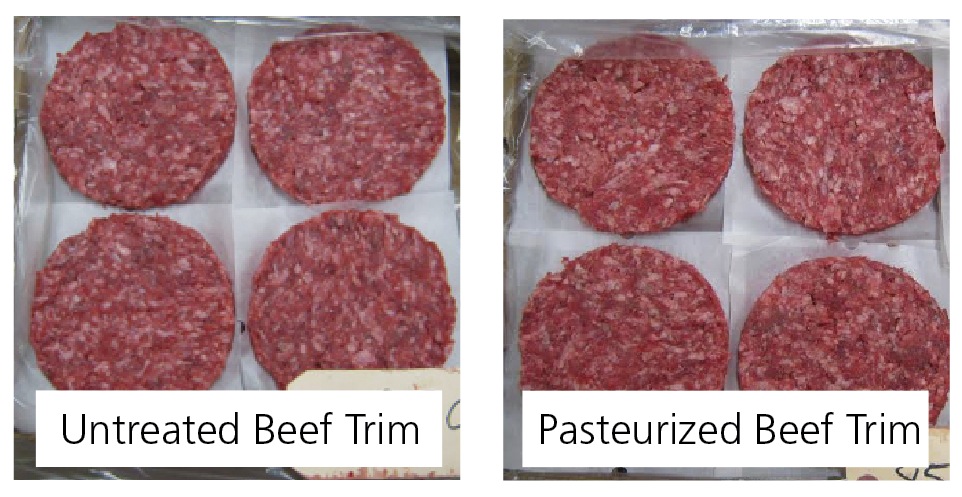
In phase 1, treating trim for 20 seconds did not reduce aerobic bacteria compared to untreated trim, but treating trim for 40 seconds reduced bacterial counts by 90%. Treating trim for 60 seconds provided no further improvement.  The 40 second treatment also had negligible effects on the color, cooking characteristics or texture of cooked ground beef.

Based on the results from Phase 1, Phase 2 compared untreated trim to trim treated with 85oC water for 40 seconds. The trim was refrigerated for 1, 7, 10 or 14 days before being ground into 70% (regular) and 85% (lean) ground beef. Some ground beef was packed in chubs and refrigerated for 2 or 4 weeks before being assessed for color and spoilage. The remaining ground beef was formed into ground beef patties and assessed for microbiology, color, odor, appearance and shelf life over a 3 day period in a simulated retail meat case. Some patties were frozen for 6 to 8 weeks then assessed for oxidation and cooking characteristics.

Screen Shot 2014-10-09 at 3.33.39 PM

Trim: Regardless of lean content (65% vs. 85%), treating trim with 85oC water for 40 seconds did not cause the trim to gain or lose weight. Treated trim had lower bacterial counts than untreated trim throughout the storage period.  Treated and untreated trim smelled similar early in the storage period, but spoilage odors were less noticeable in the treated than in the untreated trim after 10 to 14 days.

Refrigerated ground beef: Chubs of ground beef made from treated trim spoiled much slower (4 weeks) than chubs made from untreated trim (2 weeks). No color differences were detected between ground beef from made from hot water treated trim vs. untreated trim.

Fresh patties: Bacterial numbers stayed lower for a longer period of time in patties made from treated trim than those made from untreated trim.  As a result, hot water treatment extended the retail shelf life of burger patties by 4 days. Patty color varied with long the trim was stored before grinding, fat level of the burger, and how long the patties were in the simulated retail case, but these color changes were similar regardless of whether patties were made from treated or untreated trim.

Cooked patties: Hot water treatment did not affect the cooking characteristics (weight loss, shrink) or texture (e.g.  hardness, chewiness) of ground beef patties.  A panel of 300 consumers did not report any differences in the appearance, color, flavor, juiciness, texture or aftertaste of beef patties made from treated vs. untreated trim.

Treating trim with 85oC water for 40 seconds reduces bacterial counts and extends the shelf life of ground beef, with no negative impacts on consumer acceptability of the retail product. Subsequent focus group testing found that consumers viewed hot water treatment of trim in a positive light.

Click here to subscribe to the BCRC Blog and receive email notifications when new content is posted.

The sharing or reprinting of BCRC Blog articles is typically welcome and encouraged, however this article requires permission of the original publisher.

We welcome your questions, comments and suggestions. Contact us directly or generate public discussion by posting your thoughts below.

Flipping for Mechanically Tenderized Beef

This article written by Dr. Reynold Bergen, BCRC Science Director, originally appeared in the October 2014 issue of Canadian Cattlemen magazine and is reprinted on the BCRC Blog with permission of the publisher.

Click to view digital issue

All food surfaces carry bacteria, including steaks and roasts. Because beef cooks from the outside in, the outer surface is exposed to higher temperatures for a longer time than the inside of the beef. The heat of cooking will inactivate bacteria as long as they remain on the outside of cuts, and the surface is cooked thoroughly. That’s why steaks and roasts can be eaten rare. In ground beef, microbes from the surface get mixed throughout the beef, so consumers are encouraged to cook ground beef to an internal temperature of 71oC.

Mechanical tenderization pierces beef with small blades or fine needles. This cuts the connective tissue and makes the beef more tender. This improves the eating quality of lower cost, tougher beef cuts. Price and tenderness are two of the major drivers of consumer buying behavior and eating satisfaction, so mechanical tenderization has proven quite useful. Approximately 20% of Canadian beef is mechanically tenderized.

But if there are microbes of the surface of the steak, mechanical tenderization may push some of them deeper into the muscle. Other steaks in the same processing batch may be cross-contaminated if the blades transfer microbes from one steak to the other. Taking care to disassemble, thoroughly clean, sanitize and dry the equipment between batches is critical to minimize this risk. This risk became very apparent in 2012, when several human E. coli O157:H7 infections were linked to mechanically tenderized beef.

In response, Health Canada proposed labelling mechanically tenderized beef with recommended cooking instructions. Initially, the proposed label recommended cooking mechanically tenderized beef to 71oC (well-done).

This posed a dilemma for packers, retailers and restaurants. Mechanical tenderization makes beef more tender, but cooking a steak until it is well-done makes it tougher, drier and less tasty. If consumers are asked to choose between eating satisfaction and safety, they may choose not to buy beef. Canada’s beef industry should be able to ensure both satisfaction and safety.

National check-off funds from the Beef Cattle Research Council (BCRC) and provincial government funding from Alberta Livestock and Meat Agency supported a series of research projects to identify the best way to cook mechanically tenderized beef. This research was led by Drs. Colin Gill and Xianqin Yang at Agriculture and Agri-Food Canada’s (AAFC) Lacombe research center, and was published in the Journal of Food Research (2:77-89) and the Journal of Food Protection (6:919-926).

What They Did

Eye of round steaks (1 to 3 cm thick) were deliberately inoculated with known amounts of E. coli O157:H7. The E. coli inoculation sites were marked with a dye. After refrigeration, the steaks were barbequed or cooked on a hot plate (skillet). Internal temperature was monitored at various locations in the steak during cooking. Some steaks were flipped once during cooking, some were flipped twice, and others flipped more often. Steaks were cooked until the centers reached temperatures ranging from 56oC to 75oC. The numbers of E. coli that survived the cooking process were then counted.

What They Learned

The internal temperature at the center of a steak is not the only indicator of food safety; how often the steaks are flipped is important too. Flipping steaks only once allowed some of the E. coli to survive, even if the center of the steak was cooked to a well-done endpoint. Heat doesn’t always penetrate the steak at a uniform rate, so not all parts of the steak were heated enough to inactivate all of E. coli when flipped once. When steaks were flipped twice or more at four minute intervals, they heated more uniformly, and no E. coli survived. More E. coli were inactivated in steaks that were flipped twice and cooked medium-rare (63oC) than in steaks that were flipped only once and cooked well-done (71oC).

What it Means

Mechanically tenderized beef can be prepared safely without cooking it like hamburger. These research results were submitted to Health Canada as they developed the new labels for mechanically tenderized beef. The Health Canada label was finalized and released in August. The new label recommends that mechanically tenderized beef be cooked to a minimum internal temperature of 63oC (medium rare), and flipped at least twice during cooking.

These researchers and the producer check-off dollars that fund their work are essential to developing effective, science-based solutions to important industry challenges. Industry check-off dollars supported Dr. Yang’s training through the first Beef Science Cluster, and the BCRC worked to have AAFC hire her as a research scientist. This research contributed to a simple, practical, easy-to-follow label for mechanically tenderized beef, and is an example of how industry check-off funds are important to ensure that Canada maintains core research expertise.

Click here to subscribe to the BCRC Blog and receive email notifications when new content is posted.

The sharing or reprinting of BCRC Blog articles is typically welcome and encouraged, however this article requires permission of the original publisher.

We welcome your questions, comments and suggestions. Contact us directly or generate public discussion by posting your thoughts below.

Bug Spray for Beef?

This article written by Dr. Reynold Bergen, BCRC Science Director, originally appeared in the January 2014 issue of Canadian Cattlemen magazine and is reprinted with permission.

The last two research columns have been about technologies and best practices that large and small beef packers can adopt to avoid bacterial contamination during dressing of beef carcasses, and to avoid bacterial (re)contamination of beef cuts and trim during further processing. Ground beef is more of a food safety risk than other cuts, for reasons discussed in last month’s column. As a result, Dr. Colin Gill, Xianqin Yang, Madhu Badoni and Mohamed Youssef of AAFC’s Lacombe Research Station have studied whether lactic acid sprays can combat E. coli in beef trim. This research was funded under the Beef Science Cluster and published in 2012 and 2013 (Food Control 25:717-722 and 34:13-16).

Lactic acid is a natural compound. It is responsible for the sour flavor of yogurt and sourdough bread. The body also produces lactic acid; this is what makes muscles “burn” during intense work or exercise. It also has antibacterial properties. However, some types of E. coli (e.g. E. coli O157:H7) can be acid tolerant. If lactic acid kills harmless bacteria but not E. coli O157:H7, then E. coli O157:H7 will have no other competitors, and could grow and multiply unchecked. That could mean that an acid treatment meant to improve beef safety could actually backfire and make it less safe. In addition, the researchers needed to determine what lactic acid concentrations and spray volumes would be most effective.

What They Did

This research was done under controlled lab conditions. The researchers inoculated muscle, fat and membrane-covered meat surfaces of beef trim with high (100,000 cells per 10cm2 of trim), medium (10 cells per 10cm2) or low (1 cell per 10cm2) levels of E. coli (including acid-adapted E. coli O157:H7). The trim was then sprayed with water containing 0%, 2% or 5% lactic acid. Two different spray volumes were used (0.02 ml or 0.5 ml per cm2). Numbers of bacteria that survived were counted.

What They Learned

Acid tolerance of E. coli: Lactic acid was just as effective against E. coli O157:H7 as against harmless E. coli. This was somewhat unexpected. But remember, packing plants routinely apply acid sprays to carcasses after evisceration. So the E. coli that survive that process are already somewhat acid tolerant, whether they are E. coli O157:H7 or not.

Lactic acid concentration: Generally, the 5% lactic acid solution killed more E. coli than the 2% solution. Water alone was least effective. The differences were smaller than expected, though. Proteins and other naturally occurring compounds in the beef may have buffered and inactivated some of the acid.

Spray volume: Higher spray volumes were more effective than low volumes in trim samples that were inoculated with large numbers of E. coli. But the volume of spray used didn’t matter very much in trim samples that had been inoculated with small numbers of E. coli.

Meat surface: Spray treatments eliminated E. coli from meat surfaces covered with a shiny, smooth membrane of connective tissue more effectively than from fat-covered surfaces or cut muscle surfaces. The fat and muscle surfaces have microscopic cuts and cracks where bacteria can hide and be protected from the acid sprays. This partly explains why larger acid volumes were only more effective in trim samples that had high levels of E. coli. When a lot of bacteria are present, many are on the surface and can be washed off completely, but the bacteria hiding in the cracks will be protected from the acid. When very few bacteria are present, the ones on the surface will still be washed off, but not the ones in the cracks. So the numbers of bacteria hiding in the cracks that survive the spray treatment may be roughly the same regardless of the initial degree of surface contamination.

What it Means

Lactic acid sprays may improve the safety of beef trim produced by processing plants with high levels of E. coli contamination. But modern packing plants are already capable of producing beef trim with extremely low levels of E. coli. Beef processing facilities that have introduced and maintain effective pathogen interventions to prevent microbial contamination of the carcass before, during and after dressing, and that regularly and thoroughly clean conveyor belts and other fixed equipment, knives, gloves, and worker’s hands will probably not benefit from spraying lactic acid onto beef trim. Other recently-completed cluster research indicates that irradiation is a much more effective tool to combat E. coli in beef trim.

Click here to subscribe to the BCRC Blog and receive email notifications when new content is posted.

The sharing or reprinting of BCRC Blog articles is typically welcome and encouraged, however this article requires permission of the original publisher.

We welcome your questions, comments and suggestions. Contact us directly or generate public discussion by posting your thoughts below.

Better Housekeeping

This article written by Dr. Reynold Bergen, BCRC Science Director, originally appeared in the December 2013 issue of Canadian Cattlemen magazine and is reprinted with permission.

Last month’s column discussed a Beef Science Cluster study conducted by Dr. Colin Gill, Xianqin Yang, Madhu Badoni and Mohamed Youssef of AAFC’s Lacombe Research Station. These researchers found that both large and small packing plants can produce dressed beef carcasses with very few E. coli bacteria, even though they use very different food safety interventions and strategies. But E. coli-related recalls still happen occasionally. How does beef get contaminated when the carcasses carry so few E. coli? Two papers published by this research team (Journal of Food Protection 75:144-149 and Food Control 31:166-171) help explain how this can happen.

What They Did:

This research was done in a large packing plant that processed up to 280 cattle per hour, and a small packing plants that processed up to 200 cattle per week. Bacterial counts were made on carcasses leaving the cooler, then on workers hands, gloves, conveyor belts, beef trim (for grinding) and primal cuts (e.g. for steaks and roasts) as the beef moved from the chiller through the fabrication line.

What They Learned:

Chilling successfully prevented microbial growth on the carcass sides in the larger plant. In the smaller plant, carcasses actually had 99% fewer viable E. coli after chilling than when they entered the cooler three days earlier. The longer cooling time used by the smaller plant allowed the carcass surface to become drier, which killed more E. coli.

Conveyor belts are a potential source of bacterial recontamination. Some conveyor belt parts (e.g. plastic slats on conveyor belt surfaces) are simple to clean routinely. Other parts (e.g. hinges between slats) are very difficult to clean thoroughly. These hard-to-clean parts may act as a hiding spot and breeding ground for microbes. More E. coli were found on conveyor belts at the smaller plant, indicating the larger plant did a better job of routinely cleaning and drying its conveyor belts and other fixed equipment.

Beef: Hamburger (ground beef trim) carries a higher risk of bacterial contamination than muscle cuts. A one inch cube of beef trim has a surface area of six square inches. If this cube is ground through a 1/8 inch die, it’s exposed surface area increases to more than 30 square inches. At the same time, any bacteria that may have been on the surface of the original cube will be mixed in, and will have a lot more meat surface area to grow and multiply on. This is why it is so important to always cook hamburger to a “well done” endpoint. Unlike trim, bacteria on the surface of steaks or roasts will remain on the surface, so they will be exposed to (and killed by) full heat for as long as the beef is cooked.

E. coli numbers were very similar on primal cuts and trim from the smaller plant and primal cuts from the larger plant. However, trim from the larger plant actually had lower E. coli numbers than primal cuts. This is probably because primal cuts are handled repeatedly as they move down the fabricating line, but trim isn’t. The larger plant may be able to control E. coli levels on primal cuts better if it changes how it manages worker’s gloves.

Gloves keep worker’s hands from contacting the meat surface. But cotton or steel mesh gloves will not prevent bacterial contamination. Bacteria are everywhere in every environment, so worker’s hands can be contaminated in a variety of ways before they put their gloves on and begin work. In fact, office staff had as much E. coli on their hands as the line workers did at the end of their shifts.  At the larger plant, line workers wore cotton gloves underneath steel mesh gloves. Cotton and steel mesh gloves are porous, so they will not prevent bacterial movement from hands to meat. In fact, warm hands and wet cotton gloves may provide a good environment for bacterial growth. Line workers at the smaller plant wore rubber gloves over top of the cotton and steel mesh gloves. This may have helped reduce bacterial movement from gloves to meat. This helped the smaller plant reduce the amount of bacteria that were re-introduced to the primals as they were repeatedly handled on the fabrication line.

What it Means:

Bacteria are present in both large and small beef plants. But the risk of contaminated beef can be minimized when beef processing facility management and workers understand and effectively implement known best management practices. Under the second Beef Science Cluster, this research team will help beef processing plants identify how to adjust in-plant practices to improve food safety.

Click here to subscribe to the BCRC Blog and receive email notifications when new content is posted.

The sharing or reprinting of BCRC Blog articles is typically welcome and encouraged, however this article requires permission of the original publisher.

We welcome your questions, comments and suggestions. Contact us directly or generate public discussion by posting your thoughts below.

More Than One Way to Skin a Cow

This article written by Dr. Reynold Bergen, BCRC Science Director, originally appeared in the November 2013 issue of Canadian Cattlemen magazine and is reprinted with permission.

This time last year, Canada’s beef industry was coping with the Lakeside-XL beef recall. That event focused attention on the safety of Canadian beef, and the practices that the beef packing industry uses to manage food safety risks.

Since the late 1990’s, North America’s beef processors have used Hazard Analysis Critical Control Point plans (also called HACCP, and pronounced “hassip”) to improve food safety. A HACCP plan identifies food safety hazards, identifies the steps that can adequately control those hazards, actively monitors the controls that are implemented, outlines how to fix problems that arise, develops ways to verify that these management practices are working, and keeps records to document that these steps are being done right. Not all packing plants are designed and built from the same blueprint, so each plant has unique challenges. Rather than impose a one-size-fits-all solution on every packer, HACCP plans are tailored and customized for different plants. Federally inspected beef packing plants develop their own HACCP plan, and the CFIA audits the plant to ensure they are following the plan.

In the case of bacterial hazards like E. coli, HACCP plans aim to prevent bacteria from dust, hair, tag, manure and gut contents from contacting the meat. The most obvious critical control points are on the kill floor, when the hide is removed and the carcass is eviscerated. Large companies can afford more costly and complex technologies to combat E. coli at high line speeds. Small plants can’t afford these technologies, but they can take more time to skin and dress carcasses. In a recent Beef Science Cluster study, Dr. Colin Gill, Xianqin Yang, Madhu Badoni and Mohamed Youssef from AAFC’s Lacombe Research Station compared E. coli levels on beef carcasses at commercial beef plants. These results were presented at the 2012 International Congress of Meat Science and Technology, and published in the Journal of Food Protection (75:144-149).

What They Did:

These researchers visited a large (up to 280 cattle per hour), and a small (200 head per week) beef packing plants. The large plant had installed a battery of technologies to combat bacterial contamination. Hide-on carcasses were first washed with 1.5% caustic soda at 55oC and rinsed with chlorinated water. After skinning, but before dressing, carcasses were washed then spray-washed with 5% lactic acid. Dressed carcasses were trimmed to remove visible contamination. After splitting, carcass sides were washed and sprayed with 5% lactic acid before being steam pasteurized (over 90oC) and chilled. The small plant used fewer interventions. Skinned carcasses were simply washed and trimmed to remove visible contamination before chilling.

Swab samples were collected from several sites on 25 randomly selected carcasses as they moved through each packing plant. Numbers of E. coli were counted in each sample.

What They Learned:

In the early 2000’s, commercial beef packing plants in Canada were capable of producing carcasses with as few as 40 viable E. coli cells per carcass. This study showed how food safety interventions have improved since then. In the large plant, some E. coli were found after skinning, fewer after washing and none after the first acid spray. No E. coli were found on the freshly dressed carcasses, either.  Some E. coli reappeared on the carcass sides after splitting, but these E. coli were nearly eliminated by the next washes and acid sprays. There were so few E. coli left that the steam pasteurizer didn’t appear to help very much. The large packing plant produced carcasses with as few as 4 viable E. coli cells per carcass (90% fewer than in the early 2000’s). The small plant had fewer, simpler tools at its disposal. But it allowed carcasses to dry as they chilled, and this resulted in only 40 E. coli per carcass. The small plant did as well as large plants could in the early 2000’s.

What It Means:

Different HACCP solutions work for different packing plants. Careful dressing and effective carcass cleaning practices used in large commercial packing plants can essentially eliminate E. coli from carcasses. Smaller plants that cannot afford costly equipment can still produce carcasses with very few E. coli by drying carcasses during chilling. Carcass decontaminating treatments and carcass drying are likely just as effective against E. coli O157:H7 and Salmonella as they are against generic E. coli. With current practices at Canadian plants, the risks from pathogens on carcasses are largely eliminated.

Alert and skeptical readers will ask why E. coli recalls continue to occur, given that Canada’s beef processors can produce virtually pathogen-free carcasses. Next month’s column will help to answer that question.

Click here to subscribe to the BCRC Blog and receive email notifications when new content is posted.

The sharing or reprinting of BCRC Blog articles is welcome and encouraged, however this article requires permission of the original publisher.

We welcome your questions, comments and suggestions. Contact us directly at info@beefresearch.ca or generate public discussion by posting your thoughts below.

How do Carcass Processing Procedures Impact Food Safety?

Canadian beef packing plants have progressively and effectively modified their processes over time to reduce the levels of harmful bacteria contamination on product. Studies have shown that carcass pasteurizing is generally effective in commercial practice, but cuts and trim carry more E. coli than beef in its whole carcass state. Therefore beef is being contaminated during carcass breaking. What’s the source of the bacteria?

A recently-completed research project, funded by the National Check-off and Canada’s Beef Science Cluster, worked to determine how

  • beef carcass dressing and breaking processes,
  • carcass and cut treatments and
  • cleaning of both plant equipment (e.g. conveyors) and personal equipment (knives and gloves)

affect the microbiological condition of beef carcasses, cuts and trim.

The study found that careful dressing and effective carcass cleaning practices used in large commercial packing plants can essentially eliminate E. coli from whole carcasses. Smaller plants that cannot afford to install costly equipment can still produce carcasses that carry very few E. coli by drying carcasses during chilling. Personal equipment was the source of most of the E. coli deposited on cuts. Conveyer belts, to a lesser extent, were also a source of contamination.

Following treatment of carcasses, bacterial contamination can be wholly avoided by ensuring that hands, cotton gloves, steel mesh gloves and knives are thoroughly and regularly cleaned, and by wearing disposable rubber gloves between cotton gloves and steel mesh gloves. Control of bacterial contamination from conveyors and other fixed equipment has benefited from improved equipment cleaning processes developed in recent years, and can be enhanced by thoroughly drying equipment after it has been cleaned.

To learn more about this research, view the fact sheet.

The sharing or reprinting of BCRC Blog articles is welcome and encouraged. Please provide acknowledgement to the Beef Cattle Research Council and list the website address, www.BeefResearch.ca.

We welcome your questions, comments and suggestions. Contact us directly at info@beefresearch.ca or generate public discussion by posting your thoughts below.

Stay connected by following us on Twitter @BeefResearch, liking us on Facebook, and subscribing to our YouTube Channel.

Click here to subscribe to the BCRC Blog and receive email notifications when new content is posted.