Prenez des décisions éclairées pour votre opération avec des informations livrées directement dans votre boîte de réception.
Obtenez les derniers outils, innovations et informations scientifiques pour l'industrie canadienne du bœuf, y compris des considérations sur la production saisonnière et des analyses économiques.
Ropes, Chutes or Darts? How to Safely Treat Sick Cattle on Pasture
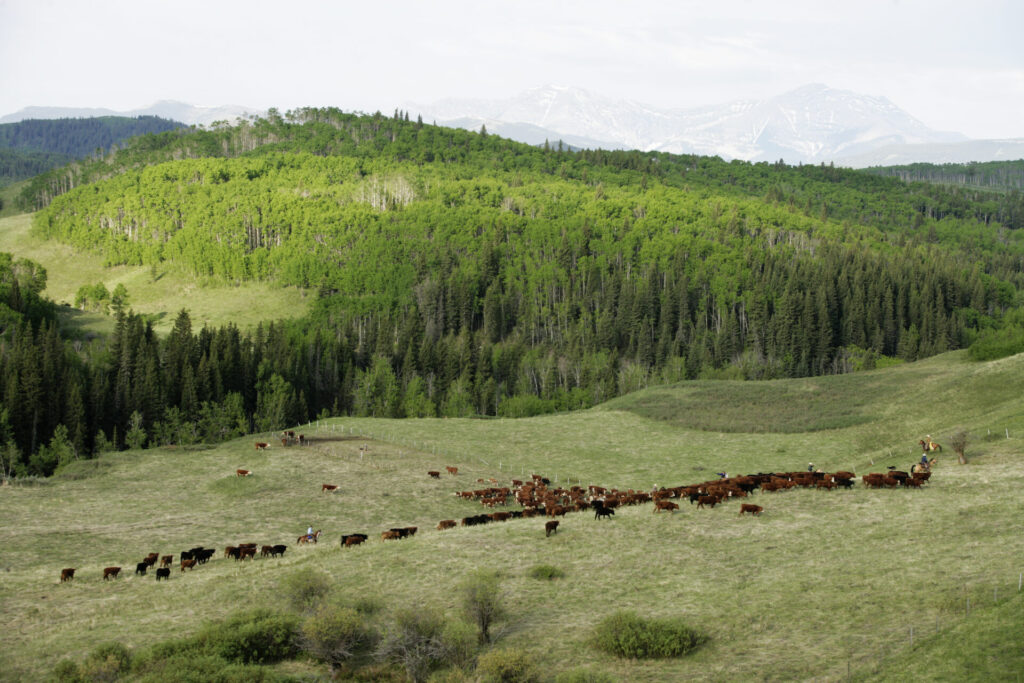
There is no more idyllic scene than a herd of cattle on a lush green pasture in the Canadian landscape. Everyone loves to see the hillsides dotted with animals enjoying the benefits of May rainfall. As satisfying as it is seeing those cows turned out to pasture, this new season comes with its own set of obstacles. Fences must be maintained, pastures must be rotated and sometimes cattle become ill in those remote locations.
What does a beef producer do when a cow or calf becomes sick far away from the conveniences of the farmyard? Ideally the animal can be rounded up and treated on pasture, either by using handling facilities at the location, or by roping and restraining in the field. In some situations, livestock can be loaded and hauled home to the main farm’s facilities.
In the following video, Central Alberta rancher Trevor Bellerive explains how sometimes it is not always possible to have handling facilities at every pasture, and how rough terrain can make roping cattle nearly impossible. In these circumstances it can be necessary to utilize a remote drug delivery device (RDDD) such as a dart gun, pole syringe or crossbow.
While RDDD’s can help to treat animals in a timely manner when facilities are not available, it is still very important to recognize their limitations and to always follow the recommendations for best practices when injecting any animal.
Dr. Ben Schultz of Maverick Large Animal Veterinary Service explains, “As an industry we cannot adopt practices that are going to harm the product, and harm the industry’s reputation for having safe food.”
Following the best practices recommendations outlined in these free producer resources will help ensure equipment is used safely and effectively.
Sharing or reprinting BCRC posts is welcome and encouraged. Please credit the Beef Cattle Research Council, provide the website address, www.BeefResearch.ca, and let us know you have chosen to share the article by emailing us at info@beefresearch.ca.
The BCRC is funded by a portion of the Canadian Beef Cattle Check-Off.
Your questions, comments and suggestions are welcome. Contact us directly or spark a public discussion by posting your thoughts below.
Do Cattle Bacteria Contribute to Antibiotic Resistance in Human Medicine?
This article written by Dr. Reynold Bergen, BCRC Science Director, originally appeared in the November 2020 issue ofCanadian Cattlemenmagazine and is reprinted on the BCRC Blog with permission of the publisher.
E. coli live in the digestive tracts of warm-blooded animals and birds. Most are harmless, some are beneficial, and some (like E. coli O157:H7) can be very dangerous. E. coli are also involved in antibiotic resistance.
“Extended-spectrum beta-lactamase producing” (or ESBL) E. coli are a major concern in human medicine. These bacteria are resistant to many antibiotics used in both human and veterinary medicine. Ordinary E. coli can cause urinary tract or bloodstream infections in people. They’re usually quite easy to treat with antibiotics. But if ESBL E. coli are responsible, the infection can’t be easily treated with antibiotics, and the illness can be much worse or even fatal.
E. coli rarely causes disease in feedlot cattle. But ESBL E. coli are still a concern, because antibiotic resistance genes are often located on “mobile genetic elements” that bacteria can trade with each other, even with completely unrelated bacteria. So antibiotic resistant BRD bacteria like Mannheimia, Pasteurella or Histophilus can spread their antibiotic resistance genes to each other, or possibly to E. coli. That’s like a border collie developing horns after a day of herding Herefords.
Dr. Tim McAllister and other researchers from Agriculture and Agri-Food Canada, the University of Manitoba, the Public Health Agency of Canada, the Canadian Food Inspection Agency, Alberta Agriculture and Forestry, Feedlot Health Management Services and the University of Calgary looked for ESBL E. coli in feedlot environments and compared them to ESBL E. coli isolated from human environments. The results of this Beef Cluster study were published earlier this year (Whole Genome Sequencing Differentiates Presumptive Extended Spectrum Beta-lactamase Producing Escherichia coli along Segments of the One Health Continuum, doi:10.3390/microorganisms8030448).
What They Did:
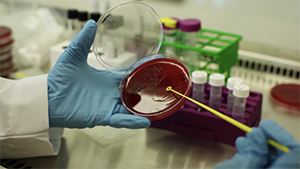
Over two years, 7,325 E. coli isolates were collected at four southern Alberta feedlots (pen floor feces, catch basin water and surface streams), a packing plant (hides, washed carcasses, conveyor belts, trim, whole muscle cuts and ground beef), sewage treatment plants (Calgary and Medicine Hat) and human patients (Calgary Laboratory Services). Suspect ESBL E. coli from feedlot and packing plant samples were rare and could only be found after they were exposed to multiple antibiotics. In contrast, ESBL E. coli could be easily found in samples from sewage plants or humans without using multiple antibiotics to suppress other E. coli. Next, all remaining E. coli isolates were tested for resistance to 11 different classes of antibiotics to confirm their ESBL status. Overall, 750 potential ESBL E. coli from all sources were identified, and 162 of these were DNA-sequenced to identify antibiotic resistance genes, assess how closely related they were, and find mobile genetic elements.
What They Learned:
ESBL E. coli were found in cattle-associated, beef processing and human-associated samples. However, only four ESBL E. coli isolates were found in the beef-processing samples, suggesting that carcass washes, cleaning steps and other interventions used to combat food safety pathogens in packing plants help impede the potential movement of ESBL E. coli from cattle to humans.
All the ESBL E. coli carried genes for resistance to multiple antibiotics. But DNA sequencing revealed that different antibiotic resistance genes predominated in ESBL E. coli from different environments. Of the 13 antibiotic resistance genes that differed between ESBL E. coli from cattle- and human-associated samples, 11 were more common in ESBL E. coli from the human-associated samples. This seems to suggest that the ESBL E. coli that prevailed in sewage and human samples probably didn’t originate from cattle.
Three main “families” emerged when genetic relatedness was compared among the ESBL E. coli isolated from the different sources. Those isolated from feedlot pens, catch basins and streams were closely related to each other, those from the packing plant were closely related to each other, and those from clinical patients and municipal sewage were closely related to each other. But there was very little relatedness or genetic overlap between the three groups. Like other bacteria, E. coli evolve to fit their environment, and it can be difficult for an E. coli from one environment to thrive in another.
Integrative conjugative elements (ICE), one group of mobile genetic elements bacteria use to carry and trade antibiotic resistance genes, are rarely found in ordinary E. coli. But ICE were found in all 162 of the ESBL E. coli isolates in this study. Genetic analyses revealed that most of these ICE likely originated from different bacteria like Vibrio, Pseudomonas, Salmonella or Yersinia. Although environmental challenges and food safety interventions all help to prevent ESBL E. coli from moving from cattle to people, bacteria may still be able to “bucket brigade” their antibiotic resistance genes from one environment to another.
What it Means:
This study adds to a growing body of evidence that antibiotic resistance in bacteria associated with beef cattle likely doesn’t drive antibiotic resistance associated with bacteria in humans.
But it also emphasizes the importance of appropriate antibiotic use. When bacteria manage to assemble multiple antibiotic resistance genes on the same ICE element, the stage is set for rapid spread of multi-drug resistance among a lot of different bacteria, whether on the farm or in the hospital.
The Beef Cattle Research Council is funded by the Canadian Beef Cattle Check-Off. The BCRC partners with Agriculture and Agri-Food Canada, provincial beef industry groups and governments to advance research and technology transfer supporting the Canadian beef industry’s vision to be recognized as a preferred supplier of healthy, high quality beef, cattle and genetics.
Click here tosubscribeto the BCRC Blog and receive email notifications when new content is posted.
The sharing or reprinting of BCRC Blog articles is typically welcome and encouraged, however this article requires permission of the original publisher.
We welcome your questions, comments and suggestions. Contact us directly or generate public discussion by posting your thoughts below.
Does Antibiotic Resistance Move Through the Environment?
This article written by Dr. Reynold Bergen, BCRC Science Director, originally appeared in the December 2018 issue ofCanadian Cattlemenmagazine and is reprinted on the BCRC Blog with permission of the publisher.
Recent columns have talked about antibiotic use in Canadian cow-calf and feedlot operations. Contrary to common misconceptions, antibiotic resistant bacteria are very unlikely to transfer from cattle to beef, evade food safety interventions in the processing plant, survive cooking, and cause an antibiotic resistant infection in a person. But can antibiotic resistant bacteria be transmitted from cattle, through feedlot manure and runoff, across soil, through wetlands, streams and rivers, and reach humans through the environment?
A Beef Science Cluster study led by Dr. Rahat Zaheer and Tim McAllister of Agriculture and Agri-Food Canada (with collaborators from the Public Health Agency of Canada, the University of Calgary’s faculties of medicine and veterinary medicine, University of Guelph, Alberta Agriculture and Feedlot Health Management Services) examined this question.
What they did:
This research focused on bacteria called enterococci that can cause infections in humans (e.g. urinary tract, liver and bile duct, heart, surgery wound, and bloodstream infections). Most enterococcal infections can be effectively treated with macrolide antibiotics. This is important because macrolides (products like Draxxin, Zuprevo, Micotil, Tylan, Zactran, etc.) are commonly used in both beef production and human medicine.
Over a two-year period, this team collected samples from feedlots (pen floor fecal samples, collection ponds, stockpiled and composted manure), agricultural soils, wetlands, streams, municipal sewage, packing plants, retail meats and human patients. Advanced lab testing was used to identify the specific types of enterococci and antibiotic resistance patterns in the samples from each location.
What they learned:
Different species of enterococci thrive in different environments. For example, one species (E. hirae) accounted for 90% of the enterococci found in fecal samples from cattle but less than 1% of the enterococci in humans. In contrast, E. faecium and E. faecalis accounted for over 95% of the enterococci found in humans, but less than 5% of the enterococci in cattle. This suggests that cattle-associated enterococci may have a hard time making their way into humans.
The predominant Enterococcus species gradually shifted as sample collection sites moved from the cattle to the human environments. The farther the sampling moved away from the feedlot, the less common the cattle-associated E. hirae became. The closer the sampling moved towards the human environment, the more common the human-associated E. faecium and E. faecalis became. A big shift happened at processing and retail, where the human-adapted species suddenly increased to 75% of the enterococci collected. Human-adapted enterococci may move from people to beef in those environments, rather than from cattle to beef.
Antimicrobial resistance patterns also differed between environments. Resistance to macrolides (High Importance in Human Medicine) and tetracycline (Medium Importance) were commonly found in enterococci from feedlot samples, probably because of the extensive use of in-feed Tylan and chlortetracycline to control liver abscesses. Compared to samples from cattle-associated environments, enterococci from clinical patients and treated sewage treatment showed resistance to macrolides as well as antibiotics of Very High Importance in human medicine (e.g. antibiotics related to Baytril, Excede, Excenel and others). The antibiotic resistance patterns observed in cattle-associated environments reflected the types of antibiotics that are used in cattle, while the patterns observed in human-associated environments reflected the antibiotics used in human medicine.
Comparisons of stockpiled to composted manure found that composting was an effective way to dissipate antibiotic residues and degrade antibiotic resistance genes. A wide variety of antibiotic resistance genes was found in soil samples. This isn’t too surprising – many of the antibiotics used in human and veterinary medicine were originally discovered in soil bacteria. Bacteria naturally produce antibiotics to attack other bacteria and invade habitats that have better moisture, temperature or nutrient conditions, and they naturally develop antibiotic resistance to protect themselves from the antibiotics that other bacteria produce. As a result, microbiologically active soils appear to play an important role in degrading antibiotics and antibiotic resistance genes originating from manure.
What it means:
Antibiotic resistant bacteria and genes are unlikely to flow from cattle to people through the environment when antibiotic use, manure and runoff are appropriately managed. Responsible antibiotic use slows the rate with which antibiotic resistance develops. Practices like manure composting help degrade antibiotic residues and antibiotic resistance genes. Adopting and documenting recommended antibiotic use and manure management practices will become increasingly important as public interest in and concern about beef production practices grows.
The Canadian Beef Cattle Check-Off has increased from $1 to $2.50 per head in most provinces, with approximately 75 cents allocated to the Beef Cattle Research Council to support research. Canada’s National Beef Strategy outlined why the Check-Off increase was needed, and how it would be invested. In Canada’s National Beef Strategy, the first target outcome under the Competitiveness pillar’s “Environment Sustainability” focus area is to continually improve environmental sustainability through validating the impacts of beef production. Answering these “what-if” research questions helps the industry prepare itself before these questions arise in the minds of consumers or regulators.
The Beef Research Cluster is funded by the Canadian Beef Cattle Check-Off and Agriculture and Agri-Food Canada with additional contributions from provincial beef industry groups and governments to advance research and technology transfer supporting the Canadian beef industry’s vision to be recognized as a preferred supplier of healthy, high quality beef, cattle and genetics.
Click here tosubscribeto the BCRC Blog and receive email notifications when new content is posted.
The sharing or reprinting of BCRC Blog articles is typically welcome and encouraged, however this article requires permission of the original publisher.
We welcome your questions, comments and suggestions. Contact us directly or generate public discussion by posting your thoughts below.